How urban bats provide pest control right above our city parks
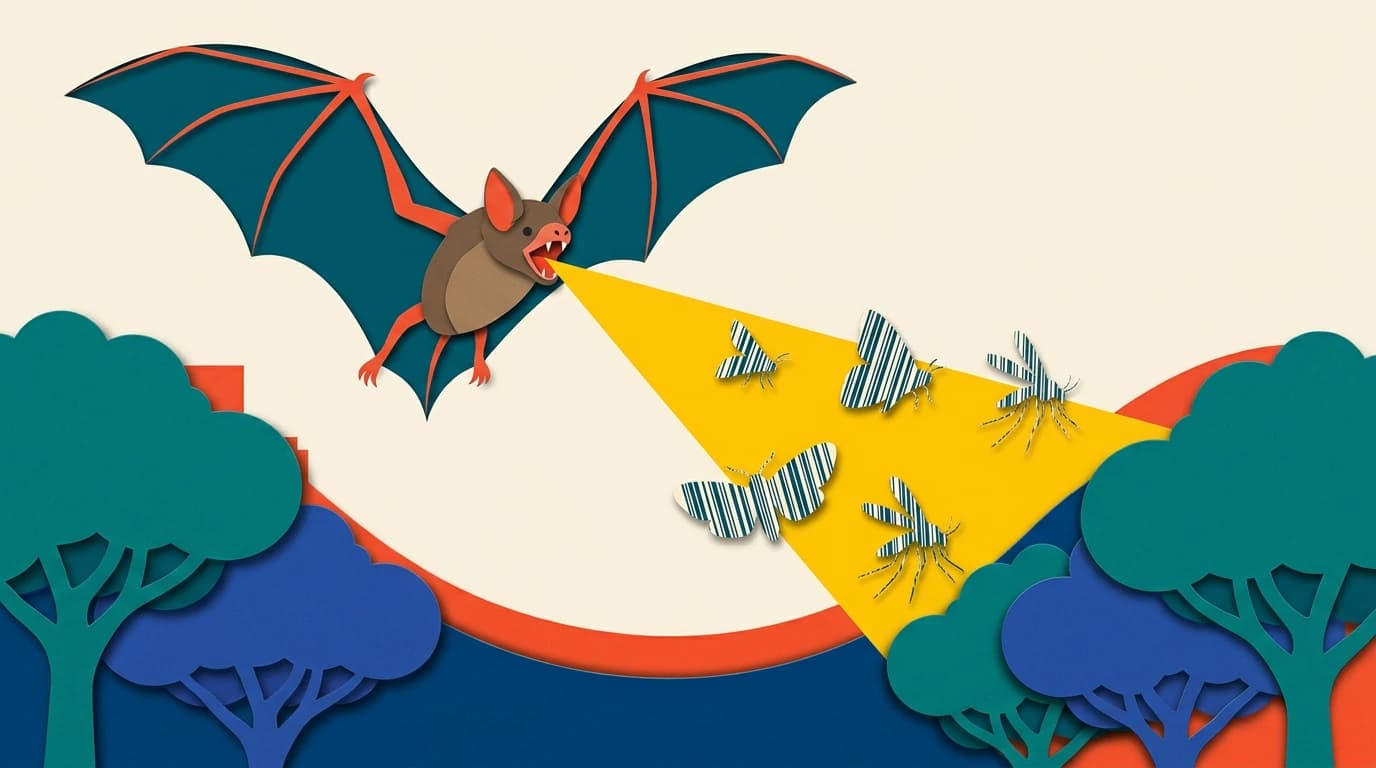
By analysing bat droppings in an urban park, researchers found that bats feed on nearly two hundred types of insects, including plant pests and disease carriers.
Reading level
The full story with proper science words explained.
Heads up: this study is a preprint, which means other scientists haven’t finished checking it yet.
Midnight diners in the park
Every summer evening, thousands of tiny predators hunt above our heads without making a sound. Scientists wondered how much urban bats provide pest control in city green spaces. To find out what they eat, researchers gathered droppings from four bat species in Slottsskogen, a public park in Gothenburg.
Scanning the leftovers
Normally, figuring out an insect-eater's menu means picking apart digested bug legs under a microscope. Instead, the team analysed faecal DNA, which is genetic material left behind in droppings. They used DNA metabarcoding, a rapid sequencing technique that reads mixed, broken-up genes all at once.
Think of it like scanning crumpled supermarket barcodes at a till instead of guessing squashed groceries by eye. The scanner matches every scrap of code against a vast digital library.
What was on the menu?
The genetic scan revealed 191 Operational Taxonomic Units, or distinct prey types. Most of these meals were dipterans—the biological order containing true flies and mosquitoes. Among them were known forestry threats, agricultural pests, and disease vectors, which are biting insects that spread infections to humans and other animals.
The diet changed with the calendar, too. One species, Pipistrellus pygmaeus, showed completely different dominant prey between spring and summer as insect hatches shifted.
Why city bats matter
These findings show that city parks are working shelters where insect-eating bats naturally protect trees, nearby crops, and public health. This natural cleanup reduces the need for chemical bug sprays. However, the barcode analogy fails when it comes to measuring volume: a genetic match proves a species was eaten, but not how many were crunched.
What we still do not know
This study tracked four bat species inside just one Gothenburg park. Researchers still do not know the exact quantitative dent bats put into total insect populations, or how their hunting habits change across other urban habitats and wider regions.
Science words
- DNA metabarcoding
- A method that identifies multiple species simultaneously from a mixed sample of degraded DNA.
- Faecal DNA
- Genetic material extracted from animal droppings to discover what an animal has eaten.
- Operational Taxonomic Units
- Clusters of similar DNA sequences used by scientists to represent distinct species groups.
- Dipterans
- Insects belonging to the order Diptera, which includes true flies and mosquitoes.
- Disease vectors
- Organisms that transmit infectious pathogens between animals or humans.
Check it yourself
This story is based on a real research paper in Scientific Publication by Chalise, Stunz, Batista et al.. We write with AI help and check it against the paper, but the original is the final word.