How two simple numbers can build tangled, shock-absorbing metamaterials
Engineers have developed scale-rich metamaterials using just two control numbers to generate complex, multi-sized networks. These messy, varied webs scatter shock and guide vibrations in ways ordinary grids cannot.
Reading level
The full story with proper science words explained.
Ditching the perfect grid
Why do built structures rely on neat, uniform grids when nature loves messy webs? Most man-made blocks use identical, tidy rows. Yet living networks, like brains, thrive on a rich mix of shapes and sizes.
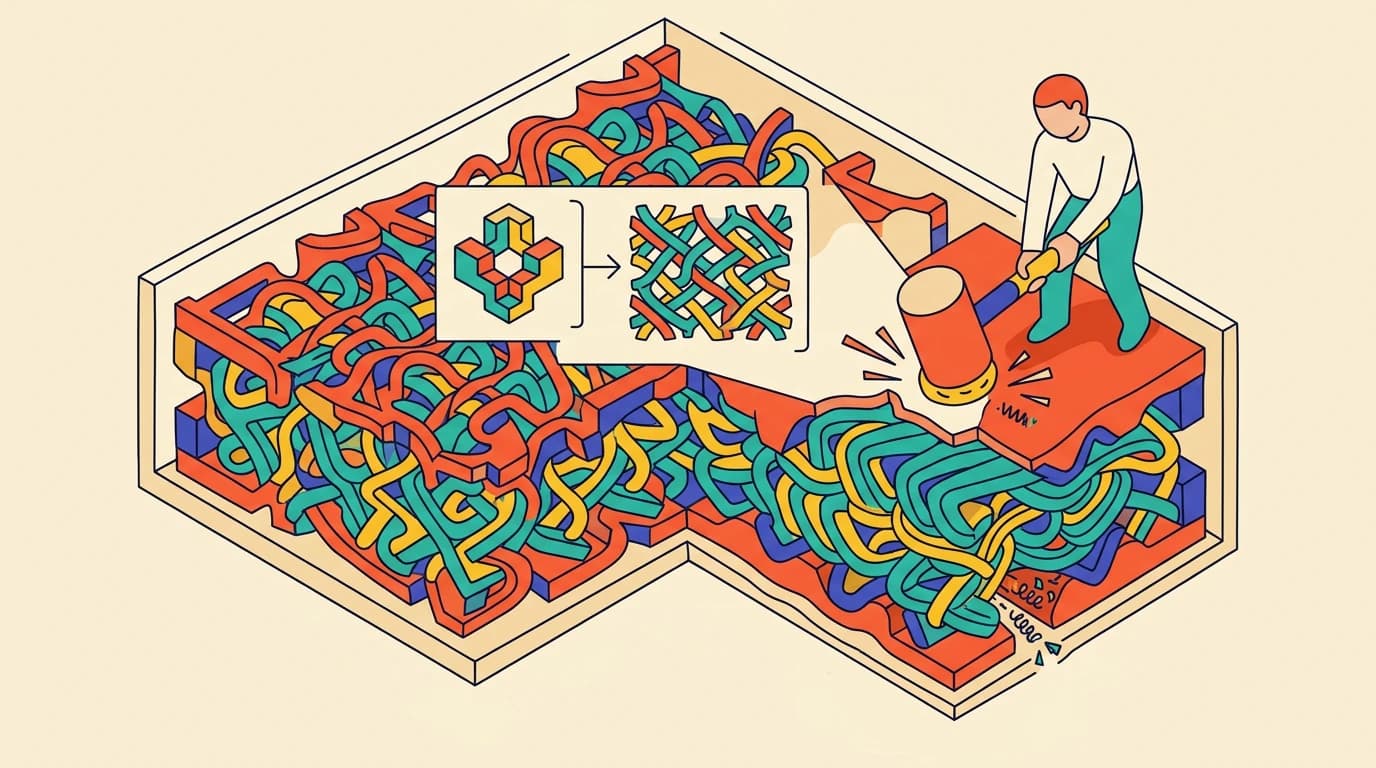
Now, scientists have built scale-rich metamaterials. These are objects whose powers come from their shape rather than what they are made of. Instead of copying stiff, square patterns, they built tangled webs using just two tuning numbers.
Controlled chaos
Think of this plan like wild woods next to a neat tree farm. Instead of same-sized trunks spaced in lines, a varied mix of stout trunks, thin twigs, and brush scatters heavy wind. This comparison breaks down during growth. Living trees shift with the seasons, but these lab webs have fixed joins.
By tuning just two values, the team varied strut lengths, strut widths, and connectivity across huge scales. Connectivity means the count of struts that meet at each joint. They tested these designs with math models and physical samples.
Bending without snapping
The varied sizes changed how forces moved through the network. Under hard pressure, the web showed delocalised nonlinear deformation. This simply means bending spreads widely across the whole frame rather than snapping a single weak joint. This broad sharing lets the web soak up high energy and damp heavy shocks from sudden dynamic loading, which refers to fast-hitting impact forces.
The team also showed off elastic anisotropy, where stiffness changes based on the pull direction. They even set up elastic-wave control, which guides or blocks mechanical vibrations travelling through the web. Importantly, the study does not report physical fabrication limits or test every base substance.
What we still do not know
The tests prove that two numbers can build useful, complex webs. Even so, basic questions remain. We do not yet know the limits of long-term durability under repeated stress, or which base ingredients perform best over time.
Science words
- Metamaterials
- Engineered objects whose abilities stem from their internal architecture rather than their chemical recipe.
- Connectivity
- The count of links, struts, or pathways that meet at a shared joint in a network.
- Delocalised nonlinear deformation
- Bending or crushing that spreads across an entire object instead of snapping at one weak spot.
- Dynamic loading
- Forces or stresses that change rapidly over time, such as sharp impacts or vibrations.
- Elastic anisotropy
- A state where a structure feels stiffer or softer depending on which direction you pull or push it.
- Elastic-wave control
- The power to guide, steer, or block mechanical vibrations and sound ripples passing through a structure.
Check it yourself
This story is based on a real research paper in Nature by Both, Chen, Gao et al. We write with AI help and check it against the paper, but the original is the final word.