How tree nut shells can become high-powered energy stores
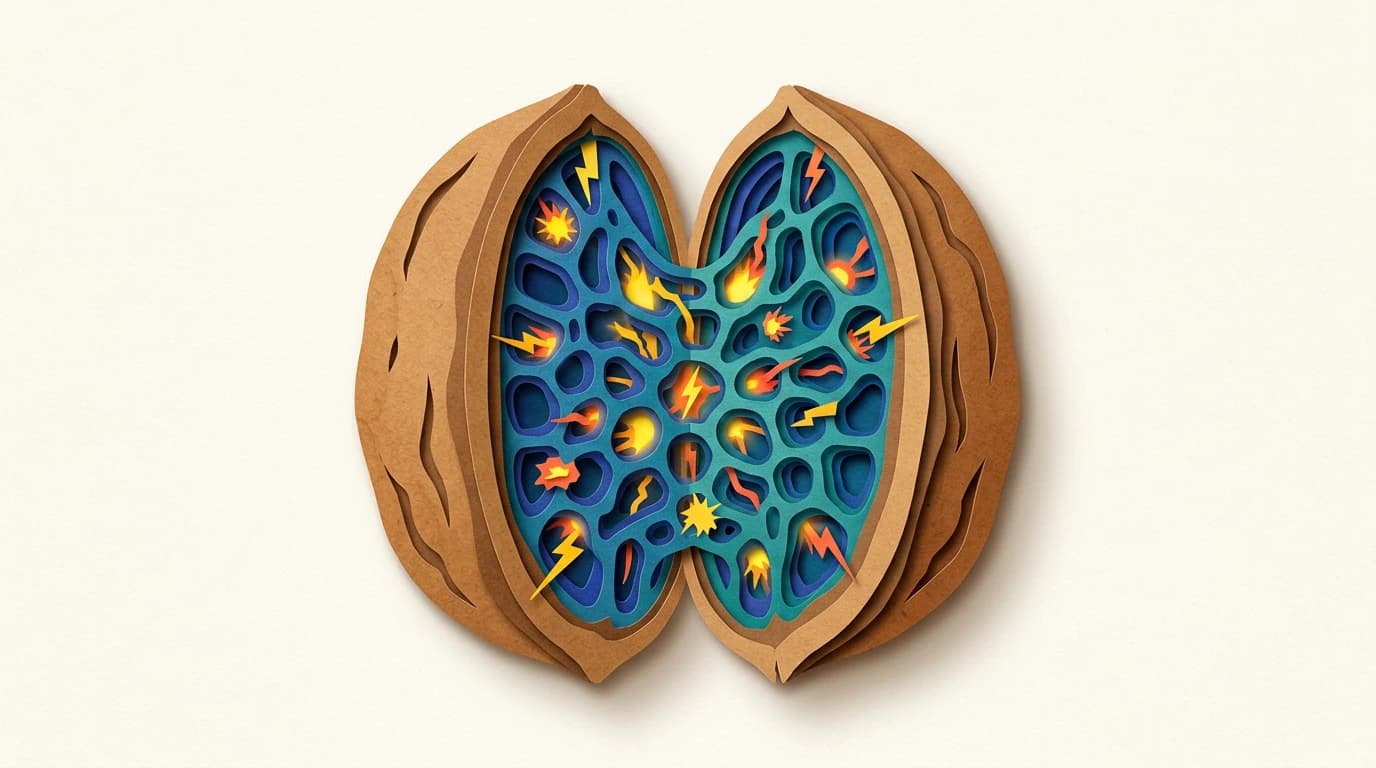
Treating waste shells from Calophyllum inophyllum nuts with common chemicals turns them into porous carbon capable of storing rapid bursts of electrical charge.
Reading level
The full story with proper science words explained.
Heads up: this study is a preprint, which means other scientists haven’t finished checking it yet.
Turning nut shells into power
Throwing away nut shells might seem harmless, but they could actually help power future electronics. Researchers took agricultural waste shells from the Calophyllum inophyllum tree and turned them into carbon. Their goal was to build a biomass supercapacitor, a device that stores and releases electrical charge far faster than standard batteries.
To make this work, the shells first underwent carbonization, a process of heating raw organic matter without oxygen until only pure carbon remained. Solid carbon alone cannot hold much charge. Ions need open spaces to dock, much like a kitchen sponge soaking up water through thousands of tiny tunnels.
Cooking with acid and alkali
The team treated the charred shells with three different activating chemicals: sodium hydroxide, sulfuric acid, and phosphoric acid. These chemicals ate away microscopic pathways, creating hierarchical porous structures with mixed pore sizes.
The choice of chemical changed everything. In cyclic voltammetry tests, sodium hydroxide produced an interconnected network that reached a specific capacitance of 638.21 farads per gram at a scan rate of 10 millivolts per second. That measurement represents how much electrical charge a material holds per unit of weight.
However, when testing complete charge and discharge cycles, sulfuric acid came out on top. In galvanostatic charge-discharge tests, it achieved an energy density of 4.02 watt-hours per kilogram, alongside a specific capacitance of 59.06 farads per gram. The acid-etched carbon held the best overall balance of total energy storage.
What we still don't know
While the sponge analogy fits how ions enter these pores, it stops working under pressure; squashing a real sponge forces water out, but electrical charges stay locked on pore surfaces until released. We still do not know how well these electrodes survive over thousands of charge cycles. Scalability remains uncertain too, because washing carbon with strong industrial acids and bases carries real environmental costs.
Science words
- Supercapacitor
- A fast-charging storage component that holds energy electrostatically on surfaces instead of using slow chemical reactions.
- Carbonization
- The process of baking organic material in the absence of oxygen to convert it into raw carbon.
- Hierarchical porous structures
- A network of connected microscopic pores of different sizes that helps ions move and dock efficiently.
- Specific capacitance
- The amount of electric charge a material can store per unit of its weight.
- Energy density
- The total amount of useful electrical energy stored per unit of mass.
Check it yourself
This story is based on a real research paper in Scientific Publication by Varghese, Verjhula. We write with AI help and check it against the paper, but the original is the final word.