How tiny solar antennas turn common bacteria into chemical factories
Researchers built an artificial photosynthesis biohybrid by sticking light-catching polymers onto bacteria that contain mineral reaction centres inside, boosting their chemical production nearly 30-fold.
Reading level
The full story with proper science words explained.
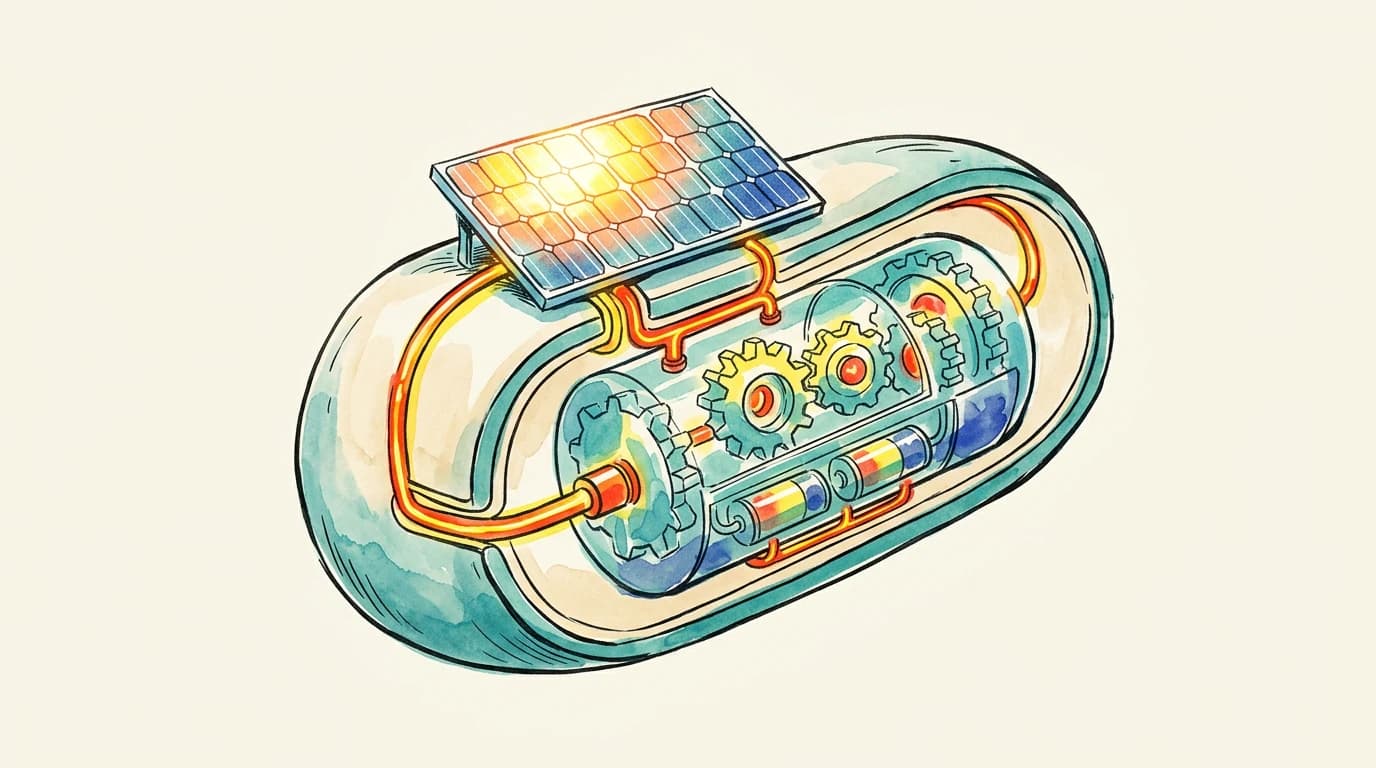
A solar upgrade for common microbes
Could you teach common gut bacteria to run on sunlight?
Microbes like Escherichia coli are exceptional at turning nutrients into useful organic chemicals, but they cannot use light on their own. In an artificial photosynthesis biohybrid, researchers pair living cells with synthetic materials to run these tiny chemical factories on solar energy. Nature already does something similar. Some bacteria rely on anoxygenic photosynthesis, a form of photosynthesis that does not produce oxygen and uses a single reaction center coupled to peripheral antenna complexes. Past artificial designs usually stuck everything on the outer shell of the cell or pushed tiny bits inside, limiting their performance.
Dividing the work across the wall
Researchers looked at that natural two-part plan and tested a split design across the cell wall. They attached tiny grains of a conjugated polymer, a light-absorbing plastic, to the outside surface of E. coli. These bits soak up light like small antennas. Inside the periplasmic space, the thin gap between the cell's outer and inner membranes, the bacteria grew cadmium sulfide crystals through biomineralization. In this step, the microbe's native sulfur metabolism turns dissolved metal ions into solid crystals right next to the inner membrane.
When light hits the cell, the outer plastic catches the incoming rays. It quickly shuttles this excitation across the outer membrane using non-radiative energy transfer. This means the energy jumps straight between particles without spitting out light photons. The cadmium sulfide bits then release high-energy electrons into the cell's inner wiring. This flow charges up fuel molecules like ATP and NADH, which drive the cell's internal factory.
A big leap in chemical output
The numbers were striking. Under white light, this paired system raised the bacterial output of malate, an organic chemical, up to 29.74-fold compared to normal E. coli. Under low light, a special thiophene copolymer design produced 47.6 milligrams per litre of malate. That beat bacteria relying only on internal cadmium sulfide by more than five times. Tests confirmed the microbe's fuel reserves climbed under the lamps. By timing how long the outer plastic stays excited, researchers recorded its fluorescence lifetime dropping from 0.170 down to 0.131 nanoseconds. This confirmed the plastic was indeed passing its energy directly to the internal mineral.
What we still do not know
The system does have real limits. Shining very bright light on the bacteria triggered photoinhibition. This light damage harmed the cells and cut down their chemical output. Adding extra plastic antennas past a set limit gave almost no extra benefit. The internal cadmium sulfide sites and the cell's own processing capacity became full. Researchers also cannot fully tell direct electron movement apart from non-radiative energy transfer in their tests. Lastly, they do not yet know if this two-part layout will work in other bacteria or make different high-value chemicals.
Science words
- Anoxygenic photosynthesis
- Bacterial photosynthesis that uses light to drive reactions without producing oxygen.
- Artificial photosynthesis biohybrid
- A system combining living cells with synthetic light-absorbing materials to power chemical production.
- Biomineralization
- The process where living cells turn dissolved metal ions into solid minerals.
- Conjugated polymer
- An organic molecule that can absorb light and conduct electric charges.
- Non-radiative energy transfer
- Passing excitation energy directly between nearby particles without emitting a photon of light.
- Periplasmic space
- The cellular gap situated between the inner and outer membranes of certain bacteria.
Check it yourself
This story is based on a real research paper in Science Advances by Yang, Wang, Zhou et al.. We write with AI help and check it against the paper, but the original is the final word.