How tiny patterned lenses make augmented reality glasses look normal
A lab test pairs a thin 1.5-mm lens with nanoscale light steering to give bright virtual images outdoors.
Reading level
The full story with proper science words explained.
The awkward bulk of smart lenses
Smart glasses often look like chunky ski goggles. To show graphics over the real world, augmented reality (AR) glasses bounce light inside clear plates called diffractive waveguides. Standard setups force an annoying trade-off. Wearers either get a tiny viewing area, a very dim picture, or thick, heavy glass.
Steering light on a tiny scale
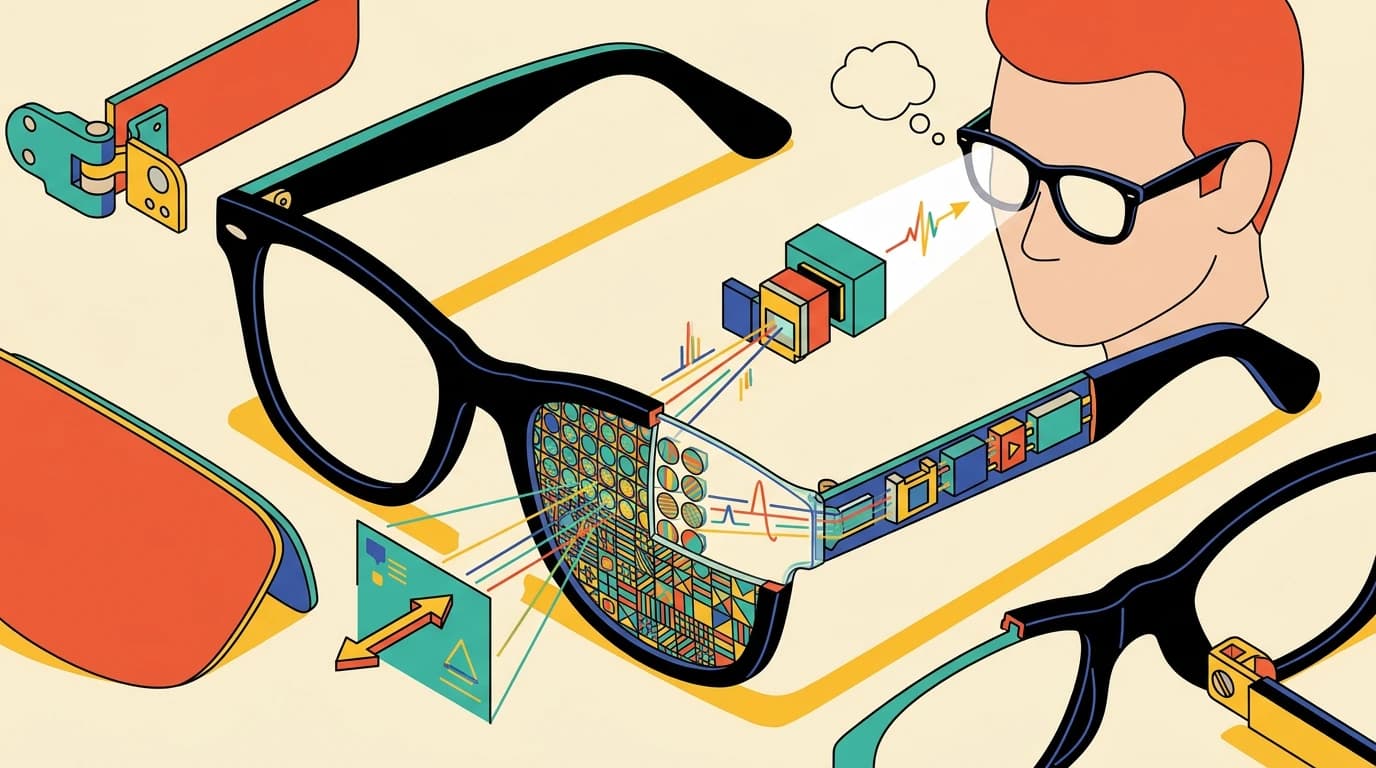
To beat this trade-off, a team built a two-layer waveguide just 1.5 mm thick. Instead of simple surface grooves, they used interwoven metasurfaces. These are flat layers covered in tiny nanoscale shapes built to steer light waves. The shapes supply several grating vectors, which act like mathematical guideposts that send light in different directions at the same time.
First, light enters the thin sheet from a small projector. Next, the patterned surfaces split the beams across the lens without adding extra glass. Then, the paths recombine to shoot a clear picture right toward the pupil. This layout gives the system more control over how beams travel, delivering clear imagery without bulky parts.
Bright results in the sun
Lab tests showed strong numbers. The test model hit an average luminance efficiency of 1,938 nits per lumen, peaking at 4,225 nits per lumen. Luminance efficiency measures how well light input turns into visible screen brightness. That output was high enough to keep virtual graphics sharp and stable under bright outdoor sun.
The test device also produced a 30-degree field of view. It created an 8-by-8-millimetre eyebox. The eyebox is the sweet spot where your eye can drift around without losing sight of the image.
What we still do not know
This design proves that slim lenses are possible. Still, the hardware is a lab test rather than an everyday product ready for store shelves. The viewing cone stays fixed at 30 degrees, and the eyebox covers only 8 by 8 mm. We do not know yet if this method works for full-colour displays without losing brightness or slimness. Everyday comfort, manufacturing costs, and long-term durability over all-day wear remain open questions too.
Science words
- Augmented reality (AR)
- A technology that superimposes digital information and virtual imagery directly onto a user's view of the physical world.
- Diffractive waveguide
- A transparent slab of glass or plastic that uses light-bending patterns to steer visual imagery from a projector into the eye.
- Metasurface
- An ultra-thin surface structured with nanoscale patterns designed to manipulate light in complex ways.
- Grating vectors
- Directions and spatial frequencies within a pattern that dictate precisely where and how incoming light waves are redirected.
- Luminance efficiency
- A metric showing how effectively electrical or light input is converted into visible display brightness.
- Eyebox
- The viewing area where a wearer's eye can move and still see the full display clearly.
Check it yourself
This story is based on a real research paper in Nature by Yun, Kang, Choi et al. We write with AI help and check it against the paper, but the original is the final word.