How tiny ocean creatures drive the marine sulfur cycle
A major review synthesises how marine life creates and destroys DMSP, an abundant sulfur compound that feeds ocean food webs and shapes climate-cooling gases.
Reading level
The full story with proper science words explained.
A microscopic shield with global impact
Take a deep breath near the sea, and you are smelling sulfur. Out in the water, marine algae, bacteria, corals, and plants make huge amounts of an organosulfur compound called dimethylsulfoniopropionate, or DMSP. These organisms build it to survive everyday hardships, from physical stress to hungry predators.
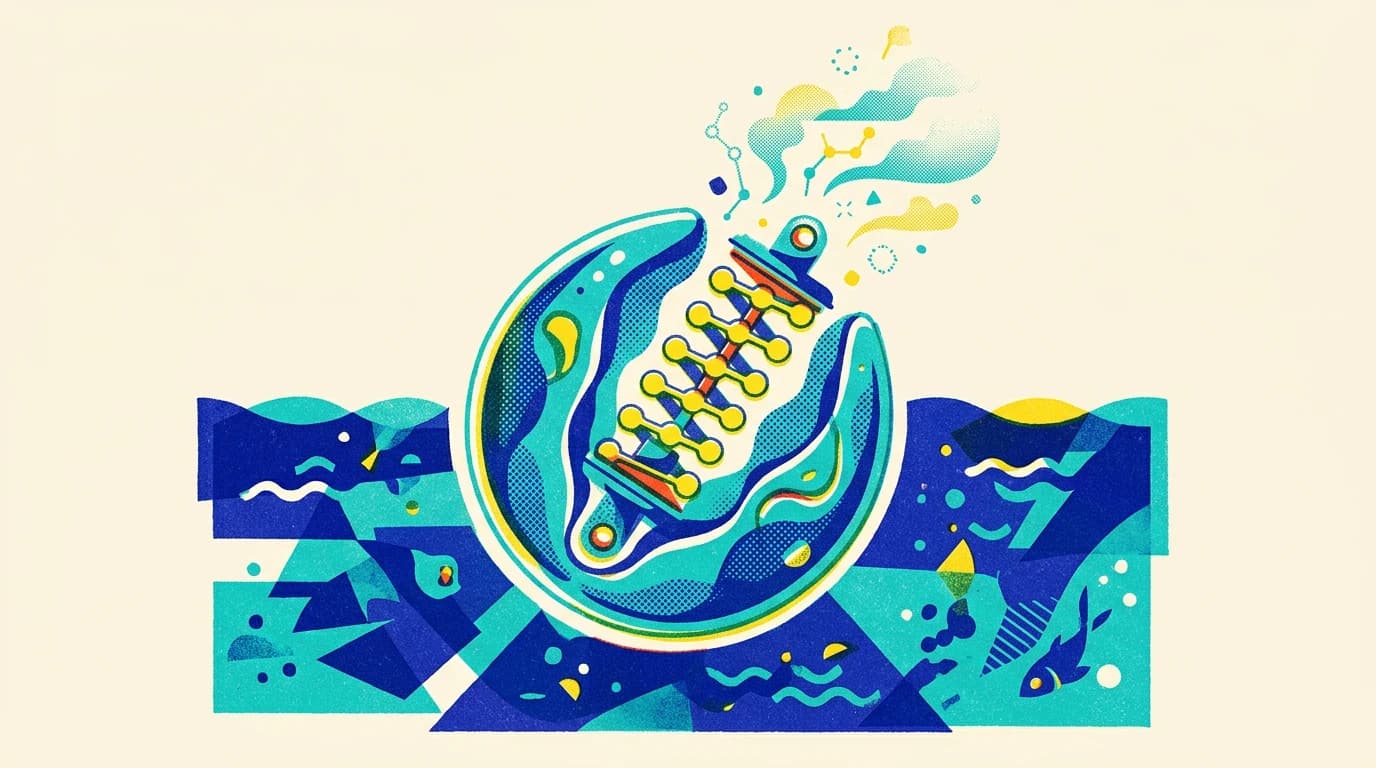
DMSP works like a cellular shock absorber, buffering tiny cells against environmental strain so they do not collapse under pressure. Once released into the open water, it acts as a universal currency. Marine microbes trade it for carbon, sulfur, and energy, while others read it as an environmental signal.
Breaking it down into the air
The story does not stop in the water. Specialized microbes take in DMSP and related chemicals, driving their catabolism—the process of breaking down complex molecules to release energy.
Through degradation and a process called S-methylation, these microbes transform DMSP into volatile gases like dimethylsulfide (DMS) and methanethiol. Because DMS readily escapes into the air, it aids cloud formation above the water. In this way, microscopic digestive habits in the marine sulfur cycle feed straight into Earth's climate-cooling systems.
Rethinking old assumptions
For a long time, textbooks painted a simple picture of where these sulfur chemicals came from and who consumed them. Recent discoveries have challenged those long-standing beliefs, revealing far more varied producers, diverse metabolic pathways, and unexpected microbial partners than researchers originally assumed.
What we still don't know
While this review brings together current understanding and research priorities, real puzzles remain. Scientists still face significant uncertainties regarding the full diversity, regulation, and fate of these compounds in the natural environment. We do not yet understand the full suite of genes that govern how microbes import, make, and destroy DMSP across the global ocean.
Science words
- Organosulfur compounds
- Chemical molecules that contain carbon atoms directly bonded to sulfur atoms.
- Dimethylsulfoniopropionate (DMSP)
- An abundant, naturally occurring sulfur molecule made by marine organisms for stress protection.
- Catabolism
- The biochemical process of breaking down complex molecules into simpler pieces to release energy or nutrients.
- S-methylation
- A chemical reaction where a small carbon cluster called a methyl group is attached to a sulfur atom.
- Dimethylsulfide (DMS)
- A volatile, sulfur-rich gas released from seawater that helps seed cloud formation in the atmosphere.
- Methanethiol
- A simple, volatile sulfur gas produced when microbes break down or modify organic sulfur molecules.
Check it yourself
This story is based on a real research paper in Nature Microbiology by Carrión, Zhu, Azizah et al. We write with AI help and check it against the paper, but the original is the final word.