How tiny magnets inside a solid chip act like living creatures
Scientists have shown that patterns inside an engineered magnetic material can behave like distinct, interacting life-like creatures. The team proved these magnetic creatures can coexist in physical hardware without needing biological cells or computer code.
Reading level
The full story with proper science words explained.
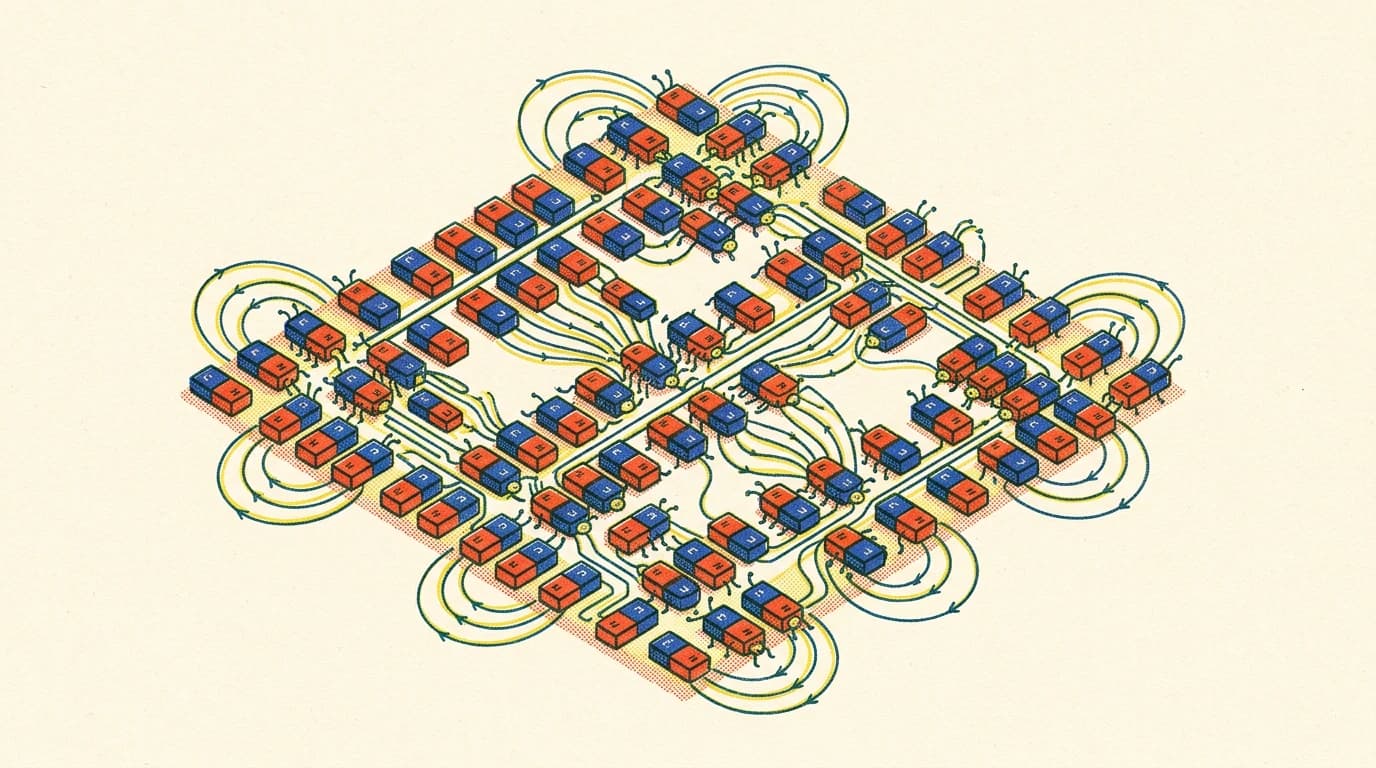
Tiny magnets that wake up
Could life exist not in water or carbon cells, but directly inside a solid grid of microscopic magnets? A study shows that magnetic artificial life can exist inside physical matter. The team looked at an artificial spin ice, an engineered substance made of tiny magnets set in regular grids.
These tiny bars push and pull on their neighbours. Together, their joint magnetic poles create spatio-temporal magnetic patterns, which are shapes that shift across space and time. To spot useful shapes in this sea of forces, the team used a genetic algorithm. This search program copies natural selection, testing thousands of shapes to locate stable, repeatable arrangements.
Wigglers, travelers, and collisions
The search discovered three distinct classes of magnetic creatures. First, still life shapes stayed completely frozen over time. Next came oscillators, which ticked back and forth through a set cycle. Finally, gliders moved steadily across the grid while keeping their shape.
Remarkably, several different types of creatures coexisted under the exact same physical conditions. This matters because it shows that solid matter can host complex life-like events using simple forces instead of living cells. To test whether this worked beyond software models, the team built the system in the lab. Using real hardware, they watched two simple creatures meet and interact inside the solid substance.
What we still do not know
This system behaves like the classic Game of Life, but uses physical magnets instead of screen pixels. Still, the tests have real limits. The lab experiment only tracked two simple creatures meeting at once. The patterns also did not appear entirely by chance; they required a guided computer search to find them.
Scientists do not yet know how complex these meetings can become in larger systems. It is also unknown whether these magnetic shapes can ever reproduce or sustain open-ended evolution.
Science words
- Artificial spin ice
- A synthetic metamaterial made of microscopic magnets arranged in interacting geometric grids.
- Spatio-temporal magnetic patterns
- Magnetic configurations across a material that shift and change across both space and time.
- Genetic algorithm
- A computer search method inspired by natural selection that tests, selects, and mutates designs to find viable solutions.
- Still life
- A stable pattern that stays unchanged over time unless perturbed.
- Oscillators
- Patterns that repeat the same sequence of states in a regular cycle.
- Gliders
- Patterns that travel across a grid or material while keeping their overall structure.
Check it yourself
This story is based on a real research paper in Artificial Life by Penty, Jensen, Dale et al.. We write with AI help and check it against the paper, but the original is the final word.