How tiny built-in fire extinguishers could make fireproof lithium batteries
Scientists have packed tiny, liquid-filled capsules into a solid battery electrolyte that burst open during extreme heat to actively smother flames. This two-part safety shield stops catastrophic battery fires while still letting the cell store and deliver power normally.
Reading level
The full story with proper science words explained.
A hidden danger inside energetic cells
Even when cut with scissors and held over a burner flame, this test cell refused to burn. High-energy lithium metal cells pack huge power into small spaces, but they carry a scary flaw. If they get too hot or crushed, they can enter thermal runaway. This is a runaway, self-heating loop that shoots out extreme heat, toxic smoke, and flames.
Solid electrolyte sheets—the middle layers that ferry charges between both cell ends—were designed to fix this. They swap out runny fluids for dry plastic films or slabs. Yet under harsh heat or puncture, even solid layers can break down and catch fire. How can we stop a cell from burning without cutting off its electric flow?
Tiny pods with a two-step trick
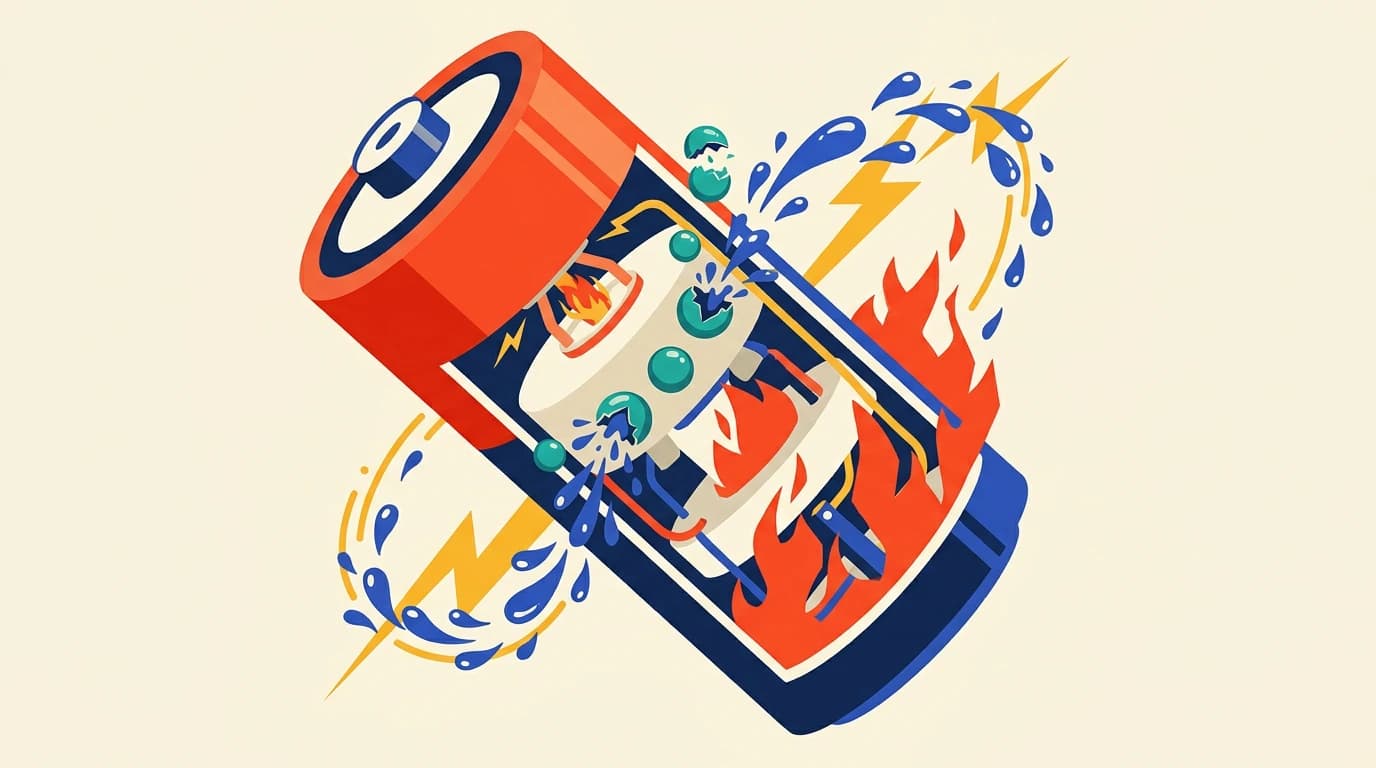
A team built a solid middle film packed with microscopic pods. Inside each shell sits a liquid fire-snuffer called PFHK. On the outside, the coat is made with a char-forming agent called AHP.
These tiny pods act like a sprinkler set behind a fireproof wall. During normal use, they stay shut tight. Out in the open air, bare liquid PFHK dries up within 23 hours. Trapped inside the shells, over 98% of it stayed sealed after 150 days at 25°C.
When intense heat hits, two shields activate at once. The outer coat breaks down into a thick char crust that shuts out air and blocks heat. At the same time, rising vapour force cracks the shell open. This action lets PFHK gas burst out to put out open flames instantly. The team calls this sheet a hierarchical solid polymer electrolyte, or HSPE.
Testing under direct fire
The tests under open flame gave clear results. Standard wet layers burned for an average time of 137.6 seconds per gram. Plain solid plastic layers burned for 55 seconds per gram. The new pod-filled layer, tested as HSPE-30, scored zero. It refused to catch fire at all, even across 15 direct blasts from a burner.
The pods did not keep the cell from doing its main job. Full cells kept 81.4% of their charge room after 180 slow cycles, and 74.3% after 500 faster cycles. Flexible pouch packs kept powering light diodes while being folded, bent, and cut with scissors.
What we still do not know
This design marks a solid step toward safer packs, but it brings real trade-offs. Adding more pods makes the plastic layer brittle and cuts its stretch strength. It also pulls down the transference number—the share of electric current moved solely by lithium ions—from 0.73 down to 0.51.
The pods also leak slightly in steady heat. They shed about 10% to 15% of their mass at 60°C and a quarter at 80°C. We do not yet know how the leftover char affects cell parts over thousands of cycles. Nor is it clear if big plants can blend millions of identical pods evenly, or how they will fare in freezing winter chill.
Science words
- Thermal runaway
- An uncontrollable, accelerating chain reaction where battery overheating triggers rapid destruction, smoke, or fire.
- Electrolyte
- The internal substance or membrane that carries ions between the two ends of a battery.
- PFHK
- A fast-evaporating, non-flammable liquid chemical used to put out fires.
- AHP
- A phosphorus- and nitrogen-rich compound that turns into a heat-blocking char when scorched.
- HSPE
- A solid, plastic-like battery membrane embedded with protective microcapsules.
- Transference number
- The fraction of the total electrical current in an electrolyte carried specifically by lithium ions.
Check it yourself
This story is based on a real research paper in Advanced Science by Huang, Gui, Cao et al.. We write with AI help and check it against the paper, but the original is the final word.