How the brain's private border gate fails in early Alzheimer's
A study in mice reveals that the blood-brain barrier selectively imports protective blood proteins, but this specialised transit system alters early in Alzheimer's disease.
Reading level
The full story with proper science words explained.
A VIP transit pass
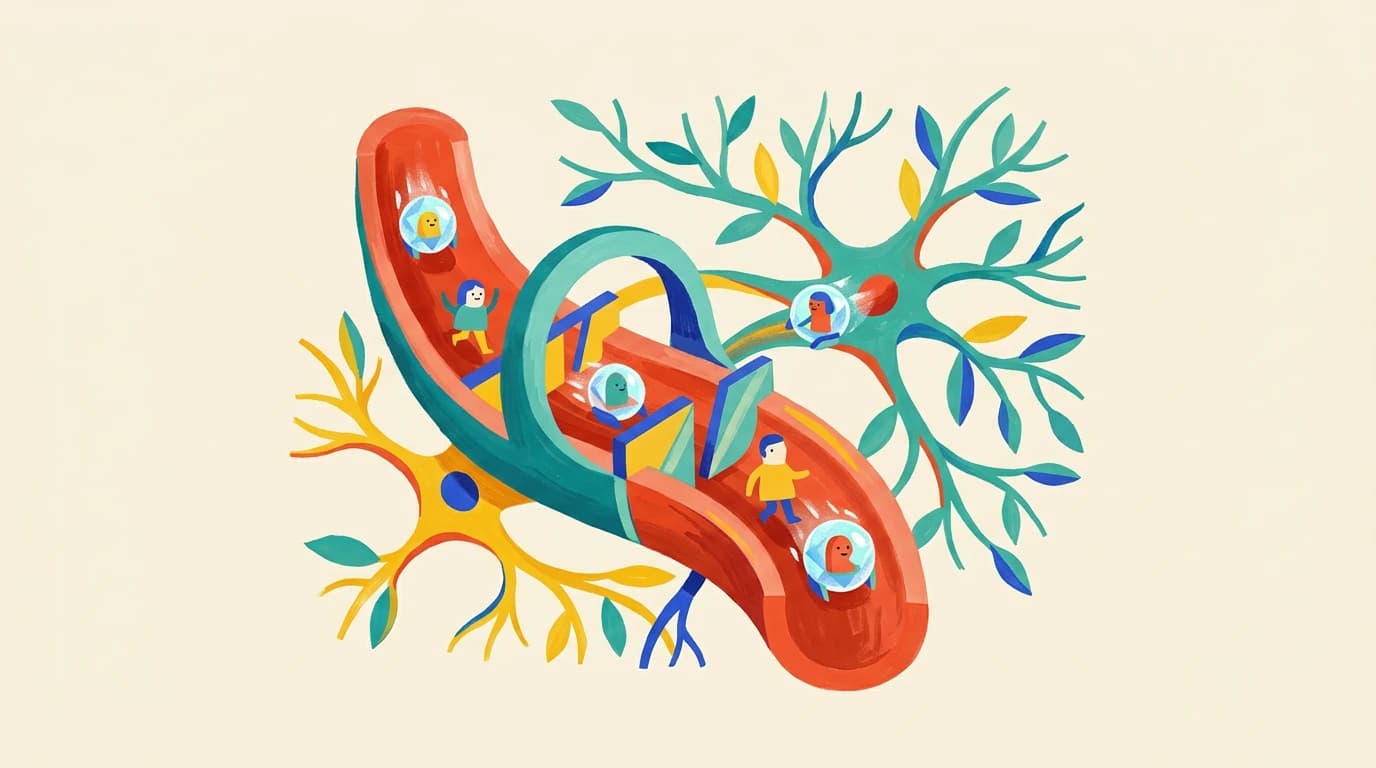
Your brain is fussy about what it lets inside. For decades, textbooks described the blood-brain barrier as a plain brick wall that shields nerve cells from dangerous chemicals in the blood. Yet it acts more like a guarded border checkpoint with private shuttles, letting in chosen guests and sending them straight to their desks.
Using bioorthogonal proteomics—a clever way to tag molecules chemically without disturbing normal biology—scientists tracked blood proteins in mice. They tested 191 plasma proteins and found that 92 crossed into the brain parenchyma, which is the organ's main working tissue. These travellers did not wander at random. Instead, they displayed clear tropism, meaning they headed straight for particular cells. For instance, alpha-1 antitrypsin went to microglia, the brain's immune scouts. Meanwhile, apolipoprotein A1, or APOA1, headed straight for star-shaped cells called astrocytes.
The molecular hand-off
Getting APOA1 across the border takes a neat relay step. A docking port on the blood vessel wall called SR-B1 catches APOA1 from the blood. It passes the protein across to a partner port, ABCA1, on nearby astrocytes. This hand-off triggers cholesterol efflux, a cleanup step that clears out excess fat to keep nerve junctions working well.
However, tests in young 5xFAD mice—a common lab model for Alzheimer's disease—revealed a surprise. The brain border was not cracking open or leaking randomly like a broken dam. Instead, the gate changed its shipping orders. The barrier took in far less APOA1 while pulling in more alpha-1 antitrypsin. When the researchers boosted APOA1 production in the liver, blood levels rose, brain supplies recovered, and the mice showed better memory and healthier brain connections.
What we still do not know
This work shows that early Alzheimer's disease might involve a faulty postal route rather than a crumbling wall. Importantly, these tests were done in mice, not people. Scientists still need to find out what the other crossing proteins do and whether human brains suffer this exact same hand-off failure.
Science words
- Bioorthogonal proteomics
- A chemical tagging method used to trace proteins in living systems without disturbing natural biology.
- Brain parenchyma
- The functional working tissue of the brain containing nerve and support cells, separate from large blood vessels.
- Tropism
- The selective movement or homing of a molecule toward a particular cell type or target.
- Cholesterol efflux
- The process where cells export excess fats to keep their cell membranes balanced and healthy.
- 5xFAD
- A genetically modified mouse strain commonly used in lab research to model Alzheimer's disease.
Check it yourself
This story is based on a real research paper in Cell by Zhou, Maynard, Pennacchio et al. We write with AI help and check it against the paper, but the original is the final word.