How tardigrade cryo-EM snaps tiny animal proteins without cleaning them first
Researchers imaged natural protein complexes straight out of unpurified tardigrade extract at near-atomic detail.
Reading level
The full story with proper science words explained.
Skipping the wash cycle
How do you inspect the molecular machinery of an animal that is barely visible to the naked eye?
Structural biologists usually need massive batches of identical, carefully cleaned proteins to see their shape. But tiny water bears, known as tardigrades, yield very little biological material. Purifying enough of one specific protein from them is almost impossible.
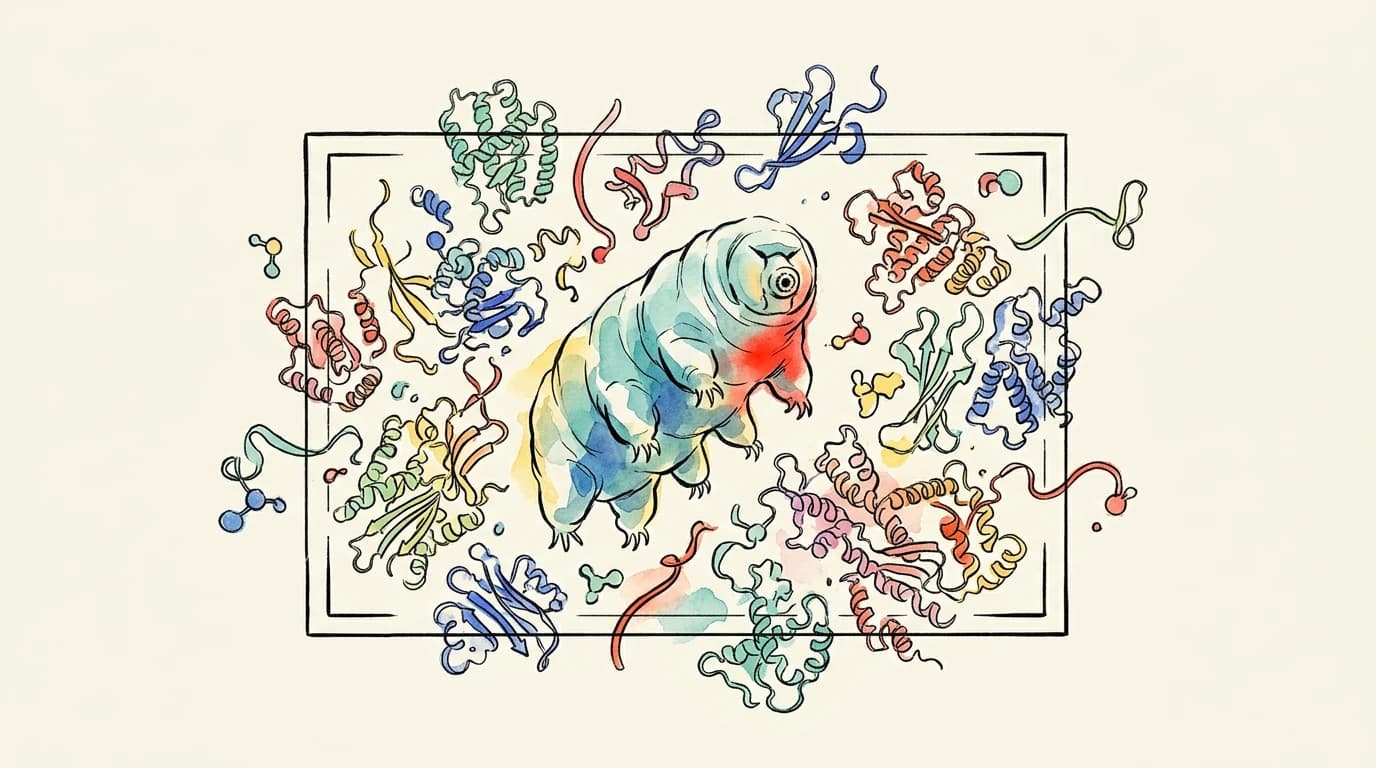
To tackle this puzzle, a team tried tardigrade cryo-EM without standard purification steps. Cryogenic electron microscopy (cryo-EM) rapidly freezes biomolecules so an electron beam can image their atomic structures. Instead of isolating single targets, researchers crushed a wild-derived culture of Macrobiotus cf. shonaicus into a raw, crude extract and froze the whole mixture.
Portraits in a crowd
Using single-particle cryo-EM, the team snapped images of several endogenous assemblies—naturally occurring multi-protein complexes—all at once. They matched the resulting 3D density maps to the organism's genes using long-read cDNA sequencing.
The mixture revealed a two-part vitellogenin complex at 3.10 Å resolution (an Ångström, or Å, is one ten-billionth of a metre). Vitellogenin is an egg-development protein, and its map revealed lipid-like contents sheltered inside a chamber lined with sugars. They also solved a cage-like iron storage protein called ferritin at 3.09 Å resolution, showing an unusual tail lining a mineral pocket. Ribosomes were also detected, though at lower detail.
What we still don't know
This technique treats the sample like a busy crowd photo rather than an isolated studio portrait. However, the crowd analogy stops working for rare faces: low-abundance molecules will not appear clearly without extra sorting, which is likely why ribosomes produced only a blurry map.
This study is currently a preprint waiting for peer review. We do not yet know the exact identity of the mineral and lipid contents spotted inside the protein cavities. Scientists also still need to test how these native structures shift when tardigrades undergo extreme drying and rehydration.
Science words
- Cryo-EM
- Cryogenic electron microscopy, an imaging technique that rapidly freezes biological samples to view their 3D structure at near-atomic detail.
- Endogenous assemblies
- Naturally occurring multi-protein structures made inside an organism's own cells.
- Vitellogenin
- A storage protein typically involved in lipid transport and egg development.
- Ferritin
- A hollow, cage-like protein used by cells to store and safely isolate iron.
- Å (Ångström)
- A tiny unit of length equal to 0.1 nanometres (one ten-billionth of a metre), used to measure atomic details.
Check it yourself
This story is based on a real research paper in Preprint by Fukuda, Motooka, Imamura et al.. We write with AI help and check it against the paper, but the original is the final word.