How splitting light into zones sharpens quantum microscopy with fewer photons
A passive optical setup splits light into separate frequency channels, capturing fine target details using five times fewer photons than standard imaging. The technique improves precision near the physical diffraction limit without altering the sample.
Reading level
The full story with proper science words explained.
Sorting the whisper from the roar
Every photo is built from tiny packets of light called photons. When light is very dim, the random arrival of these packets creates a grainy fuzz called shot noise. In standard microscopes, broad shapes send a massive flood of light to the sensor. This heavy glare brings lots of noise, which drowns out the weak signals from tiny, fine features.
Think of an audio speaker that splits sound. It sends booming bass to a large woofer and soft treble to a small tweeter. Without that split, the loud bass would swallow the faint high notes. A standard camera dumps all light into one spot, burying thin stripes under bright background glare.
Carving up the lens
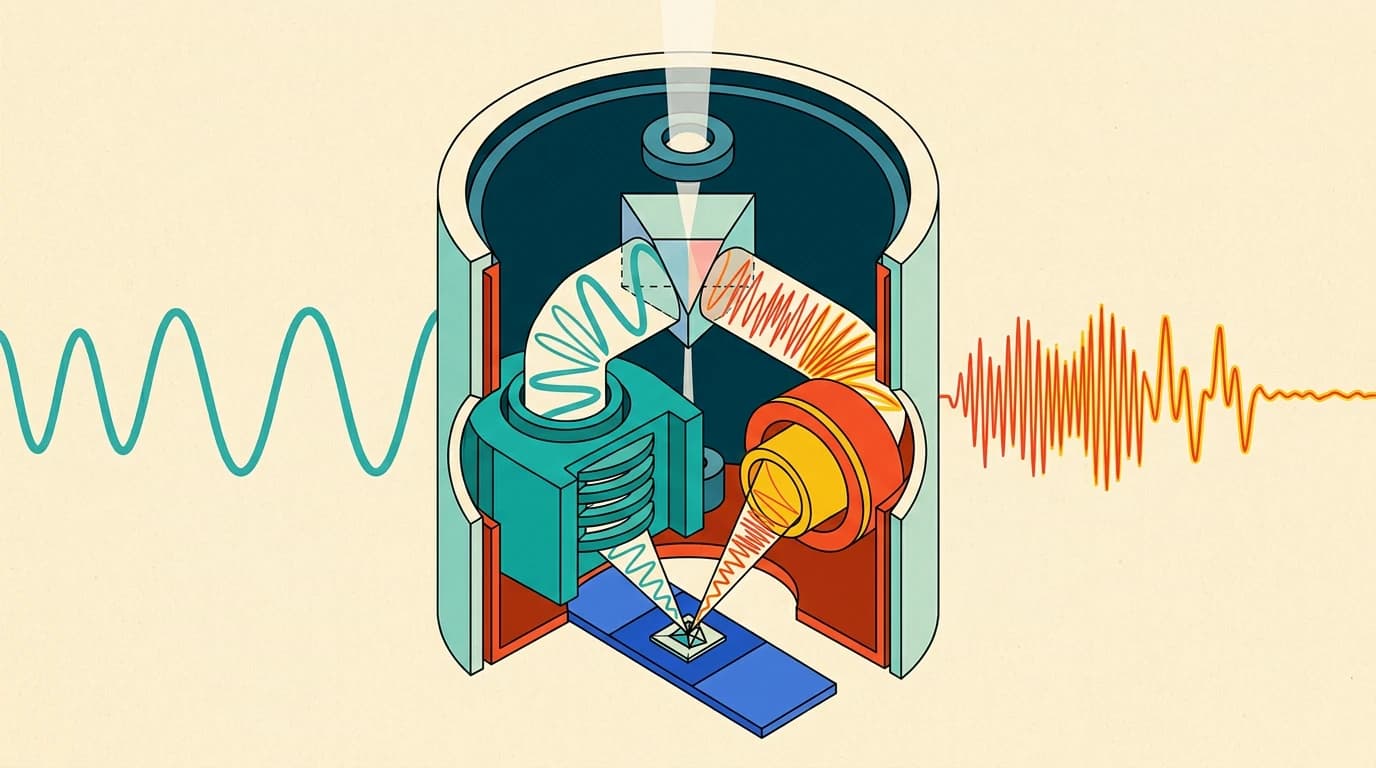
To fix this problem in quantum microscopy, a team tested a clever setup called Fourier domain division (FDD). They placed a liquid-crystal screen called a spatial light modulator behind the main lens. This device split the pupil into five distinct regions and gave each zone a slight tilt.
As a result, the dazzling centre beam went to one sub-picture on the sensor. The faint light holding fine patterns was steered into other sub-pictures. Keeping the beams apart meant tiny details could be seen without being swamped by noise from the centre. A computer then joined these raw sub-pictures using a Wiener filter, an algorithm that restores fine detail without blowing up noise.
Sharper views with less light
The team tested this method on a glowing test chart with 4500 lines per millimetre. Standard direct methods needed at least 1220 photons per pixel to resolve these tiny stripes. In contrast, the new method resolved the exact same stripes with only 244 photons per pixel.
That is a fivefold drop in the light needed to see the structure. For this thin pattern, the setup gave a signal-to-noise boost of 4.97 decibels. On paper, it cuts measurement variance by a factor of five, yielding up to a 1.1-fold gain in overall resolution.
Importantly, the method does not break the hard physical cutoff limit of the lens. Instead, it boosts measurement precision for details that sit just below that boundary. Because it works with ordinary light, it avoids harsh laser beams that could harm delicate living cells.
Questions that remain
Even with these clear gains, some hurdles stay in place. The noise level in these tests is still more than twice as high as the quantum Cramér-Rao bound. That bound marks the ultimate limit of precision allowed by quantum laws. Whether simple glass lenses and mirrors can ever reach that quantum floor is still unknown.
The test setup also had to snap sub-pictures one after another, rather than all at once. This avoided colour blurs from broad-spectrum fluorescent light. In addition, deep lens effects stretched the light along one direction, leaving horizontal test lines unresolved. The team also needs to test if the math holds up when photon levels drop even lower.
Science words
- Shot noise
- The random, grainy fluctuation in optical measurements caused by the arrival of discrete photons.
- Fourier domain division (FDD)
- An optical method that partitions a lens aperture into separate zones to measure coarse and fine details independently.
- Wiener filter
- A computational algorithm that reconstructs a clear image from degraded data by balancing detail against background noise.
- Quantum Cramér-Rao bound (QCRB)
- The ultimate lower limit set by quantum mechanics on how precisely a physical quantity can ever be estimated.
Check it yourself
This story is based on a real research paper in Science Advances by Gong, Zhang, Dastidar et al. We write with AI help and check it against the paper, but the original is the final word.