How Spiking Neural Networks Are Learning to Listen to Their Coaches
Source PublicationSpringer Science and Business Media LLC
Primary AuthorsDoborjeh, Doborjeh, Kasabov et al.
"Like a football player receiving coaching feedback rather than just kicking a ball randomly in an empty field."
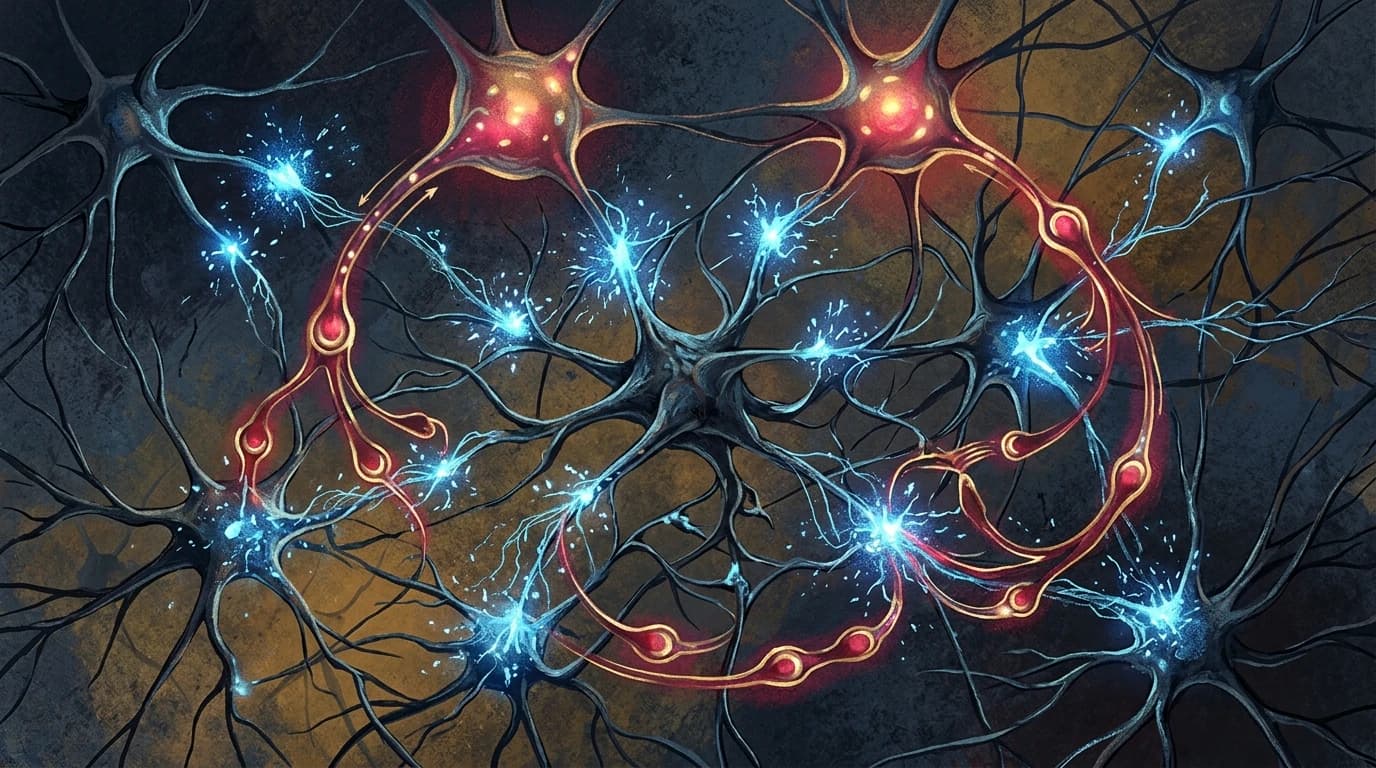
Imagine practising football drills alone. If you just kick the ball randomly, you might get good at kicking, but you won't necessarily score goals during a match. You need a coach giving you feedback to shape those raw movements into winning plays.
Traditional AI models consume massive amounts of computer power. To build more efficient tech, scientists look to our brains, which run on less power than a dim lightbulb. They use brain-inspired models that only fire when they receive a specific signal, much like sending a quick text instead of hosting a continuous video call.
Refining Spiking Neural Networks with Smart Feedback
In an early-stage preprint paper awaiting peer review, researchers introduced a framework called HERO-SNN. Standard models of this type learn passively, but this new system adds a feedback loop. It tracks which pathways are active, rewards connections that lead to correct decisions, and uses internal regulation to keep the artificial neurons stable.
The researchers tested their model on EEG brainwave data. The preliminary results showed an 11% improvement in data classification accuracy compared to standard unsupervised learning methods, even outperforming some common deep learning models.
Why This Matters for Your Future
While this is currently a lab-based study limited to classifying specific EEG brainwave patterns rather than running on real-world medical devices, it is a massive proof-of-concept. In the future, this kind of tech could help scientists better decode complex neurological data. It is a vital step toward making brain-computer systems more accurate by teaching artificial networks how to listen to their 'coaches'.