How Smartwatch Pulse Monitoring Is Learning to Read Your Blood
A review of 460 studies shows deep learning is replacing manual rules to track blood pressure, heart health, and sleep from simple light sensors.
Reading level
The full story with proper science words explained.
A tiny light with big goals
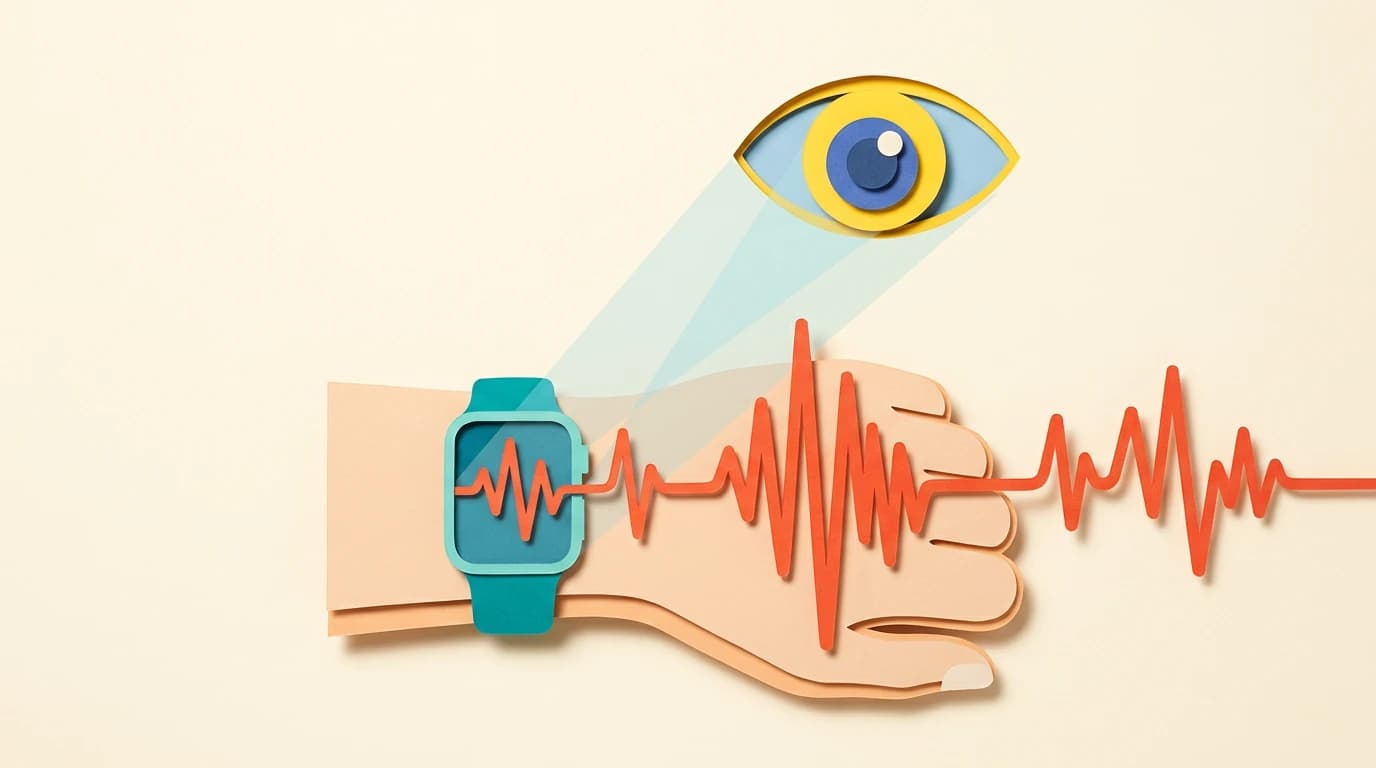
Look beneath a fitness tracker and you will see a flashing green LED. This sensor relies on photoplethysmography (PPG), an optical way to track blood volume shifts in tiny vessels with each beat. For years, health apps relied on human coders hand-measuring wave peaks and dips. Now, researchers hand that messy job over to deep learning.
A review brought together 460 studies published between 2017 and 2025 to see how artificial neural networks handle pulse data. Instead of following rigid rules, these networks learn complex body patterns straight from raw light signals. This shift matters because it lets wrist devices spot rich details that human-crafted rules easily miss.
The hunt for blood pressure
Heart health was the most common focus in the reviewed papers. Blood pressure checks led the field with 154 studies, followed by general heart checks in 106 papers. Tracking hemodynamics—the physical forces that drive blood flow through your vessels—usually requires an awkward arm cuff. Teaching software to infer arterial blood pressure from wrist light alone could make all-day checks far easier.
Teams tested many model setups, but convolutional neural networks (CNNs) were the top pick, used in 283 studies. CNNs excel at spotting wave shapes, much like finding edges in digital photos. Some teams combined them with time-tracking networks to build a CRNN, capturing sudden shape changes and rhythmic trends over time. Beyond the heart, papers explored sleep health, mental health, blood glucose, and biometric identity. In one test of 20 people, a hybrid model called CorNET hit 96% accuracy identifying individuals from their wrist pulse alone.
Messy wrists and real life
Teaching software to read a pulse wave is like training an automated seismograph. Instead of asking a geologist to measure every wiggle with a ruler, the computer learns the overall earthquake pattern directly. However, an earthquake does not bump into doorframes. When a person walks or types, arm movement corrupts the light signal with heavy noise. Without careful filtering, these false spikes can easily mislead a model.
Importantly, the review does not combine performance scores across models or prove that any specific tool works for medical diagnosis in a clinic. Modern Transformer networks also face hurdles here. Long pulse signals demand huge computing power, and pulse data collections remain small compared to image libraries. Generative models also suffer from unstable training when trying to recreate subtle pulse shapes.
What we still do not know
Can these wearable tools hold up in daily life? Moving outside test labs introduces harsh movement noise and sensor shifts. It remains unproven whether cuffless blood pressure or glucose estimates will ever be reliable enough for diverse people in daily living, or whether large foundation models can successfully adapt to smartwatch pulse monitoring.
Science words
- photoplethysmography (PPG)
- A light-based method that shines LEDs into skin to detect changes in blood volume.
- hemodynamics
- The physical dynamics and forces involved in blood flow through the body.
- arterial blood pressure (ABP)
- The continuous force exerted by circulating blood on the walls of arteries.
- CRNN
- A hybrid model combining layers that spot local wave shapes with layers that track patterns over time.
Check it yourself
This story is based on a real research paper in Health Data Science by Nie, Zhu, Tang et al. We write with AI help and check it against the paper, but the original is the final word.