How smart traffic lights could trim queues and collisions
A computer model suggests smart traffic lights powered by artificial intelligence can cut dangerous vehicle conflicts while simultaneously shortening queues.
Reading level
The full story with proper science words explained.
Teaching junctions to think ahead
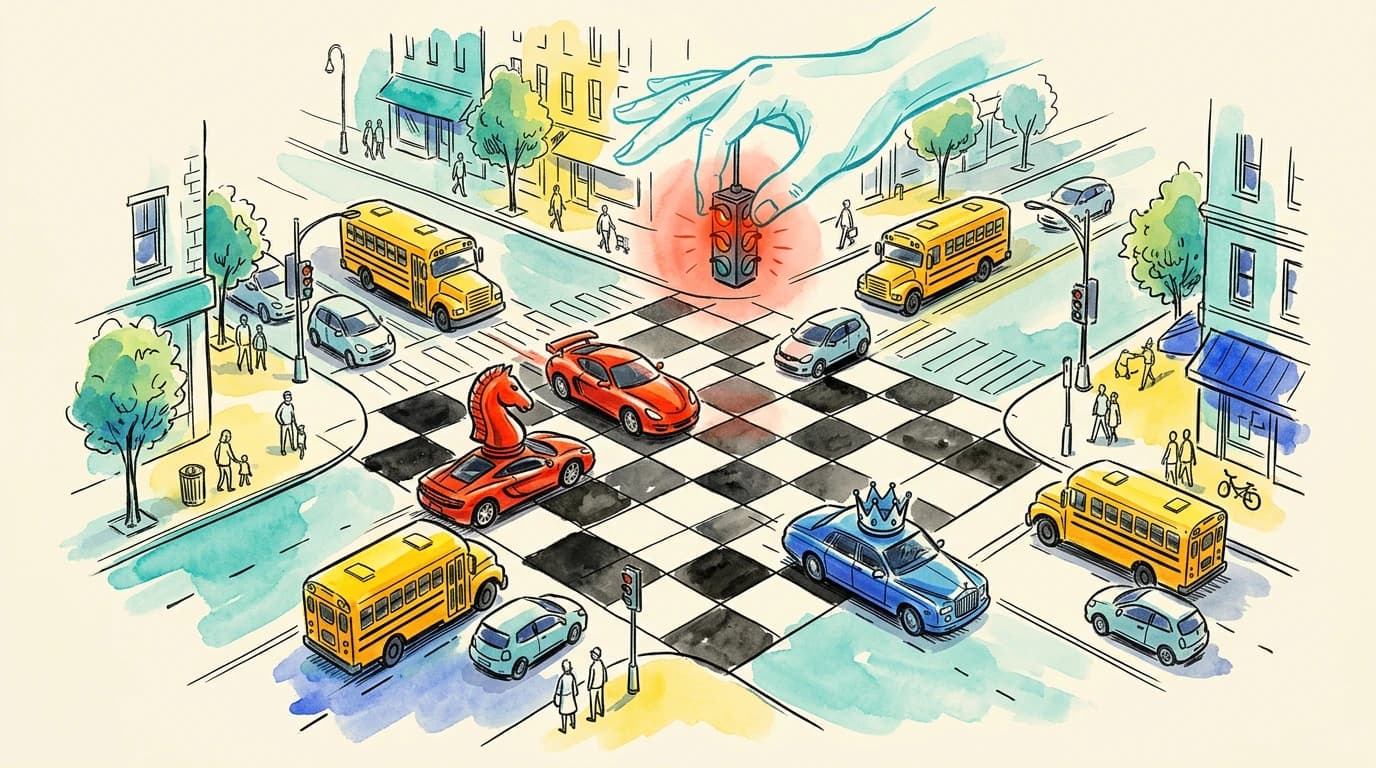
Nobody enjoys waiting at red lights, but making signals change faster often risks creating dangerous near misses. Historically, signal timers prioritised car speed and capacity above safety. To solve this dilemma, researchers designed smart traffic lights using reinforcement learning—a method where an artificial intelligence learns optimal choices through digital trial and error.
Testing the digital crossroads
The researchers set up a microscopic traffic simulation, a computer model that tracks each car individually. They fed it video from two four-legged junctions in Queensland, Australia, recorded across two weekdays. Genetic algorithms adjusted the simulation so virtual cars matched real driving habits. Next, a graph neural network mapped the lanes and vehicle paths like interconnected points on a network map. This network calculated risk using the proportion of stopping distance—the gap a car has available compared to what it needs to stop.
Safer roads and faster trips
Compared to the actual field signal timings, the AI model lowered time spent in conflict by 17.3%. In these near-miss zones, vehicles were kept safely separated. Remarkably, this extra caution did not cause gridlock. Instead, the virtual queues shrank by 7.9%, and average waiting time dropped by 5.1%. When tested on a second junction with a completely different layout, the learned control policy still outperformed the field signal plan on both safety and efficiency.
What we still do not know
These gains are promising, but the performance benefits were evaluated only inside a calibrated computer simulation, not during a live trial on real streets. The original data also came from just two Australian junctions recorded on two weekdays. We do not yet know how the system copes with adverse weather, extreme congestion, or heavy crowds of pedestrians and cyclists. Further tests are needed to see if it works on complex junctions beyond four-legged layouts.
Science words
- Reinforcement learning
- A form of machine learning where an AI learns by trial and error to hit specific goals.
- Microscopic traffic simulation
- A computer model that simulates the movements and decisions of individual cars rather than general traffic flow.
- Genetic algorithms
- Rules inspired by natural evolution that tweak computer settings until they match real-world observations.
- Graph neural network
- An AI system built to process connected data, such as a map of road lanes and turnings.
- Proportion of stopping distance
- A safety score comparing the gap a driver has to stop against the distance physically required.
- Time spent in conflict
- The time vehicles spend uncomfortably close to one another with a risk of colliding.
Check it yourself
This story is based on a real research paper in Accident Analysis & Prevention by Islam, Tahir, Haque. We write with AI help and check it against the paper, but the original is the final word.