How smart software sorts messy biological sample metadata
Using local large language models, researchers harmonised messy details across 4.2 million biological records and linked 99% of the extracted facts straight back to their sources.
Reading level
The full story with proper science words explained.
The messy global filing shelf
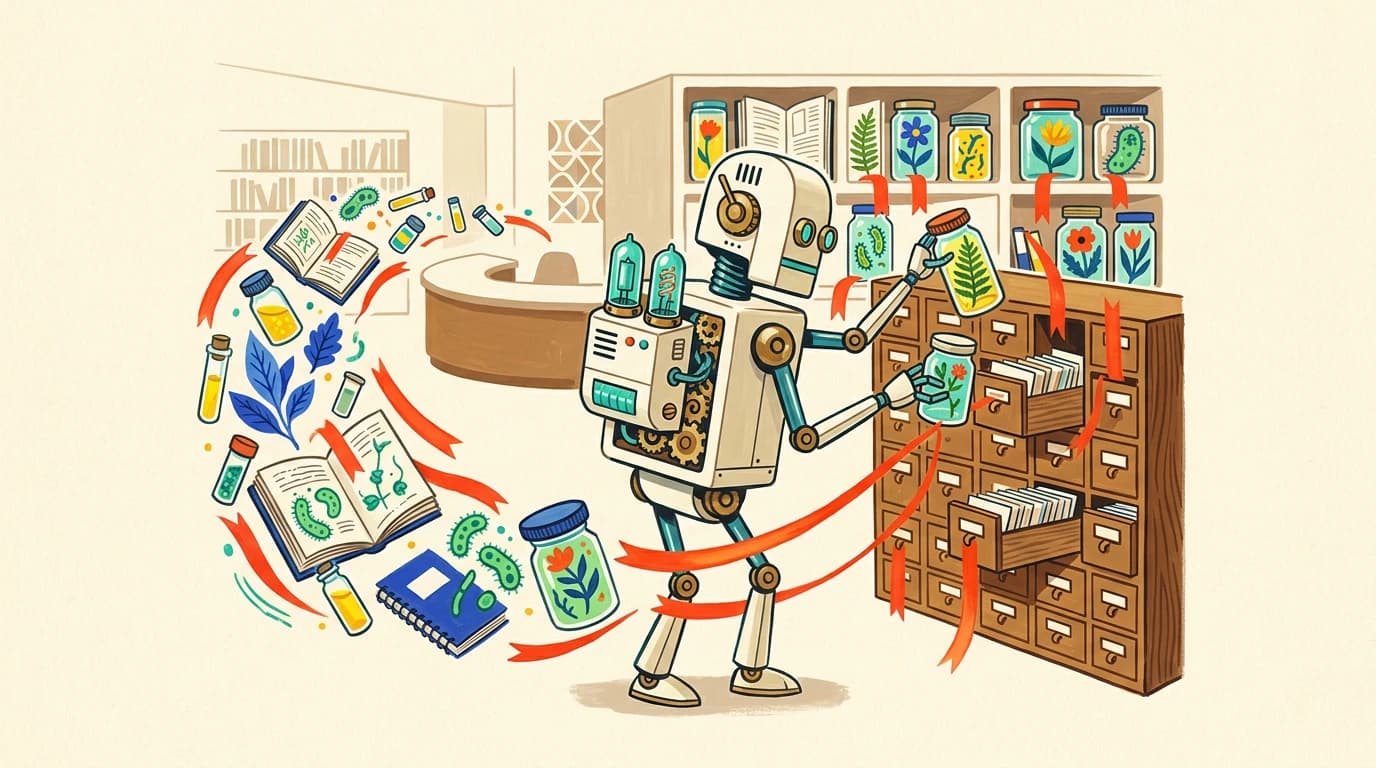
Think of an open store room where thousands of people shelved boxes using their own made-up tags. That clutter is real in public science archives. When researchers submit biological sample metadata—the background notes on cell types, tissues, and test setups—they describe them however they like.
Searching the BioSample database becomes hard when everyone invents novel labels. In fact, just 32 common labels account for 90% of the recorded facts. The remaining 10% sits scattered across more than 6,000 distinct labels. Finding matching files is like trying to guess six thousand different passwords.
Bringing in an automated reader
To fix this, a team used locally run large language models to read 4.2 million human and mouse records. The software parsed the messy free text and pulled out nine key kinds of details. It then mapped these into 8.2 million values tied to standardised ontology terms—fixed scientific vocabulary words that mean the same thing to every researcher.
An automated reader that invents facts is risky in science, so the team tracked data provenance, or the verifiable paper trail for each fact. By combining deterministic matching—a strict, rule-based text search—with checks from a language model, the system linked 99% of its extracted facts back to the original text. It even spotted its own mapping errors without needing people to check every line.
The team placed these cleaned records into an early alpha web tool. This setup lets researchers search and map tests on screen.
What we still do not know
Sorting chaotic notes into clean tags helps people reuse old files, but a digital index cannot re-run lab work. The system also has clear limits. The tool is only an early alpha build and covers human and mouse files alone. Furthermore, researchers do not yet know how closely the software's self-evaluations will match judgements made by human domain experts, or whether the method will work smoothly on other species.
Science words
- metadata
- Descriptive information explaining the context, origin, and experimental conditions of data.
- BioSample
- A database storing descriptive information (metadata) about biological samples used in experiments.
- ontology terms
- Standardised, controlled vocabulary words organized in a hierarchy to ensure everyone refers to the same biological concept consistently.
- provenance
- The verifiable origin or paper trail showing exactly where a piece of extracted data came from in the original source.
- deterministic matching
- A rule-based, exact method of finding text matches that always yields the same result without statistical guessing.
Check it yourself
This story is based on a real research paper in Scientific Publication by Ikeda, Fàbrega, Suetake et al.. We write with AI help and check it against the paper, but the original is the final word.