How smart code learns seizure prediction by copying biology
A computer framework called CMS-NAS automatically designs tiny, accurate neural networks to predict epileptic seizures from brain activity. It combines image filters, memory models, and brain-like spiking neurons to run on low-power wearable chips.
Reading level
The full story with proper science words explained.
Listening to the static in the brain
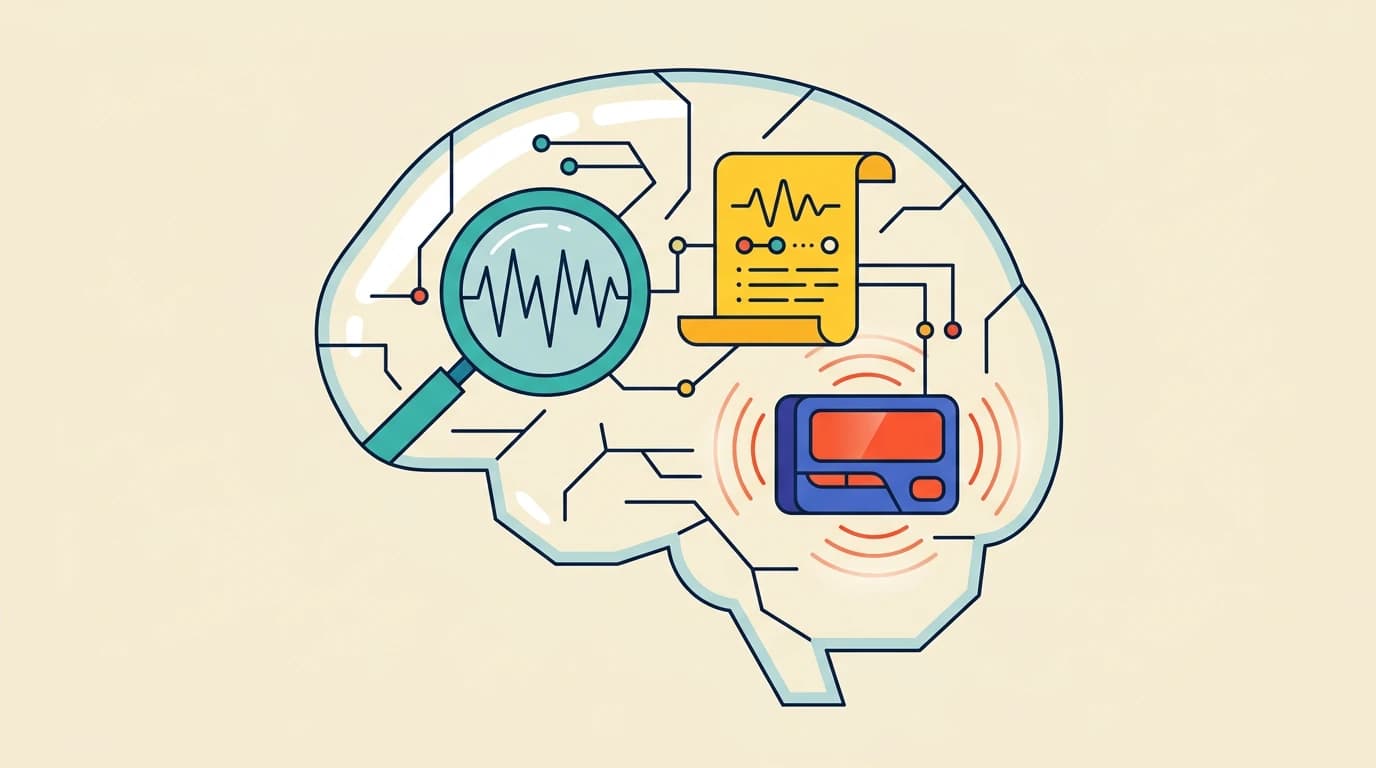
Waves of current inside our heads buzz with noisy signals every second. For around 50 million people across the globe who live with epilepsy, sudden shifts in these patterns can spark a seizure. Spotting these changes early—an approach called seizure prediction—gives patients time to find a safe space. Yet human doctors cannot sit and study an electroencephalogram, or EEG, every hour of the day.
An EEG tracks the head's continuous brain waves through sensors on the scalp. The recorded lines look messy, jump around, and drift over time. Normal computers burn through large amounts of power trying to parse these wavy lines quickly. Small wearable monitors need to be clever enough to catch tiny clues while drawing very little power.
A team of digital specialists
Scientists built a search tool called CMS-NAS to solve this puzzle. Instead of human coders designing the network by hand, the system uses natural selection rules. It tests many candidate designs, blends the best performers, and trims away bloated shapes that contain too many parameters.
Think of each chosen network as a three-part medical response squad. The first part, called a ConvSpike unit, uses depthwise separable convolutions to scan local patches of data for rapid, short-term spikes. The second part, known as a MambaSpike unit, relies on Mamba sequence modeling. This smart design tracks how brain rhythms wander over long stretches of time without slowing the processor to a crawl.
Finally, both units send their clues to leaky integrate-and-fire neurons, which make up a spiking neural network. Most computers send endless streams of heavy numbers back and forth. In contrast, these biologically inspired digital cells stay quiet most of the time. They soak up incoming values, leak away harmless static, and only fire sharp binary pulses when incoming danger crosses a set line.
Trimming power without losing track
This sparse pulse method saves precious energy, making it a great match for small chips. The framework begins by breaking raw EEG data into frequencies and time steps using a short-time Fourier transform. Candidate models then try to classify these converted charts.
Standard neural nets often hold millions of internal weights, which drains power and overloads tiny processors. The search method scores every test build on two goals: catching seizures correctly and keeping total parts low. By pairing strong detection with compact shape, the process uncovers lean models that can easily fit on wearable sensors.
What we still do not know
Running this evolutionary search takes massive computing effort at the start, which forms a major bottleneck. The rules also limit the variety of network shapes that the tool can test. Most importantly, these hybrid designs were tested inside computer simulations. We do not yet know how they will hold up on real brain-computer interface chips in living patients, or across wider, more diverse groups of people.
Science words
- Electroencephalogram (EEG)
- A medical recording that tracks electrical waves along the scalp.
- Spiking Neural Network (SNN)
- An artificial intelligence model where digital cells communicate through brief pulses instead of constant numbers.
- Leaky Integrate-and-Fire (LIF)
- A neuron model that stores incoming signals, slowly leaks them away, and fires only after reaching a set threshold.
- Mamba
- A sequence-tracking design that remembers long-term patterns without slowing down computers.
- Depthwise Separable Convolution
- An efficient computation method that detects patterns in data while keeping the model small.
- Short-Time Fourier Transform (STFT)
- A mathematical tool that breaks complex waves apart to reveal which frequencies exist at specific moments.
Check it yourself
This story is based on a real research paper in Cyborg and Bionic Systems by Yu, Li, Song et al.. We write with AI help and check it against the paper, but the original is the final word.