How quantum spins can push a levitating diamond
Scientists have shown that tiny electron spins trapped inside a diamond can exert real forces, driving the movement of a floating object weighing over 100 milligrams.
Reading level
The full story with proper science words explained.
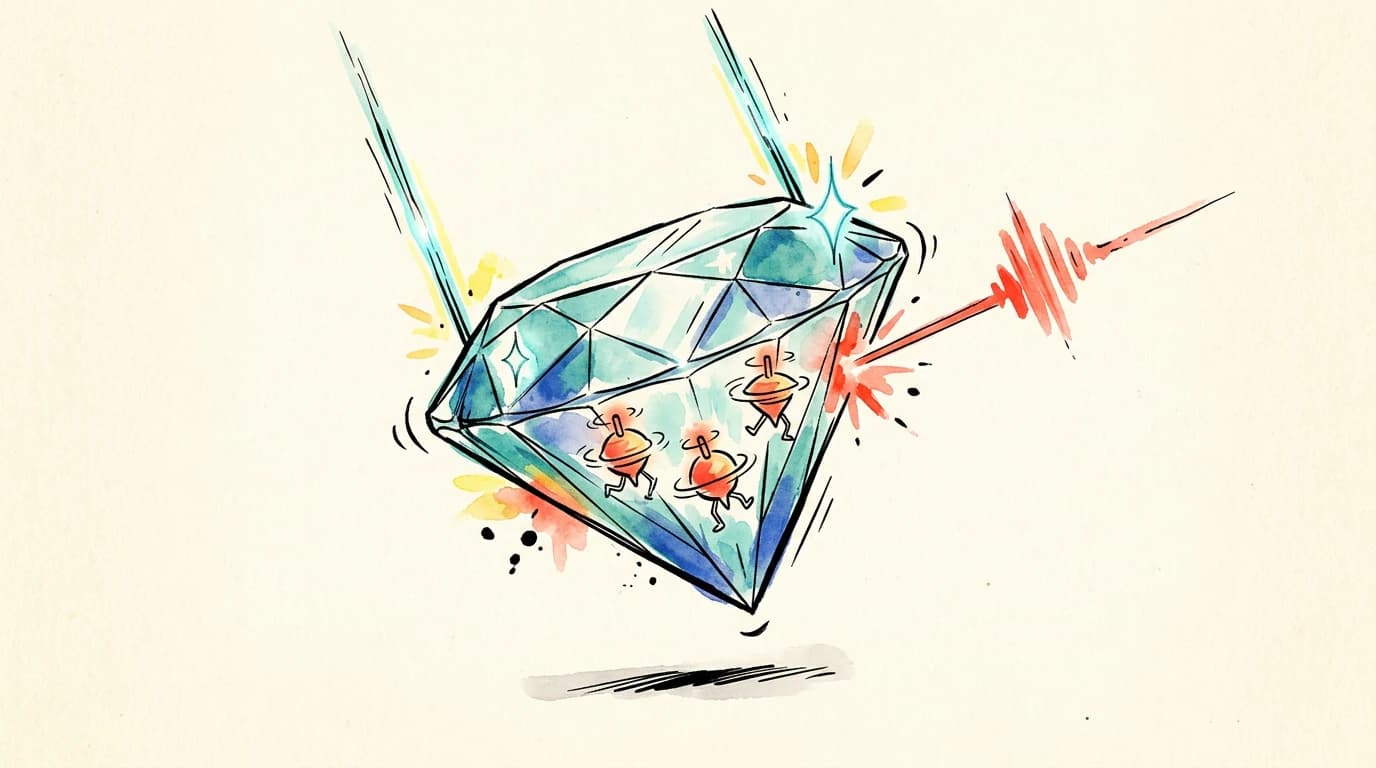
A playground swing powered by atoms
Can tiny quantum traits move an object you can see?
Picture pushing a friend on a playground swing. If you shove at random moments, nothing happens. But if you push in step with their usual pace, each small nudge builds up. Soon, the swing climbs surprisingly high.
Scientists have now used this exact trick on a floating plate weighing 128 milligrams. That might sound tiny, but it is macroscopic: comfortably large enough to rest on your fingertip. Using spin force levitation, the team proved that tiny quantum states can push a real object back and forth through space.
Turning defects into microscopic paddles
To pull this off, the team hung a small gem under a slotted graphite plate. Graphite naturally repels magnetic fields, enabling stable diamagnetic levitation without any strings attached.
Inside the gem were billions of tiny crystal faults called nitrogen-vacancy centres, or NV centres for short. Each NV centre traps electrons with an intrinsic magnetic trait known as spin. When placed inside an uneven magnetic field, these spins feel a tiny shove known as a Stern-Gerlach force.
The secret tool was a green laser pulsing at 17.6 hertz, the exact resonance pace of the floating board. Every flash lined up the electron spins, producing a shared magnetic pull before they relaxed. Interacting with the field gradient, this repeating push acted just like timed shoves on a swing. Working together, these defect spins drove the whole 128-milligram board to swing up and down by about 100 nanometres.
Proving the quantum push
How did the team know quantum spins caused the movement, rather than simple heat from the beam? They ran strict checks.
First, an interferometer tracked the motion down to fractions of a nanometre. The resulting vibration peaked four orders of magnitude above background Brownian noise, the random jiggling of surrounding air molecules. Then, when the team swapped the green beam for an infrared beam that cannot align the spins, the motion vanished completely. Taking away the magnet also stopped the swings.
The measured push exceeded 5 nanonewtons. Interestingly, stronger magnets did not always give bigger pushes. The effect relied on the field gradient—how steeply the field changes over space—meaning a small, steep magnet pushed harder than a bulky one.
What we still do not know
The swing comparison works well to explain timing, but it breaks down if you picture hands touching a seat. Here, the pushes come from changing quantum magnetic states acting across empty space.
There are also clear test limits. Air friction capped the system's quality factor, a score of how well it keeps swinging without losing energy, at just 55. Room shaking also limited tracking to about one nanometre.
We still do not know if placing this setup in a high vacuum can raise its quality factor towards 100,000, or whether microwaves could create even larger forces. If refined, this method could help test the quantum nature of gravity.
Science words
- Nitrogen-vacancy centre
- A tiny defect in diamond where a nitrogen atom sits next to an empty spot, trapping electrons with useful quantum spins.
- Diamagnetic levitation
- A way to float objects using magnetic fields that push against materials naturally repelled by magnetism, such as graphite.
- Stern-Gerlach force
- A physical push felt by a magnetic moment, like an electron spin, when placed in a magnetic field that varies in strength.
- Interferometer
- An instrument that uses overlapping light waves to measure extremely small distances with high precision.
- Quality factor
- A number showing how slowly an oscillating object loses its energy to damping or friction.
- Brownian noise
- The random, jittery motion of objects caused by collisions with surrounding thermal molecules.
Check it yourself
This story is based on a real research paper in Science Advances by Nayak, Kim, Tian et al. We write with AI help and check it against the paper, but the original is the final word.