How Quantum Light Nonlinear Optics Can Supercharge Lasers Without Burning Them
Source PublicationNature
Primary AuthorsJiang, Pan, Chen et al.
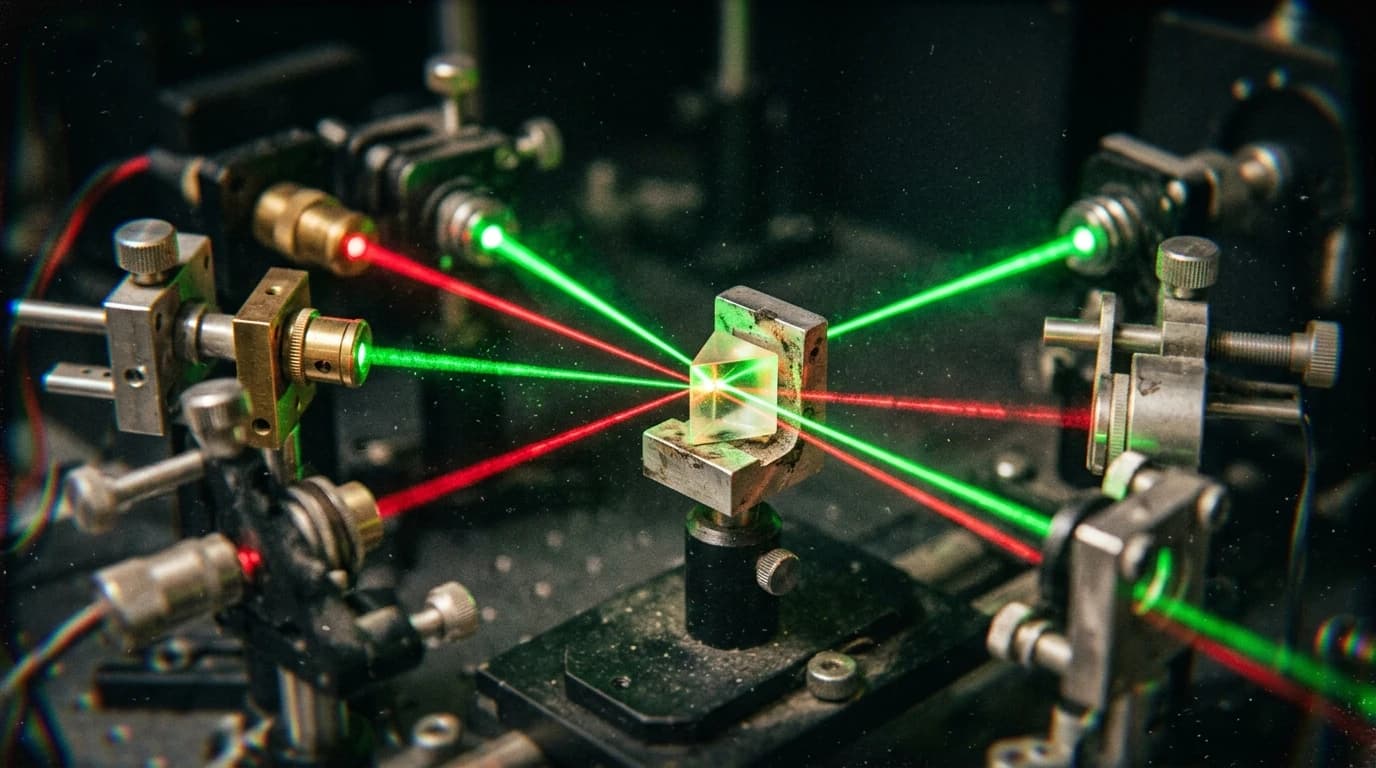
Imagine trying to knock down a locked door. Instead of swinging a massive, destructive battering ram that breaks the doorframe, you use a team of lockpicks who strike the internal pins in perfect, coordinated unison.
These results were observed under controlled laboratory conditions, so real-world performance may differ.
The Power of Quantum Light Nonlinear Optics
This is the principle behind a new experiment in quantum light nonlinear optics. Usually, driving complex interactions between light and matter requires blasting materials with high-intensity lasers. However, this brute-force method often overheats and damages delicate targets.
To solve this, researchers experimented with a special type of quantum light called bright squeezed vacuum (BSV). BSV organises its photons so they arrive in highly correlated, cooperative bursts rather than a steady stream.
Measuring the Quantum Boost
The team tested this by using the light to trigger tunnelling ionisation—a process where electrons are pulled from isolated atoms. By measuring the momentum of the ejected photoelectrons, they compared the quantum light against standard coherent laser light.
The study measured that a BSV pulse of just 300 nanojoules achieved the same physical effect as a 7.1-microjoule classical laser pulse. This represents a more than 20-fold boost in efficiency.
What This Means for the Future
By tuning the photon correlations, researchers also demonstrated they could control the effective intensity of the light without changing its energy.
While currently limited to isolated atoms in a laboratory setting, this discovery suggests that scientists may soon customise light-matter interactions using quantum statistics instead of raw power. This could lead to:
- More efficient attosecond science and high-harmonic generation experiments.
- Advanced quantum-controlled strong-field dynamics.
- Tailored nonlinear optical processes that avoid classical intensity-scaling damage.