How quantum dots reshape light for future screens
Tiny semiconductor crystals can absorb one colour of light and emit intensely pure new hues. However, building great devices requires smart optical design alongside good chemistry.
Reading level
The full story with proper science words explained.
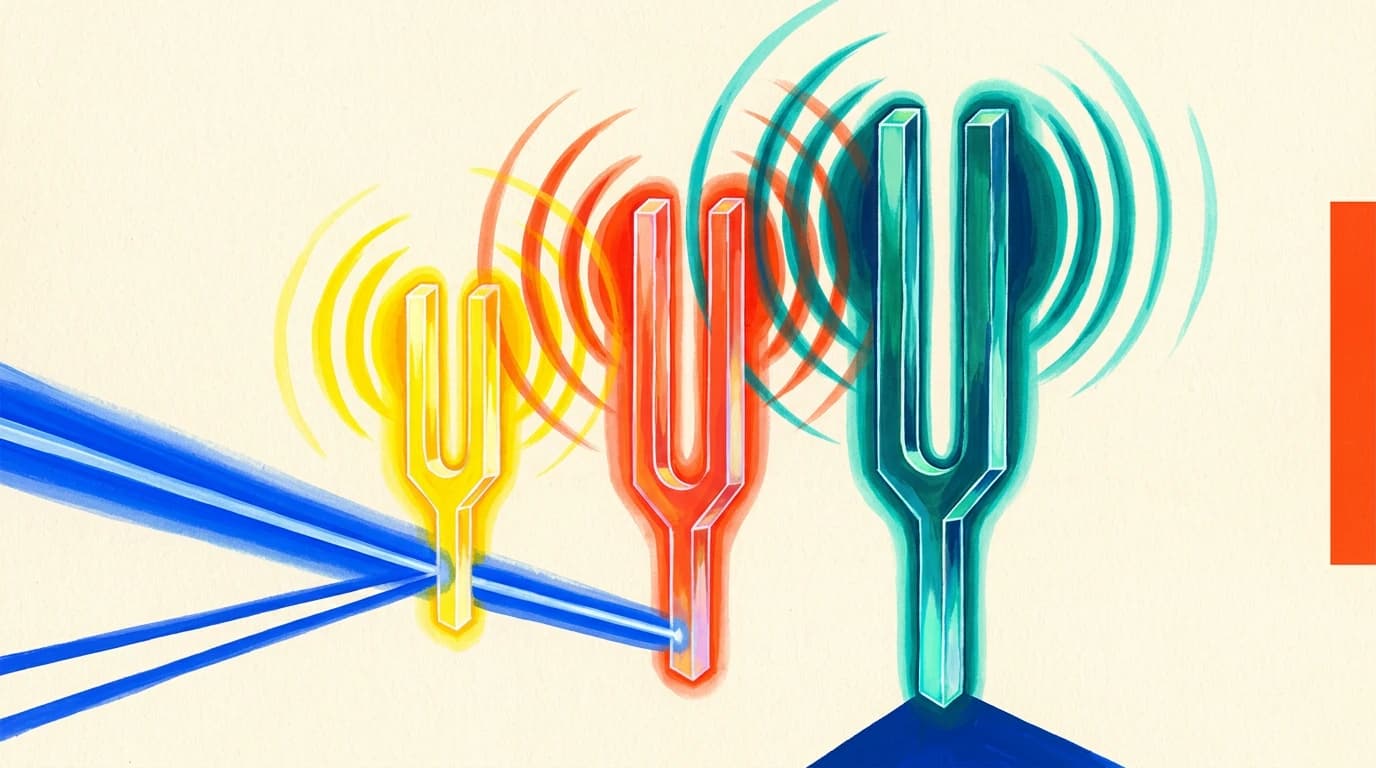
Tiny crystals with bold colours
Shrink a semiconductor crystal down to just a few billionths of a metre and its colour shifts. These tiny specks are quantum dots. By changing their physical size, makers can tune them to shine in exact shades of red, green, or blue.
Instead of building separate coloured light sources, device makers spread these crystals into thin films called colour conversion layers. These sheets soak up incoming blue light and swap it for a vivid new shade. Because they boast a high photoluminescence quantum yield, meaning they emit almost every photon they absorb, they waste very little light. They also have a narrow emission linewidth, which means the light stays focused in a tight band of colour. This gives them far purer hues than standard phosphors found in older displays.
Why good materials are not enough
Mixing great materials in a lab beaker does not guarantee a bright screen. A new review shows that material chemistry alone cannot make a display shine at its best. Once packed closely inside a device, the crystals run into tricky light traps.
First, neighbouring crystals can quickly trap and swallow freshly made light. This loss is called reabsorption. Second, raw blue light can slip straight through the film without changing colour. This excitation-light leakage washes out the picture on screen. To stop both losses, teams must craft smart device shapes. These microstructures guide photon paths, pull trapped light out into the open, and block stray blue beams from escaping.
Bending light into new shapes
These thin films do far more than improve television screens. Teams now build them into visible light communication links that send data through room lamps. They also appear in flexible human-machine interfaces that twist, bend, and stretch with our bodies. Yet bending introduces real hurdles. Stretching the film alters how photons travel through the layer, and physical strain can drop conversion rates.
What we still do not know
We still do not know the best way to keep conversion steady when a flexible display stretches. Building scalable designs that stay optically stable under real physical strain remains an open puzzle.
Science words
- Quantum dots
- Nanometre-sized semiconductor particles whose optical emission colours change depending on their physical size.
- Colour conversion layers
- Coatings or films that absorb light of one colour and convert it into a different colour.
- Photoluminescence quantum yield
- The ratio of photons emitted to photons absorbed by a luminescent material.
- Emission linewidth
- The spectral width of emitted light, where narrower widths produce more saturated and pure colours.
- Reabsorption
- A phenomenon where emitted photons are absorbed again by adjacent particles within the same layer, causing energy loss.
- Excitation-light leakage
- Unconverted primary light escaping through the conversion layer, which degrades colour purity.
Check it yourself
This story is based on a real research paper in Small by Kim, Lee, Bae et al. We write with AI help and check it against the paper, but the original is the final word.