How plate tectonics pulled open a sea from across the Pacific
Digital tests show that sinking rock slabs near Asia pulled on the Pacific floor, sending stress thousands of miles away to tear open the Gulf of California.
Reading level
The full story with proper science words explained.
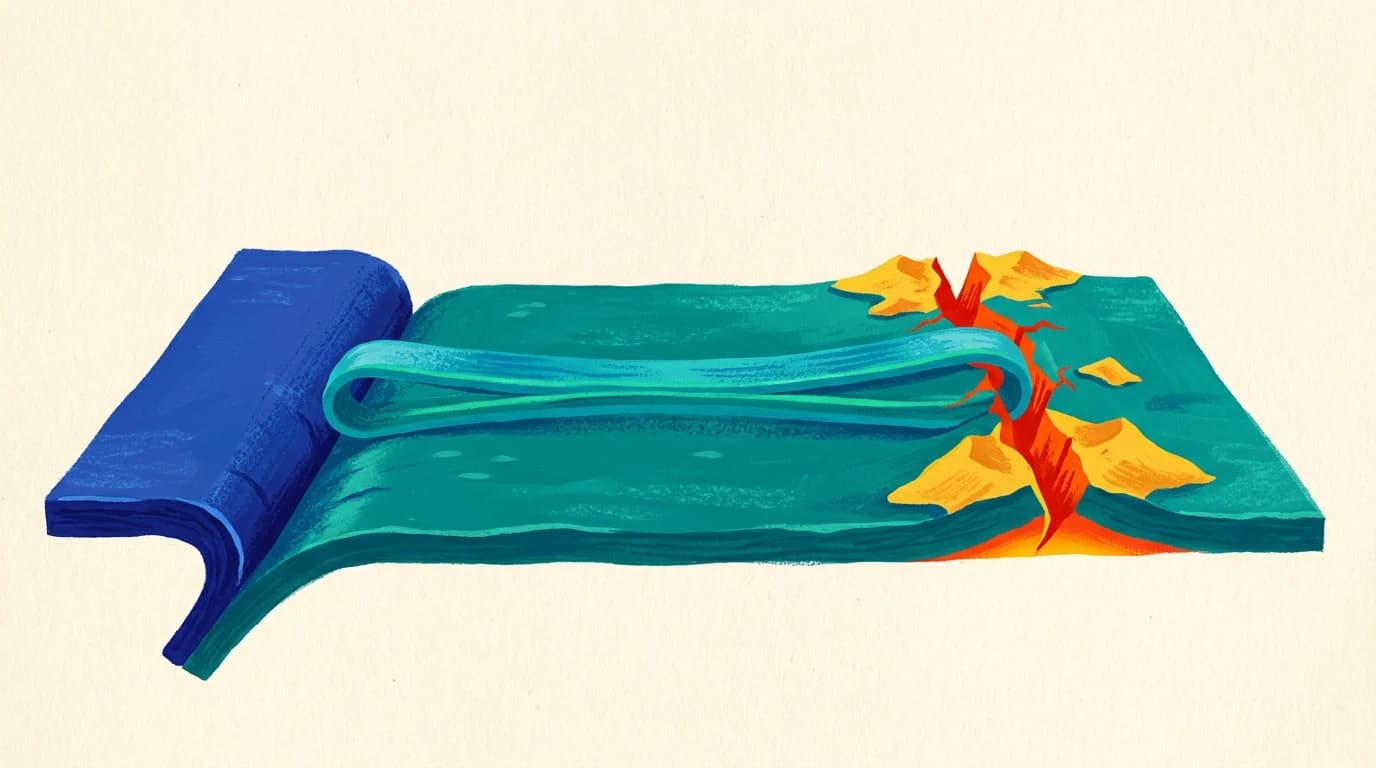
Tug of war across the sea
Between 6 and 8 million years ago, a massive tear ripped open the Gulf of California in North America. Experts long wondered what triggered this fast split. The answer might lie thousands of miles away on the far side of the sea.
Earth has a hard outer shell of crust and upper mantle called the lithosphere. This outer shell is broken into big slabs that shift through plate tectonics. Because a slab forms one continuous piece of rock, what happens on one end can echo across the entire ocean floor.
Testing the crust with code
To see how this works, scientists used geodynamic models, which are digital tests that mimic how planets move. They examined a moment when double subduction started in the Western Pacific, where two separate rock slabs sank down at the same time. This kind of digital test matters because we cannot travel back in time to measure ancient forces directly.
As these two heavy slabs sank, their weight dragged on the Pacific plate. The digital test shows that this downward pull sent an extensional stretch straight across the rock. It passed between 5 and 15 megapascals of stress, which is a standard scientific unit used to measure pressure and mechanical pull.
This transmitted force reached all the way across the sea. There, it loaded the southern San Andreas fault with extra stress. It also pulled apart the Gulf of California oblique rift, a fracture zone where the ground stretches open while sliding sideways at an angle.
What we still do not know
This big pull worked because the local crust was already preconditioned, meaning it was warm, thin, and primed to break. Without that weak spot, the distant tug might not have torn the land open. Scientists now want to learn if distant slab sinks have sparked continental rifting events around the world, or if this ocean was a special case.
Science words
- continental rifting
- The process where tectonic forces pull a continental landmass apart.
- double subduction
- A tectonic setup where two separate slabs sink into the mantle at the same time.
- lithosphere
- The rigid, rocky outer shell of the Earth, including the crust and upper mantle.
- geodynamic models
- Computer simulations that recreate forces and motions inside the Earth.
- megapascal
- A unit used by scientists to measure physical pressure and mechanical stress.
- oblique rift
- A break in the crust where rock pulls apart and slides sideways at an angle.
Check it yourself
This story is based on a real research paper in Science by Gianni, He, Becker et al. We write with AI help and check it against the paper, but the original is the final word.