How Neuromorphic Hardware Will Power Your Future Autonomous Assistant
Source PublicationMaterials Horizons
Primary AuthorsBhaumik, Ghosh, Gupta et al.
"Like a stadium crowd performing a perfect wave, where individual movements synchronise into a single, organised pattern."
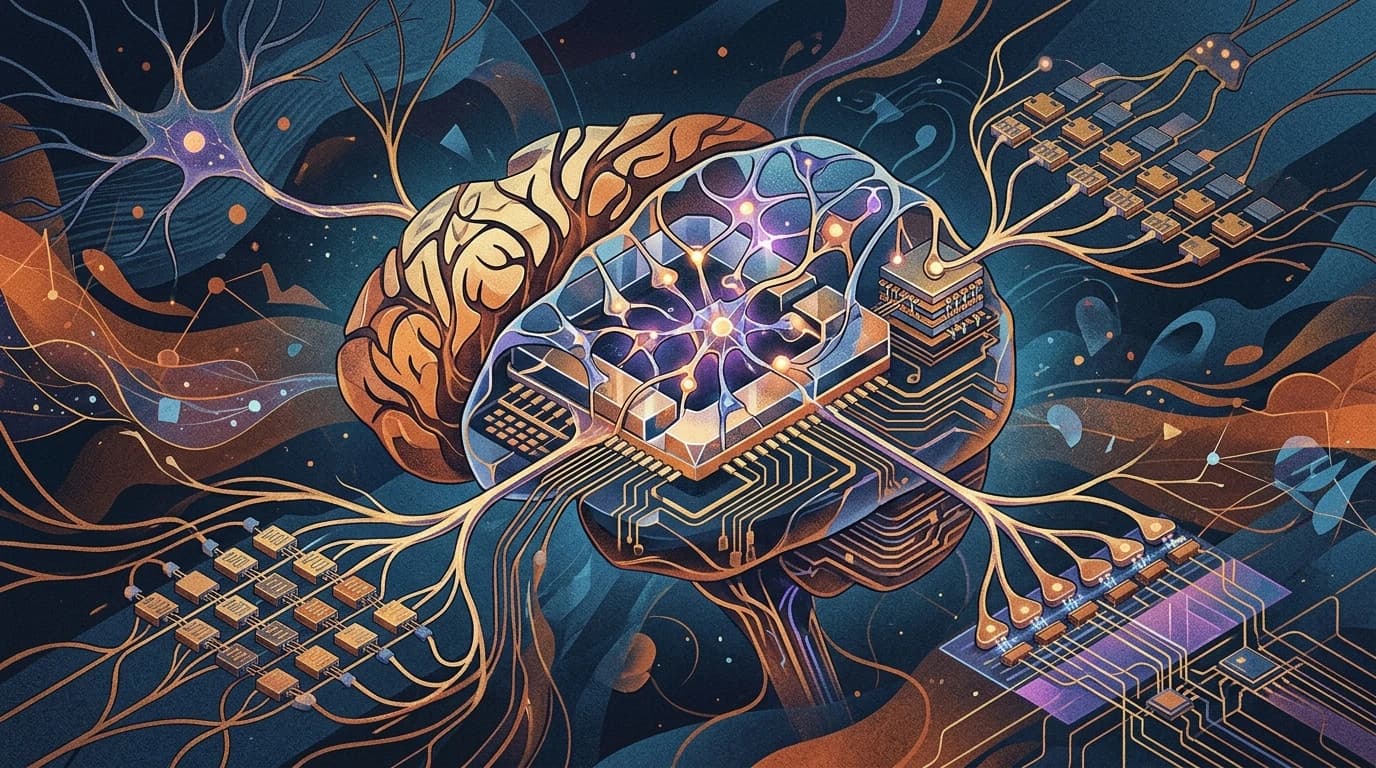
Imagine carrying a pocket-sized personal assistant that thinks, learns, and remembers without needing a daily battery charge. This future relies on neuromorphic hardware, a technology designed to mimic the human brain's physical structure and energy efficiency.
These results were observed under controlled laboratory conditions, so real-world performance may differ.
Current computer chips consume massive amounts of electricity to run artificial intelligence. While scientists have mimicked basic brain cells in silicon, replicating complex brain behaviours like synchronised rhythms and memory has remained difficult.
A Leap in Neuromorphic Hardware Design
Researchers have engineered a new oxide nanoparticle system that generates spontaneous electrical oscillations under a constant current. This material mimics how excitatory and inhibitory brain cells interact to produce neural rhythms. The study measured low spectral entropy in these oscillations, which suggests the nanoparticles synchronise collectively to organise electrical signals. The system also adjusted its oscillations based on past electrical stimulation, demonstrating a basic form of memory.
Your Career in Brain-Like Computing
This research suggests we can build computers that process complex patterns using a fraction of the power of current silicon chips. By the time you graduate college, these systems may power:
- Autonomous search-and-rescue robots
- Intelligent medical implants that adapt to body chemistry
- Low-power environmental sensors that monitor climate change
To build this future, industries will need specialists who understand both biology and computer science. Learning Python, circuit design, or molecular biology today will prepare you to design the next generation of intelligent machines.