How mosquito AI is learning to spot malaria and track breeding grounds
A review of 650 studies shows that computer vision for mosquito-borne diseases has grown rapidly since 2010, especially for malaria diagnosis. However, most tools are not yet ready for routine public health use.
Reading level
The full story with proper science words explained.
A microscope puzzle
Imagine checking hundreds of blood slides a day for tiny malaria parasites. One missed speck could cost a life. In many regions, trained lab staff are in short supply. That is why mosquito AI—using cameras and smart software to read images—has drawn huge interest.
To see how far the field has come, a team of authors ran a systematic review. They searched three major scientific databases for studies published between 2010 and 2025. Out of 1,521 records screened, 650 studies met their rules.
From blood slides to drones
The review shows a rapid rise in computer vision—software trained to interpret images or video—for mosquito-borne diseases. Most of the 650 studies focused on diagnosis, especially spotting Plasmodium, the microscopic parasite that causes malaria, on blood smears.
Methods also shifted over time. Early work used basic image processing. Newer studies use convolutional neural networks—deep learning tools built to recognise patterns in images—alongside fast object detectors and transformer models. Research has also branched out into drone-based habitat mapping, smartphone imaging, and 3D tracking of mosquito behaviour.
The back-garden problem
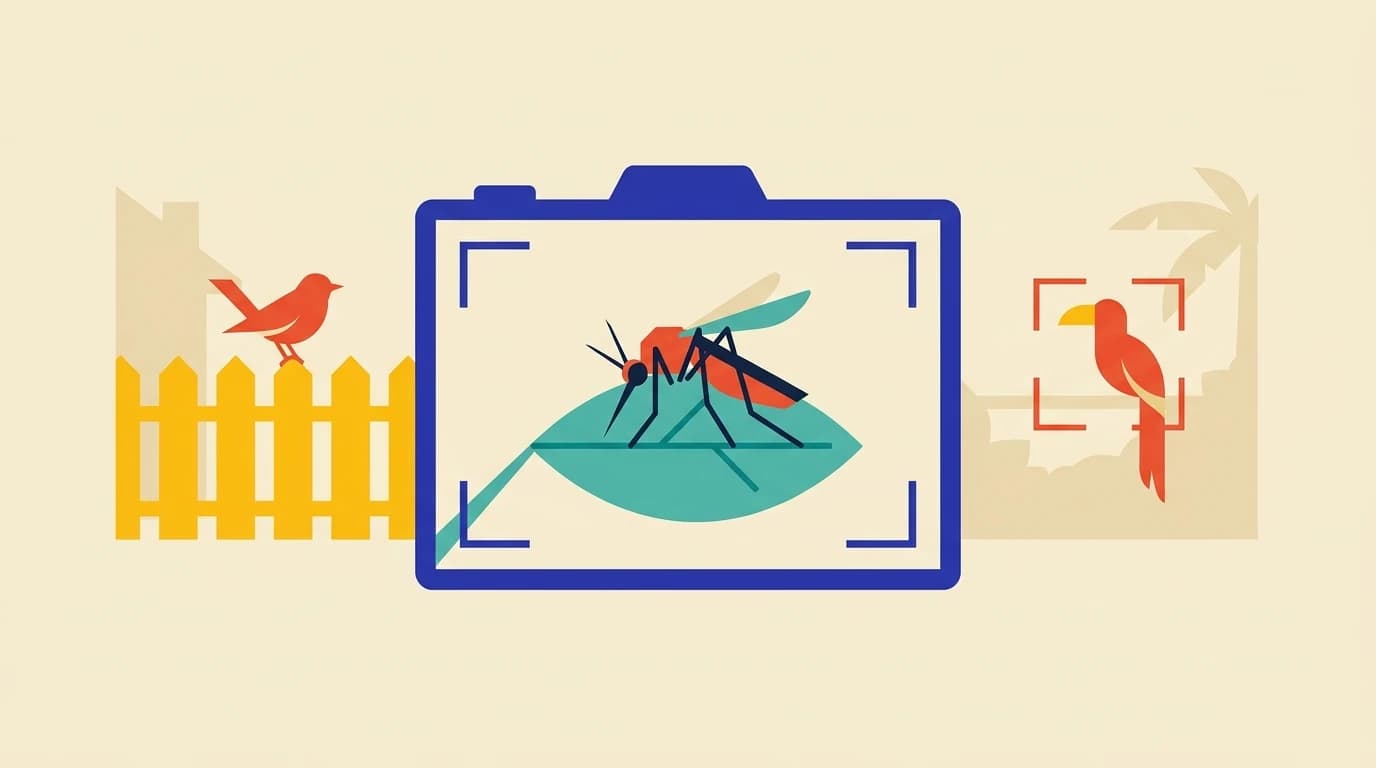
Despite the excitement, the review does not show that these tools are ready for routine public health use. Most models were trained on small, geographically limited datasets. That is like learning to recognise birds using only photos from your own back garden. You might ace that yard, yet struggle in another country. The analogy stops at the tech itself, of course—software needs formal testing, not just a change of scenery.
What we still don't know
Most studies lacked external validation, which means testing a model on completely new data from outside its original study. Very few were tested in real-world clinics or field programmes. We still do not know how well these tools perform in everyday disease control. It is also unclear what standards are needed to prove they work across different populations.
Science words
- Computer vision
- A field of artificial intelligence that trains computers to interpret and analyse visual information from images or video.
- Plasmodium
- The microscopic parasite that causes malaria and is commonly detected by examining blood smears under a microscope.
- Convolutional neural networks
- A type of deep learning algorithm specially designed to recognise patterns and features in images.
- External validation
- Testing a model on completely new data from outside its original study to prove it works reliably.
Check it yourself
This story is based on a real research paper in PLOS Neglected Tropical Diseases by Ong, Brkljač, Djerdj et al. We write with AI help and check it against the paper, but the original is the final word.