How modern CRISPR gene editing fixes DNA without breaking both strands
A comprehensive review evaluates how CRISPR has evolved from simple molecular scissors into precise tools that swap single DNA letters or paste large genes without dangerous double-strand breaks.
Reading level
The full story with proper science words explained.
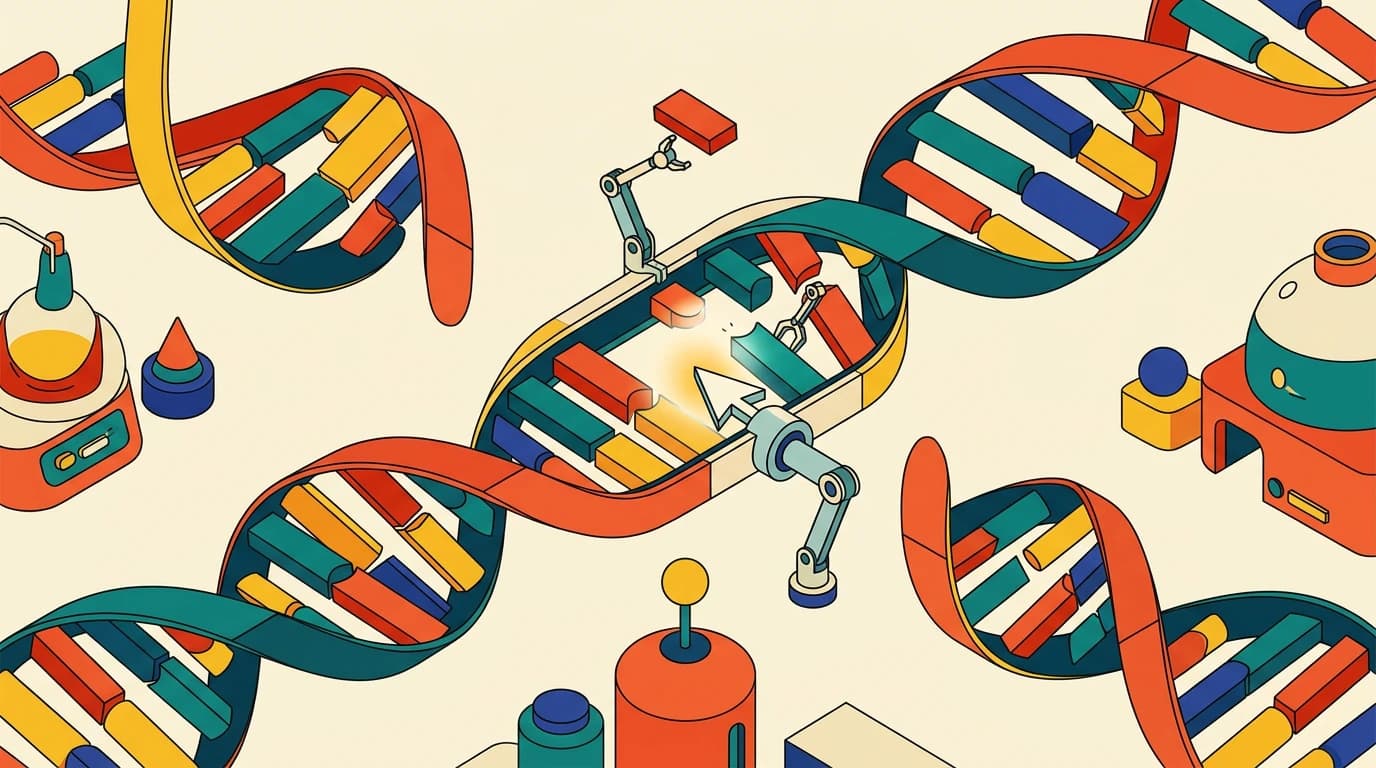
What if fixing a faulty piece of life's code did not mean cutting the ribbon in half?
For years, early forms of CRISPR gene editing acted like blunt scissors. To fix a flaw, proteins like Cas9 had to snip right across both strands of the DNA double helix. When a cell suffers this kind of severe cut, it rushes to patch the wound. This hasty repair often creates indels—unwanted letter skips or small extra pieces dropped into the sequence. These random errors can knock out an essential gene completely.
Beyond the double break
To avoid dangerous snaps, scientists built tools that work like a typed find-and-replace command. These systems guide a protein to a chosen spot on the genome. To bind properly, the protein must spot a short molecular landing strip known as a protospacer adjacent motif, or PAM. Instead of slicing clean through the DNA spiral, modified Cas proteins merely nick a single strand. Meanwhile, attached helper enzymes step in to carry out the targeted rewrite.
One approach uses base editors. These rely on deaminase enzymes to transform one single chemical letter into another without snapping the backbone. For more complex repairs, prime editing acts as a true search-and-replace system. It uses an enzyme called reverse transcriptase to copy fresh instructions straight into the site.
A fine-tuned version called vPE cuts down on indel errors by up to 60-fold. This tool reaches clean edit-to-error ratios as high as 543 to 1. Animal tests show similar precision. Circular RNA packages carrying base editors into mouse mitochondria hit up to 82% success across target sites. They altered 68 out of 70 test spots without touching the main nuclear genome.
Moving large cargo
Changing single letters can cure some conditions, but other therapies require pasting whole genes into a cell. This is where CRISPR-associated transposases, or CASTs, offer a smart answer. These setups pair guide molecules with jumping-gene enzymes called transposases. They lift and place large blocks of DNA into specific sites without snapping the chromosome in two.
Yet nature presented an obstacle. In their original form, Type I-F CAST systems taken from microbes barely function inside human cells. Packed tightly within the spool-like material called chromatin, these wild enzymes simply freeze. To overcome this hurdle, researchers developed an upgraded version named evoCAST. This laboratory-built tool integrates kilobase-sized payloads with 10% to 25% efficiency. That achievement represents a leap of more than 420-fold over the starting wild setup.
What we still do not know
Significant hurdles still stand in the path toward everyday clinical use. Base editors can sometimes trigger letter scrambling or leave behind scars if the cell tries to patch intermediate stages incorrectly. Prime editing also brings unpredictable results, which means lab teams must run tedious tests for every new guide design.
Furthermore, scientists do not fully grasp why original microbial CAST proteins shut down inside human chromatin. It is also unclear whether small enzymes like Cas12h1 or Cas13an can solve delivery hurdles across different living human tissues.
Science words
- Indels
- Random small insertions or deletions of DNA letters that often disrupt normal gene function.
- Protospacer Adjacent Motif (PAM)
- A short, conserved DNA sequence next to the target site that Cas proteins must recognise to bind.
- Base Editor (BE)
- A tool combining a Cas nickase and a deaminase enzyme to convert one single DNA base into another.
- Prime Editing (PE)
- A search-and-replace method using an RNA-guided nickase fused to reverse transcriptase to write new sequence into DNA.
- CRISPR-associated Transposases (CASTs)
- Systems combining Cas proteins with transposase enzymes to insert large DNA fragments without double-strand cuts.
- Chromatin
- The packed structure of DNA wrapped around proteins inside human and animal cells.
Check it yourself
This story is based on a real research paper in MedComm by Ma, Li, Sun. We write with AI help and check it against the paper, but the original is the final word.