How mice switch spatial navigation brain circuits before moving
Brain-wide imaging in mice reveals that distinct, fast-shifting sequences of cortical activity prepare the brain for different search strategies. Frontal brain areas stay active for over a second as animals move from the centre to the perimeter of a maze.
Reading level
The full story with proper science words explained.
Lighting up the route
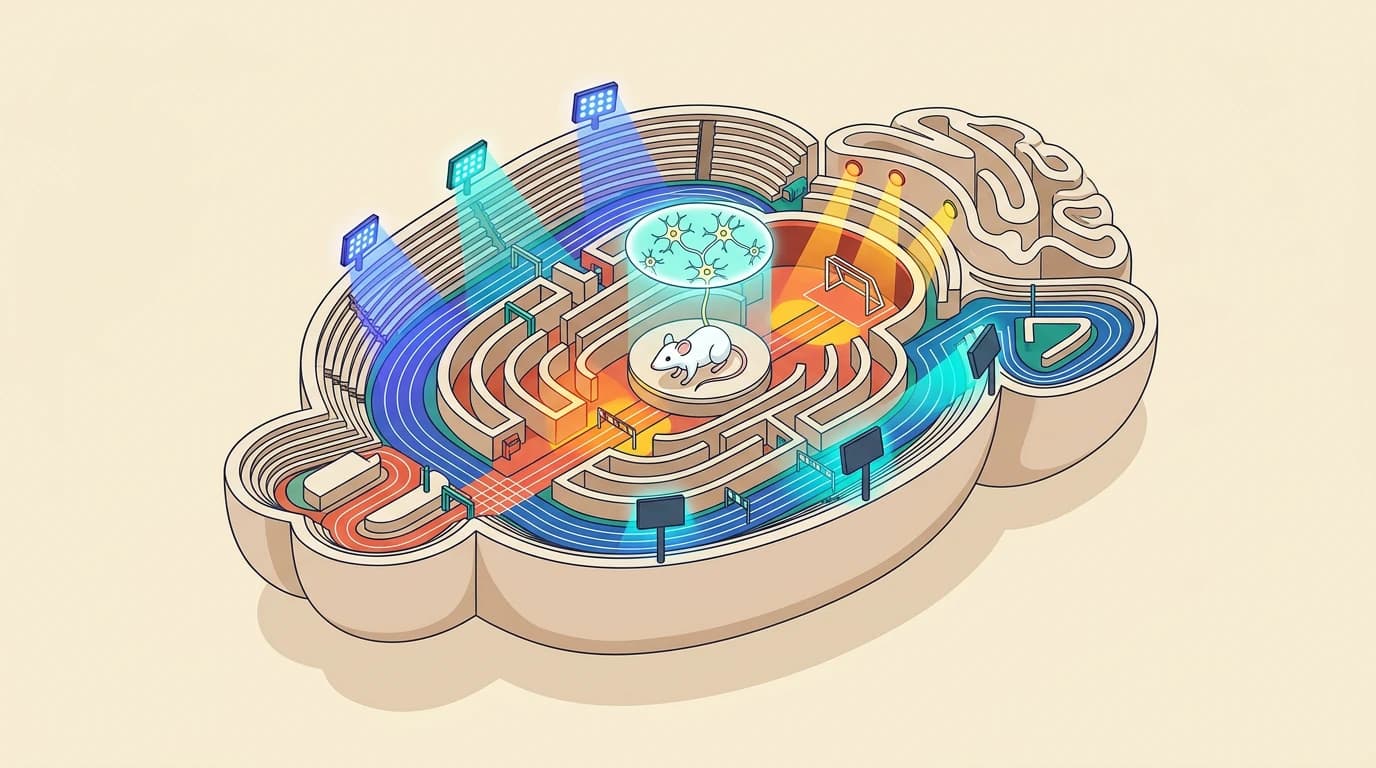
Before a mouse reaches the edge of a maze, its brain reveals how it plans to search. To study spatial navigation brain circuits, scientists placed male mice in the middle of a brightly lit Barnes maze. This round table has escape holes around its rim.
The mice had to choose a path across the open floor. Some took random routes. Others used a serial search strategy, checking holes in order along the rim. Still others used a direct spatial search strategy to reach the exit.
To watch what happened inside the brain, the team placed a tiny microscope onto each animal\'s head. This tool tracked mesoscale calcium dynamics across the dorsal cortex, the upper surface layer of the brain. When brain cells fire, calcium rushes in, making glowing markers light up. This method matters because it lets scientists track large parts of the brain at once in moving mice, rather than checking one cell at a time.
Fast shifts across the surface
The brain did not just turn on like one steady bulb. Instead, bursts of light jumped across its surface in rapid shifts lasting less than a second. Frontal parts showed prolonged signals lasting over one second as mice ran from the centre toward the rim. Yet the order of these flashes changed based on how the animal searched.
When mice ran a step-by-step search, the back of the cortex fired first, followed by signals on one side of the brain. When mice used a direct spatial search, back signals were followed by broad firing on both sides of the brain. An early clue suggested that a specific pattern, named state 3, might be uniquely tied to these direct searches. The cortex set up each path before the goal-directed run began.
What remains unknown
This wide view shows how cortical networks coordinate complex choices during movement. However, the study tested only male mice, so we do not know how patterns look in female mice. Scientists must also confirm the exact job of state 3 and learn how these widespread surface signals interact with deep brain structures like the hippocampus.
Science words
- Barnes maze
- A circular, well-lit platform where animals learn to locate an escape hole among several perimeter openings.
- Serial search strategy
- A navigation approach where an animal systematically checks consecutive locations in order along the maze boundary.
- Spatial search strategy
- A direct navigation method guided by spatial cues to reach a target without checking irrelevant locations.
- Mesoscale calcium dynamics
- An imaging method tracking broad brain activity by detecting brightness changes in fluorescent calcium indicators across wide cortical areas.
- Dorsal cortex
- The upper surface layer of the brain involved in sensory, motor, and cognitive processing.
Check it yourself
This story is based on a real research paper in Journal of Neuroscience by Surinach, Rynes, Saxena et al. We write with AI help and check it against the paper, but the original is the final word.