How Machine Learning in Mineral Exploration Reads the Earth's Hidden DNA
Source PublicationScientific Publication
Primary AuthorsInyangala¹, Waswa¹
"Finding a specific mineral is like trying to find a misprinted word in a library of millions of books. Machine learning acts as an ultra-fast speed reader that scans every single page, spots the weird spelling patterns, and points you straight to the typo."
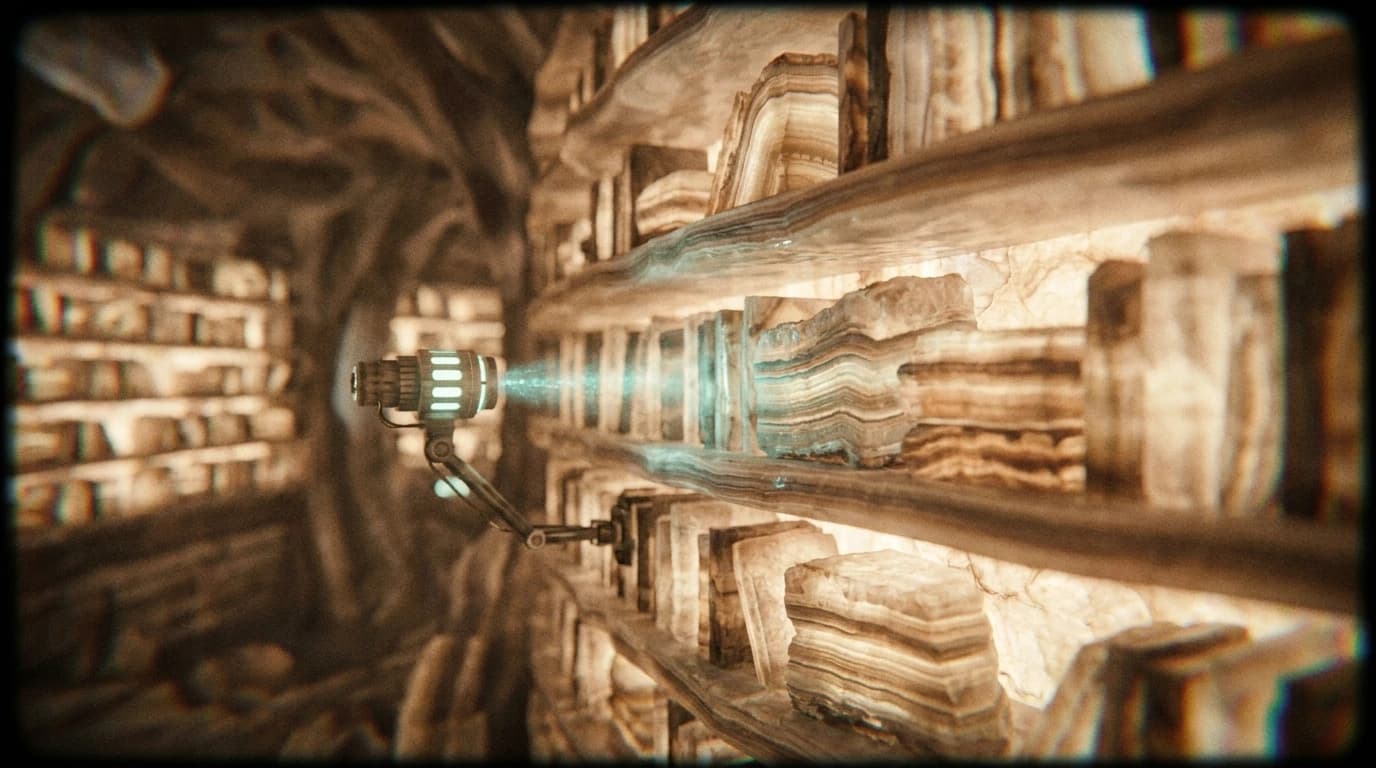
Have you ever wondered if there is a hidden elegance buried within biological chaos? Look closely at the natural world, and you will see that what appears messy is often deeply organised. We can apply this exact logic to the Earth beneath our feet. The crust of our planet is like a massive, messy genetic sequence. Over billions of years, intense heat, pressure, and tectonic shifts have scattered minerals in seemingly random ways.
For centuries, we relied on human intuition, simple tools, and basic maps to find these deposits. But the easy finds are completely gone. The days of stumbling upon a rich vein of copper or gold at the surface are mostly behind us.
The Role of Machine Learning in Mineral Exploration
Today, we are in an era drowning in geological data. Satellites scan the surface in high definition, capturing invisible light spectrums. Sensors measure subtle magnetic fields deep underground. Chemists analyse soil samples from thousands of remote sites. However, human brains simply cannot process all these overlapping maps at once.
This review examines how computer models turn this guessing game into a precise pattern-recognition task. The researchers analysed how tools like neural networks and random forests process high-dimensional data to spot hidden resources.
Let us take a philosophical detour and consider why nature would organise a genome—or a planetary crust—this way. Evolution thrives on messy, overlapping layers of information. In biology, what we once called junk DNA often hides vital regulatory codes that drive adaptation. In geology, seemingly useless rock layers harbour the chemical whispers of valuable ores forged during ancient planetary shifts. Nature does not sort things neatly into boxes. It scatters clues across time and space. Advanced algorithms could be the perfect tool to read this scattered planetary sequence, mapping the deep evolutionary history of the rocks to find exactly what we need.
Reading the Planetary Code
Rather than conducting primary measurements, the review synthesises existing literature on how various algorithms process geochemical anomalies and perform three-dimensional geological modelling. By feeding historical data into these systems, the models learn to spot the subtle signatures of hidden deposits that humans walk right past.
Yet, the researchers note a major challenge: extreme data scarcity. Although current applications are largely confined to specific, well-mapped geological terranes, there are very few known deposits compared to the vastness of empty rock, creating an extreme class imbalance for the computers to solve. They also face issues with generalising findings from one geographical region to another.
Furthermore, the review suggests that future tools must blend raw data with actual physics. We cannot just trust a black box to tell us where to dig. The algorithms must respect the strict laws of geology to provide reliable answers. If scientists get this right, these models may help us locate elusive deposits with far less guesswork, transforming mineral prospectivity from a purely knowledge-driven exercise into a precise, data-driven science.