How lung cancer ctDNA in blood reveals recovery odds
In a phase 2 trial, lung cancer patients whose circulating tumour DNA cleared during early treatment stayed cancer-free significantly longer over 24 months.
Reading level
The full story with proper science words explained.
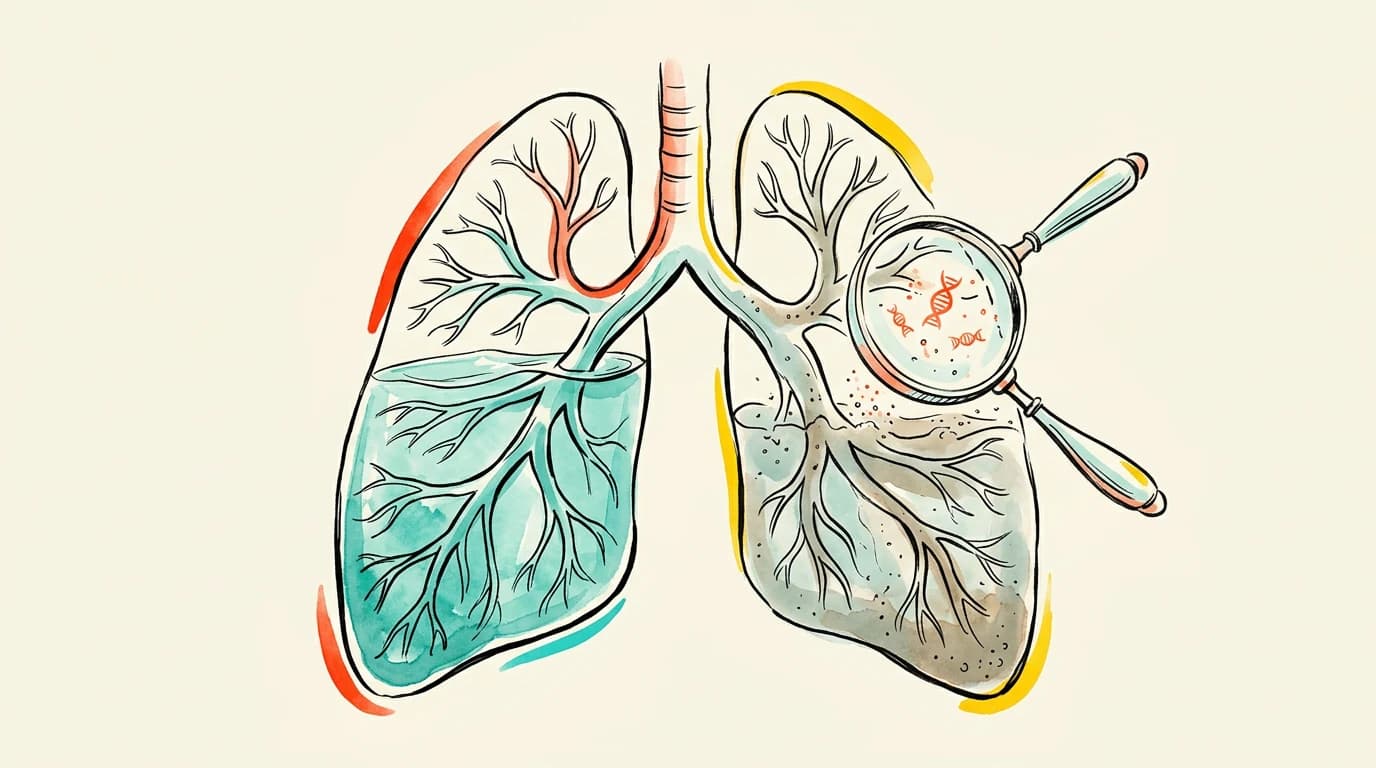
Clues floating in the blood
Even after a tumour is cut out, invisible traces might remain behind. Tumours shed broken genetic material into the bloodstream, known as circulating tumour DNA. Tracking this lung cancer ctDNA gives doctors a way to see whether treatment is actually wiping out the disease before surgery.
Testing for ctDNA is like testing cloudy river water for floating silt after a cleanup. If the water runs clear, the source of dirt upstream has stopped dumping debris.
What the trial measured
Researchers ran the NeoCOAST-2 trial on patients with resectable non-small cell lung cancer, meaning the tumour could be surgically removed. Everyone received standard chemotherapy and durvalumab alongside one of three newer drugs: oleclumab, monalizumab, or datopotamab deruxtecan.
These were given as neoadjuvant therapy, which is treatment administered before an operation. By the start of their third treatment cycle, doctors checked whose blood had completely cleared its tumour DNA. They then watched the patients over 24 months to track event-free survival, measuring how long individuals lived without their cancer returning.
Vanishing signals predict better outcomes
Patients whose ctDNA cleared early had far better odds. Across all groups, clearing these fragments was linked to a 78% reduction in the relative risk of cancer returning or worsening, compared to those whose DNA signals lingered.
Early clearance reached 50.9% with oleclumab, 54.5% with monalizumab, and 72.5% with datopotamab deruxtecan. Furthermore, when tissue analysis showed a pathological complete response—where no live cancer cells remained in the excised tissue—outcomes improved even more. Patients hitting both milestones fared best of all.
What we still do not know
This phase 2 trial does not prove one combination is definitively superior to another. While datopotamab deruxtecan showed the highest clearance rates, these differences are numerical and warrant further testing rather than head-to-head proof. Larger phase 3 studies are needed to confirm these patterns and track overall survival beyond two years.
Science words
- ctDNA
- Circulating tumour DNA; tiny fragments of genetic code shed by cancer cells into the bloodstream.
- Resectable
- Capable of being surgically removed.
- Neoadjuvant
- Therapy given prior to the main treatment, which is typically surgery.
- Event-free survival
- The duration of time after treatment begins during which the cancer does not return or worsen.
- Pathological complete response
- The complete absence of all detectable cancer cells in surgically removed tissue.
Check it yourself
This story is based on a real research paper in Nature by McGrath, Kar, Bonanno et al. We write with AI help and check it against the paper, but the original is the final word.