How loss of smell maps onto changes in the brain's outer layer
Brain scans of 52 people with anosmia and 50 healthy controls show that loss of smell is linked to specific changes in the brain's outer layer, which line up with genes for nerve-cell signalling and plasticity.
Reading level
The full story with proper science words explained.
A missing sense leaves a mark
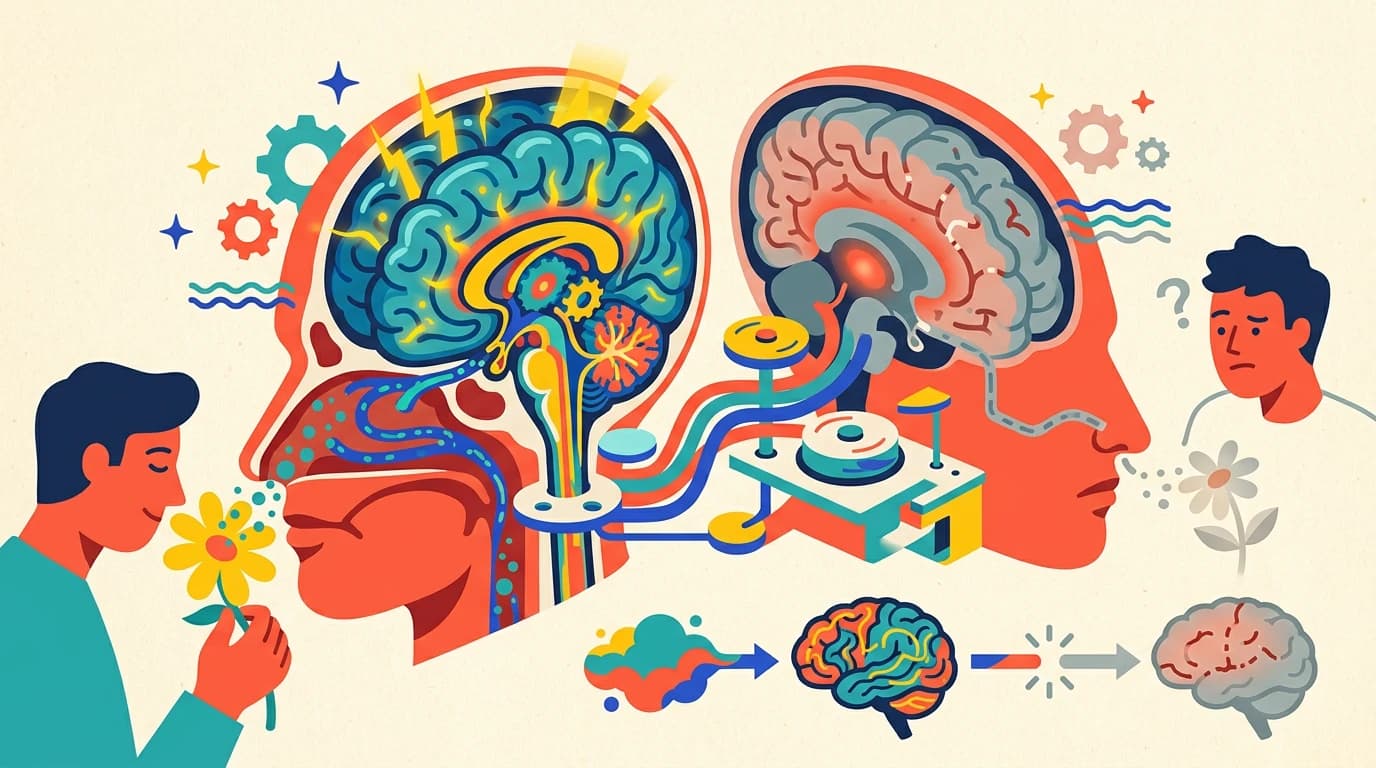
Losing your sense of smell does more than change how you experience the world. A new study shows that anosmia—the loss of smell—is linked to real changes in the brain's outer layer.
The team compared sharp MRI scans from 52 people with anosmia and 50 healthy controls. In two left-side spots, patients had a smaller cortical surface area—the size of the brain's folded outer layer. Yet in other spots, their cortical thickness, or how thick that outer layer is, was greater.
Mapping genes onto brain scans
Next, the team wanted to test if smell loss actually causes these brain shifts. To do this, they used Mendelian randomisation, a method that uses gene variants to test if one trait causes another. Using data from the ENIGMA group, they found 11 brain features linked to anosmia. None passed strict checks across 138 tests, though, so a direct cause-and-effect link is not proven.
Even without proof of cause, the team could still ask which genes sit in those changed spots. They matched the MRI scans against gene maps from the Allen Human Brain Atlas. Think of it like laying a weather map over a hill map to see where storms hit. The changed spots lined up with genes for neuronal plasticity, or how brain circuits adapt their links.
Those genes were most active in GABAergic and glutamatergic neurons. These are two main types of nerve cells that signal using the brain chemicals GABA and glutamate. This points to synapses—the gaps where nerve cells talk—as key to how the brain reacts to smell loss.
What we still don't know
The MRI check looked at just 102 people in total. Also, the gene data came from a reference atlas, not from the people in the study. Larger gene studies are needed to see if any causal links hold up. We also do not know if these brain changes reverse if smell returns.
Science words
- anosmia
- Loss of the sense of smell.
- cortical surface area
- The size of the brain's folded outer layer of grey matter in a given spot.
- cortical thickness
- How thick the brain's outer layer of grey matter is.
- Mendelian randomisation
- A method that uses gene variants to test whether one condition causes another.
- neuronal plasticity
- How neurons and brain circuits adapt their structure and links.
- GABAergic and glutamatergic neurons
- Two main types of nerve cells that signal using the brain chemicals GABA and glutamate.
Check it yourself
This story is based on a real research paper in NeuroImage by Luan, Yang, Xu et al. We write with AI help and check it against the paper, but the original is the final word.