How living cells stop their nuclear doorways from freezing solid
Inside living mammalian cells, transport receptors and tiny sugar molecules stop the nuclear pore barrier from hardening into a solid, preserving a fluid, selective doorway.
Reading level
The full story with proper science words explained.
A door that refuses to jam
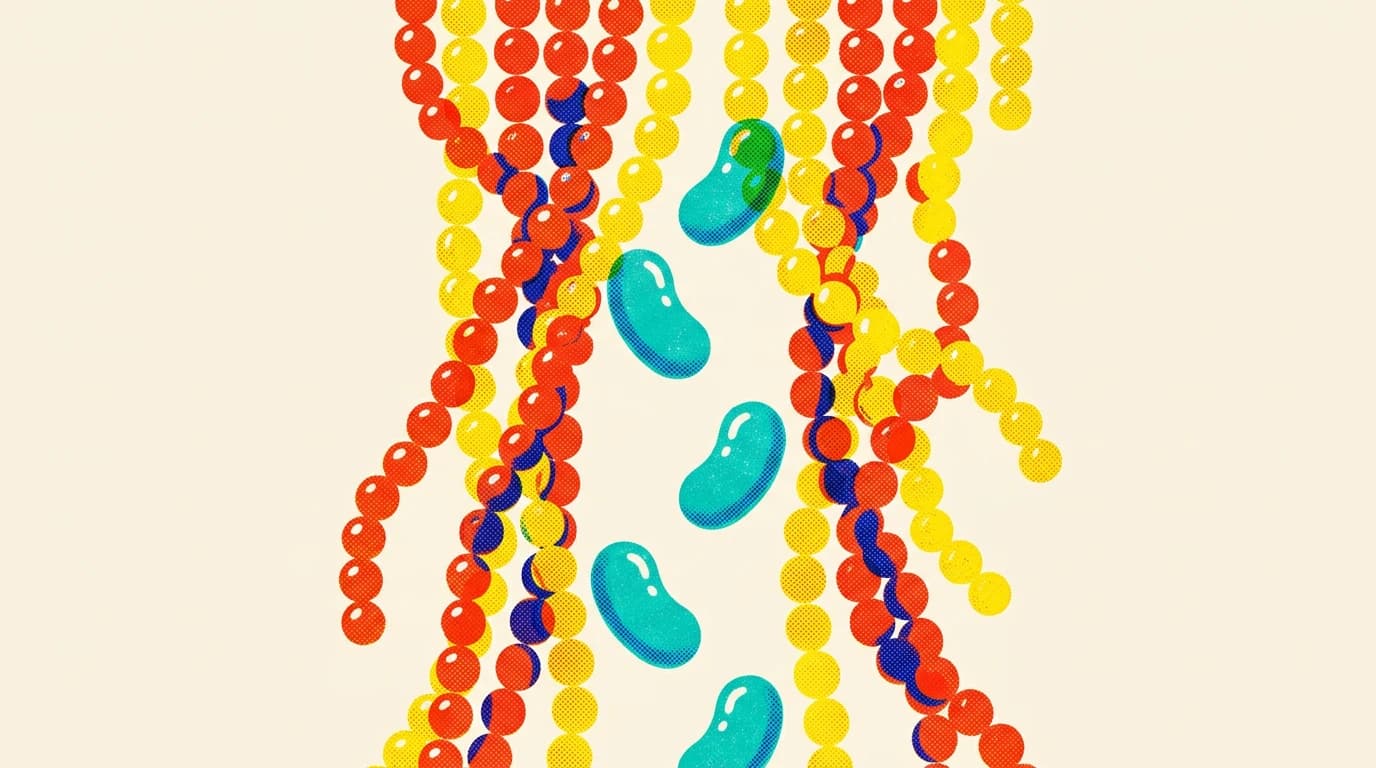
Every cell nucleus is guarded by tiny pores called the nuclear pore complex. Inside each pore sits a soft barrier made of floppy proteins called FG-NUPs. In a test tube, these proteins quickly tangle up and turn into a solid gel. Yet inside living cells, thousands of items pass back and forth every second. Scientists wondered: how do these flexible proteins avoid seizing up in real life?
The natural anti-freeze
To find out, a team looked at glowing tags on FG-NUPs inside living mammalian cells. They used a fast light method called time-resolved fluorescence anisotropy. This tool tracks how fast glowing tags twist around on a nanosecond scale. The method matters because it shows whether parts of a protein are stuck tight or free to move. Rather than freezing stiff, short parts of the protein chains kept up rapid segmental motion. They flowed like a fast-moving liquid.
Computer models and lab tests showed that two helpers stop this freeze. A transport protein called importin-β and a small sugar tag called O-GlcNAc break apart sticky spots where the protein chains touch each other. Without these two helpers, test tube samples slowly lock up into a solid. They fail to copy the liquid state found in a living cell.
Mapping the traffic zones
The scientists also used an ultra-sharp imaging method called MINFLUX. It can pinpoint single molecules with nanometre precision to map where everything sits. The images showed that importin-β gathers around the outer ring of the pore. Meanwhile, long FG-NUP chains reach into the middle. This layout creates an open, fluid path where chosen cargo can slide through while unwanted items stay out.
What we still do not know
This work focused on importin-β and O-GlcNAc tags. We do not know yet whether other transport helpers shape this soft barrier too. It also remains unknown whether stress or human illness can change this fluid state and cause the pores to break down.
Science words
- Nuclear pore complex
- A doorway in the nuclear envelope that controls transport into and out of the cell nucleus.
- FG-NUPs
- Floppy proteins rich in phenylalanine-glycine repeats that act as a gate inside the nuclear pore.
- Time-resolved fluorescence anisotropy
- An optical method that measures how fast glowing tags twist, revealing how flexible a protein is.
- Segmental motion
- The rapid, independent wiggling of small parts along a floppy protein chain.
- Importin-β
- A transport protein that carries cargo through the nuclear pore complex.
- MINFLUX
- A high-resolution microscope technique that maps single molecules down to nanometre precision.
Check it yourself
This story is based on a real research paper in Nature by Yu, Heidari, Palacio-Rodriguez et al. We write with AI help and check it against the paper, but the original is the final word.