How laser colours lock together across a wide quantum web
A computer model shows that bouncing laser combs through a crystal can weave distant colours into a shared, low-noise quantum network.
Reading level
The full story with proper science words explained.
Connecting colours that never touch
What if you could link the quantum traits of green light to heat waves across an empty gap? Normally, varied colours of light pass through one another without reacting at all. A new modelling study suggests that special setups can tie very distinct colours into a single web. These systems are known as quantum frequency combs, which act like rulers of light with evenly spaced teeth.
In standard setups, fragile quantum states form only within one narrow band of colour. The study asks whether a chain reaction of light mixing inside a mirror box could bridge that gap. The goal is locking separate colour bands together into a single bright network.
The hidden helper
To test this idea, researchers modelled strong pump and seed laser combs travelling through a crystal. This crystal sits inside a mirrored box that bounces light back and forth. Inside the crystal, a process called three-wave mixing allows light waves to merge and split. The mixing produces a lower-frequency idler comb in the mid-infrared range, which stays trapped in the box.
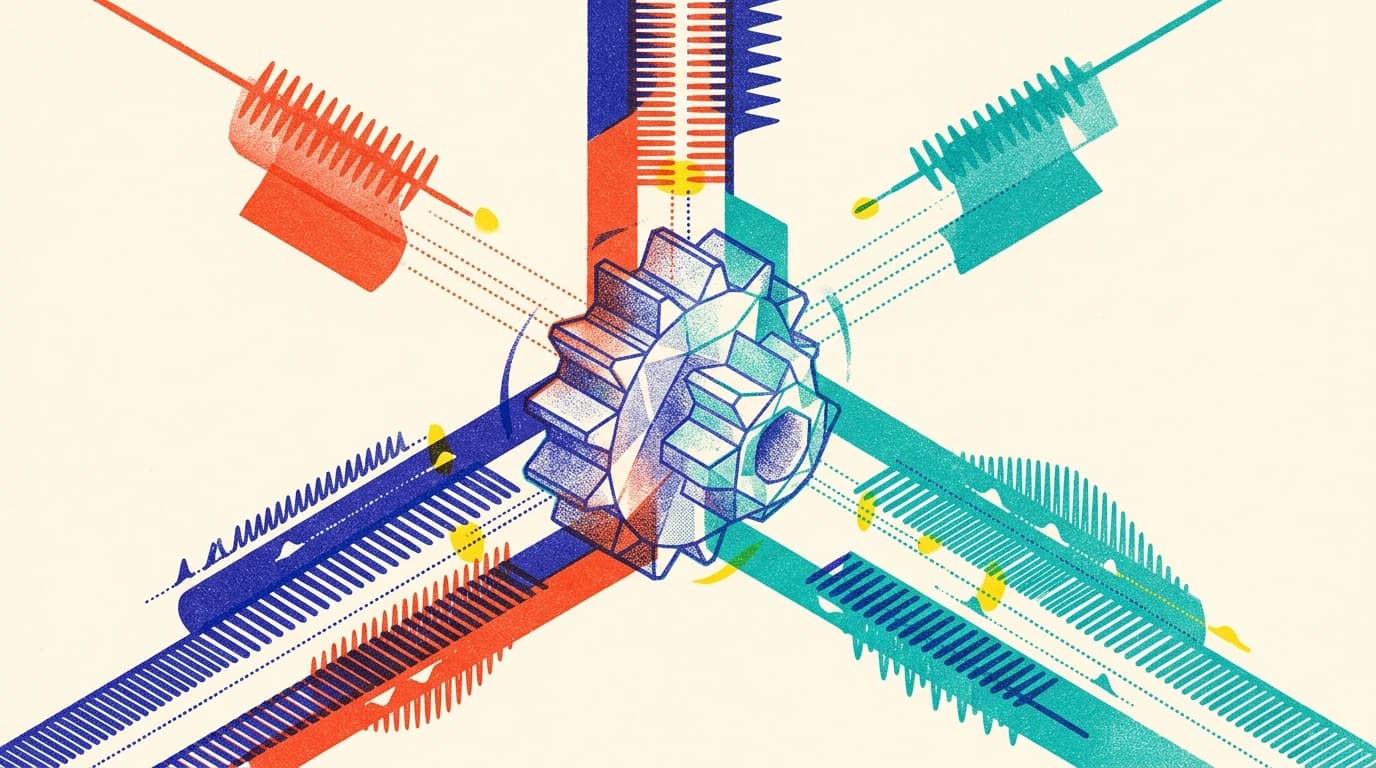
Think of this shared idler comb as a central gearbox driving several conveyor belts. The visible and near-infrared combs never touch each other directly. Yet, every single comb meshes with this central idler. As the idler circles inside the box, it acts as a shared quantum go-between. It links bands separated by hundreds of nanometres or even micrometres.
Carving out quantum quiet
This design matters because it creates bright quantum light across wide spectral gaps instead of dim beams. In a modelled box of five colour bands with five modes each, pairs showed quantum noise levels dropping more than 10 decibels below the shot noise limit. That limit is the random background crackle caused by photons arriving like tiny drops of rain. By shaping light pulses and tuning box losses, the model squeezed noise by 9 decibels between a 4.07-micrometre mid-infrared tone and an optical tone.
The team also showed these networks can form cluster states. These states arewebs of quantum modes connected like dots on a grid. In the model, values called nullifiers fell below the standard vacuum noise baseline for line, star, and ladder patterns across two synthetic frequency dimensions.
What we still do not know
These results come from a computer model based on linear equations, not a working lab device. Pushing nullifier noise below the shot noise limit does not prove genuine multipartite entanglement across every mode at once. That remains an important gap between pencil-and-paper math and real proof.
To spot these quiet states in a real lab, light leaving the box must vastly exceed any natural loss inside the crystal. Imperfections in the crystal structure might also scramble the delicate links. Whether real hardware can reliably copy this modelled quantum web remains an open question.
Science words
- Quantum frequency combs
- Sets of laser beams with sharp, regularly spaced frequencies that share interconnected quantum properties.
- Three-wave mixing
- A process inside optical crystals where two light waves combine to create or amplify a third wave.
- Idler comb
- A secondary comb of evenly spaced light tones generated at the frequency difference between the main pump and seed lasers.
- Shot noise limit
- The fundamental quantum noise floor that arises from the random arrival of individual light particles.
- Cluster state
- A web of entangled quantum modes connected in a specific pattern, like points on a mathematical graph.
- Nullifier
- A combined measurement of light's properties whose noise dips below the vacuum baseline when an entangled cluster state exists.
Check it yourself
This story is based on a real research paper in Light: Science & Applications by Pontula, Banerjee, Soljačić et al. We write with AI help and check it against the paper, but the original is the final word.