How JWST Measured a Colossal Supermassive Black Hole Mass From the Early Universe
Source PublicationScience
Primary AuthorsNewman, Gu, Belli et al.
"It is like discovering a toddler with the shoe size of an NBA player—the proportions are completely unexpected for its stage of development."
Did You Know?
Did you know that some of the universe's biggest monsters were already giants when the cosmos was in its infancy? Astronomers know that galaxies and their central black holes grow together, but measuring this growth in the distant past is incredibly difficult because quiet black holes do not emit bright light.
Calculating a Supermassive Black Hole Mass
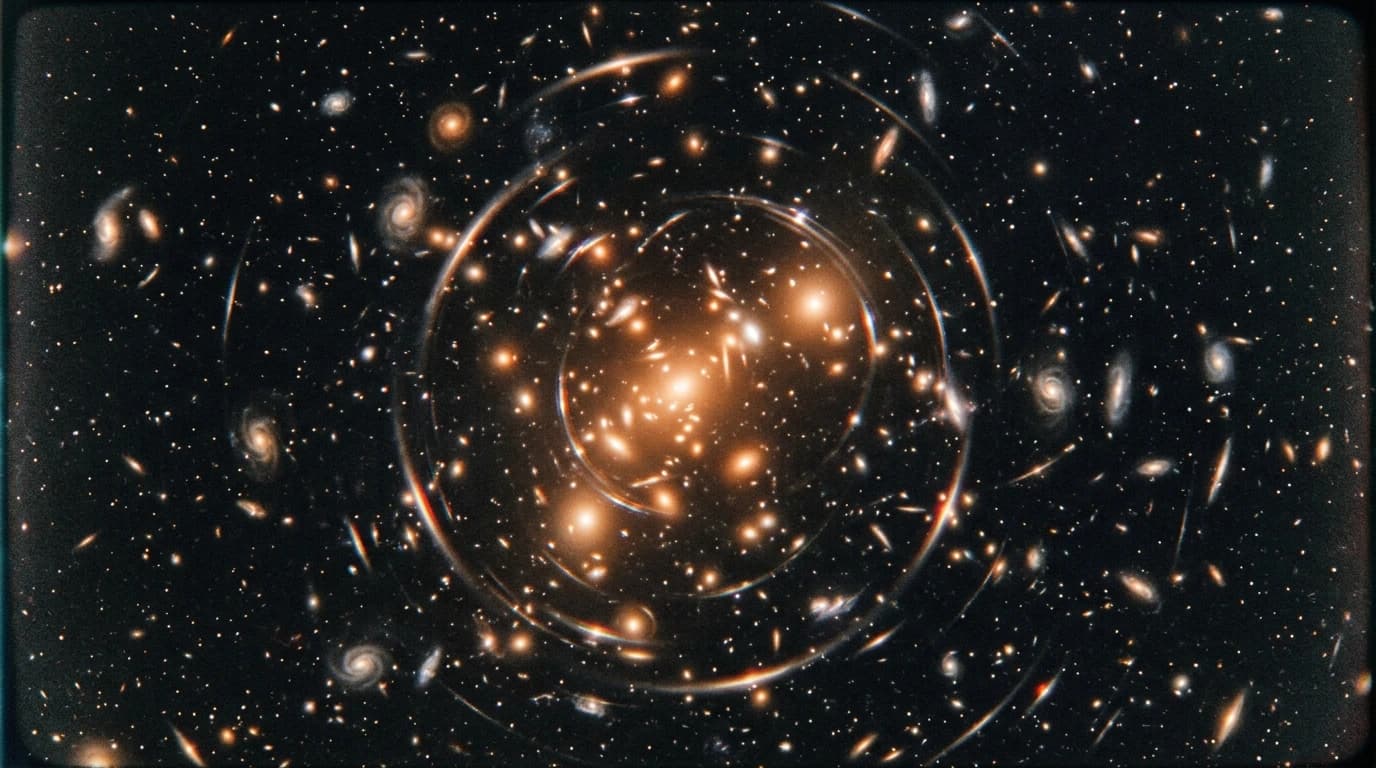
Using the James Webb Space Telescope, researchers analysed a quiet galaxy called MRG-M0138, located 10 billion light-years away. In this specific study of a single lensed galaxy, they utilised gravitational lensing—where a massive foreground object bends light like a giant magnifying glass—to successfully map the movement of stars near the galactic centre. This allowed scientists to resolve stellar motion at an incredible distance to weigh its central black hole.
These stellar speed measurements revealed an exceptionally large supermassive black hole mass that is far heavier than predicted for its host galaxy.
How This Changes Our Cosmic View
This measurement reveals that the black hole is far heavier than expected given the galaxy's total bulge mass. However, the data matches the speed at which the stars orbit. This suggests several key cosmic details:
- Black holes may grow faster than their host galaxies early in cosmic history.
- The relationship between stellar speed and black hole size has remained stable for billions of years.
- We can now measure quiet, inactive black holes at extreme distances.