How jet lag throws bird navigation off course across oceans
Rapid east-west homing flights desynchronise the internal clocks of Manx shearwaters, leading to predictable navigation errors. Even when coastlines are visible, the seabirds continue to rely on their Sun compass.
Reading level
The full story with proper science words explained.
A ticking clock in the sky
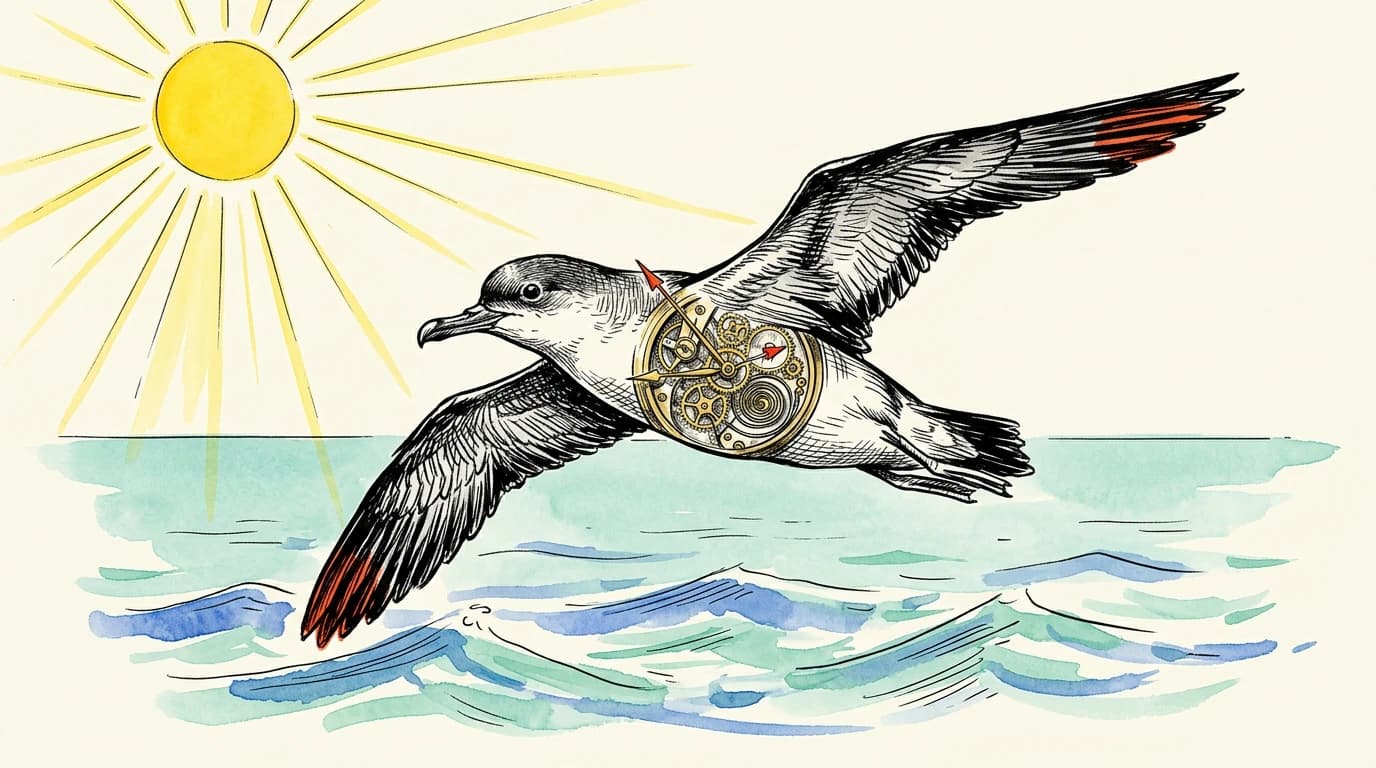
Think about speeding across time zones so fast that your body cannot keep up. For a wild seabird, this quick shift brings a real hazard. In the study of bird navigation, many birds steer by reading the Sun. Because the Sun moves across the open sky all day, a bird needs an internal timer called an endogenous clock to tell true direction.
When time zones shift mid-flight
To see how this system works in the wild, an observational tracking study placed GPS tags on homing Manx shearwaters. These seabirds often make fast longitudinal flights, crossing lines of longitude east or west in short steps. This field method matters because it captures genuine homing trips over open water rather than birds held in test cages.
As birds dart across longitudes, local solar time changes quicker than their body clocks can adapt. This time shift creates a direct gap between the bird's inner clock and the real position of the Sun. As a result, the bird misjudges its heading, making predictable orientation errors along the way.
Sticking to the wrong heading
The birds did not drop this sky-based guide when local landmarks came into view. A key caveat of these findings is that shearwaters do not abandon their Sun compass when alternative landmarks exist. Even when birds followed shorelines offering compass-independent cues, they kept relying on the Sun. They stayed loyal to their inner clock instead of switching to coastline shapes alone. This fixed habit proves that chronobiology, the study of body rhythms, sets hard limits on how well birds steer during long trips.
What we still do not know
These flights were tracked only in a single seabird species during homing journeys. We do not yet know how quickly these birds reset their inner clocks after a rapid trip. It also remains unknown whether fast longitudinal trips disrupt other clock-dependent body processes in wild birds.
Science words
- Sun compass
- A navigation mechanism where an animal determines its travel direction using the position of the Sun.
- endogenous clock
- An organism's internal biological timekeeper that runs independently of external cues.
- longitudinal flights
- Journeys travelling east or west across lines of longitude.
- time shift
- A sudden discrepancy between local environmental time and an organism's internal body clock, akin to jet lag.
- compass-independent cues
- Navigation landmarks or sensory guides, such as physical coastlines, that do not require finding compass headings.
- chronobiology
- The scientific study of biological rhythms and internal clocks in living organisms.
Check it yourself
This story is based on a real research paper in Science by Lewin, Wynn, Morford et al. We write with AI help and check it against the paper, but the original is the final word.