Physics & Astronomy13 April 2026
How Ising-type superconductivity protects gallium trilayers from extreme magnetic fields
Source PublicationNature Materials
Primary AuthorsYi, Liu, Dong et al.
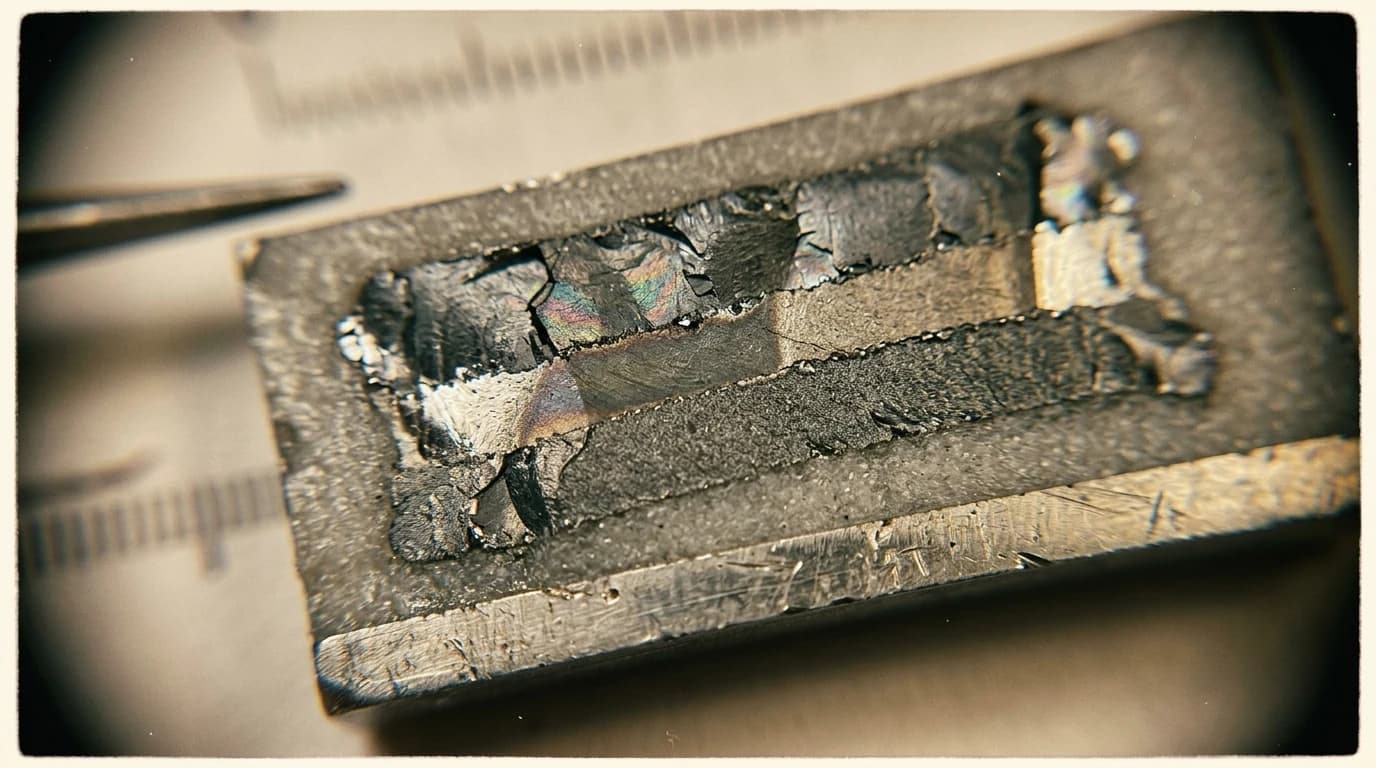
Researchers have engineered a gallium trilayer that maintains Ising-type superconductivity at magnetic fields triple the standard theoretical limit, a feat previously hindered by the tendency of magnetic forces to tear electron pairs apart. Superconductivity typically collapses under intense magnetic fields as electron spins align with the external force, breaking the Cooper pairs required for resistance-free flow. This study bypasses this limitation by pinning electron spins into a rigid vertical orientation, making them nearly immune to horizontal magnetic interference.
The mechanics of Ising-type superconductivity
Using plasma-free confinement epitaxy, the team measured an in-plane upper critical magnetic field of 21.98 T at 400 mK. This performance reaches 3.38 times the Pauli paramagnetic limit, the threshold where magnetic energy usually overcomes the pairing energy of electrons. Angle-resolved photoemission spectroscopy (ARPES) confirms the presence of split Fermi surfaces with distinct spin textures at the K and K' valleys of the gallium layer.Substrate-driven resilience
This high-field stability suggests a direct result of strong orbital hybridisation between the gallium atoms and the 6H-SiC(0001) substrate. This interaction, facilitated by a carbon buffer layer, creates a protected electronic environment that resists magnetic realignment. While the study proves that quantum confinement can induce unconventional pairing wavefunctions, it does not solve the underlying problem of low-temperature requirements for maintaining these states. This synthesis method offers a path toward developing robust quantum components that function in high-field environments.- Gallium trilayers exhibit extreme magnetic field resistance via spin-locking.
- Hybridisation with silicon carbide is the primary driver of spin stability.
- Plasma-free confinement epitaxy enables the creation of high-purity, low-dimensional superconductors.
Cite this Article (Harvard Style)
Yi et al. (2026). 'Orbital-hybridization-induced Ising-type superconductivity in a confined gallium layer.'. Nature Materials. Available at: https://doi.org/10.1038/s41563-026-02573-y