How intermittent fasting slows muscle aging differently in males and females
A study on African turquoise killifish reveals that lifelong intermittent fasting extends lifespan and restores swimming power in both sexes, but it does so through completely different cellular routes.
Reading level
The full story with proper science words explained.
A fast-forward life
A tiny freshwater killifish lives out an entire life in just a few short months. Because this species grows old so swiftly, it gives researchers a rapid look at how muscles weaken over time. Biologists tested these creatures to explore intermittent fasting muscle aging, testing whether planned meal breaks could preserve power in older bodies.
Starting one month after hatching, young fish began a cycle named IF1: two days without food followed by one day of feeding. For comparison, control groups ate ad libitum, meaning they had steady access to meals daily. The meal breaks boosted survival. Median life length jumped by 53.08% in males and 21.18% in females. Yet schedule proved key: a harsher pattern of four days fasting and three days feeding actually shortened life length by 10.3%.
Different routes to the same finish line
To measure motor performance, the team swam the fish against water currents in a flume tunnel. Normal aging slowed the animals down, but lifelong fasting gave them back their speed. Compared to older control fish, fasted males saw their top swim speeds improve by 60.86%, while fasted females gained 41.15%.
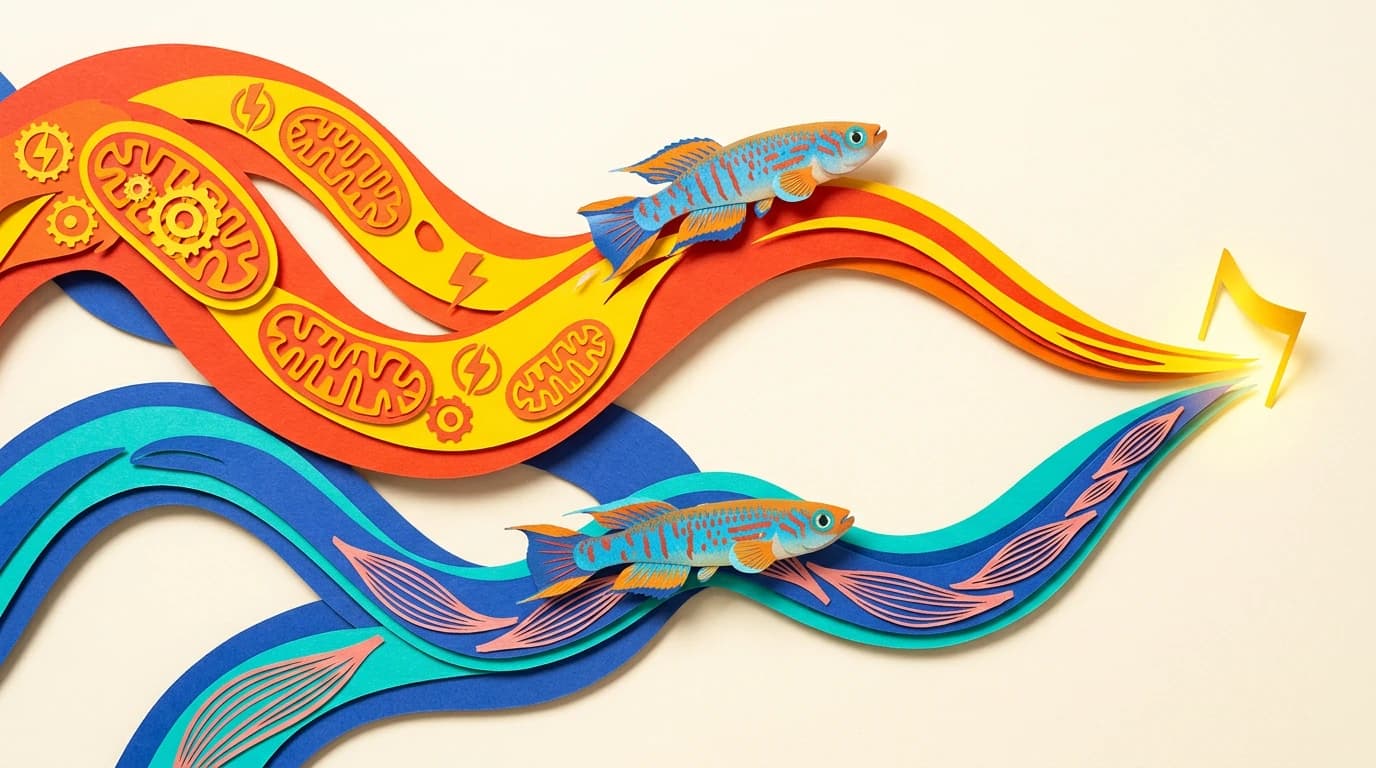
You might expect both sexes repaired their tissues the same way, but they did not. Think of it like two racing drivers taking entirely different country routes to reach the exact same destination. Fasted males and females gained similar swim stamina, but their flesh took distinct cellular journeys.
Male killifish naturally undergo hyperplasia, an increase in tissue size from creating brand-new muscle cells. Fasting curbed this overgrowth in males, keeping their muscle fibres compact. In females, total fibre counts stayed flat throughout life, but fasting preserved their quick fast-twitch muscle fibres, which otherwise vanished with age. Surprisingly, more bulk did not mean more speed: fasting made the fish smaller overall, yet far faster in the water.
Inside the muscle machinery
Using single-nucleus RNA-sequencing, a lab method that reads active genetic instructions inside isolated cell nuclei, the team mapped changes on a microscopic level. Older males showed elevated inflammatory and breakdown signals, which fasting reduced. In total, 1573 genes shifted in fasted males compared to 769 in females.
Notably, the experiment did not track whether fasting lowered overall calories or if the animals ate extra food on feeding days. The routine also demanded a steep biological trade-off. Fasted fish grew over 20% shorter, lost more than half their body weight, and produced far fewer fertile eggs.
What we still do not know
While the swim gains were clear, many questions remain. Stress-response genes like klf9 moved in opposite directions between the sexes, and biologists cannot yet explain why. Living conditions also differed during the experiment, as males lived alone while females lived in groups. Above all, we do not know if these sex-divergent benefits happen in humans or longer-lived mammals.
Science words
- Ad libitum
- A feeding condition where animals have regular, unrestricted access to food every day.
- Hyperplasia
- An increase in tissue size caused by the formation of an increased number of new cells.
- Single-nucleus RNA-sequencing
- A lab technique that reads active genetic instructions from individual isolated cell nuclei.
Check it yourself
This story is based on a real research paper in Aging Cell by Sandhi, Somers, Cox et al. We write with AI help and check it against the paper, but the original is the final word.