How gene edited cattle safely pass down extra muscle across generations
Researchers demonstrated that a precise muscle-boosting gene edit in cattle safely passes to offspring without foreign DNA or harmful health abnormalities.
Reading level
The full story with proper science words explained.
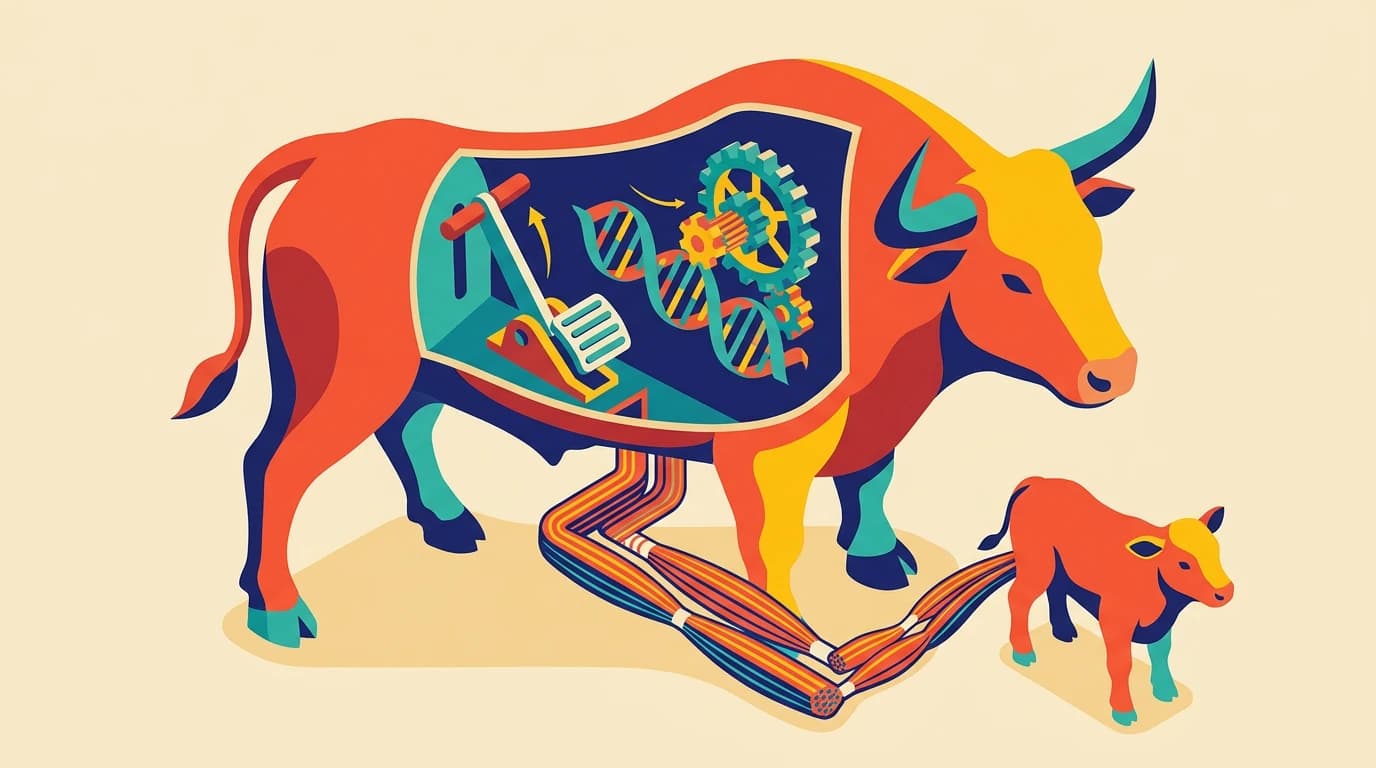
Cutting the brake on growth
What if farmers could raise beefier cattle without adding foreign DNA to farm animals? Cattle carry a natural gene called myostatin, or MSTN, which limits how big their muscles get. It acts like a built-in brake pedal for muscle growth. By gently switching off that single brake, muscle growth can continue without needing any added genes from outside species.
Using CRISPR/Cas9, a tool that makes exact cuts in DNA, researchers modified the MSTN gene in Hanwoo cattle. They delivered the editing components directly into cells as messenger RNA. That step made sure no foreign code got stuck into the genome. The big test was whether these gene edited cattle could pass the change down to their calves safely.
Passing down the modified code
Researchers collected unfertilized eggs from an edited founder cow using ovum pick-up, an ultrasound-guided method to harvest eggs from ovaries. They mixed these eggs in dishes with normal bull sperm to create early-stage embryos called blastocysts. After transferring 11 blastocysts into surrogate mothers, four live calves were born. All four received the maternal edit through germline transmission, which means the altered DNA passed through reproductive cells.
Next, the team tested whether the trait could travel one step further. Semen taken from an edited male offspring was used to fertilise 194 eggs in the lab. That step yielded 36 second-stage embryos. Out of 27 embryos tested, about 63 per cent carried the edit, showing the trait moves reliably down family lines.
Peeking under the biological bonnet
Changing DNA can sometimes shake up other parts of the genome, so researchers checked for unintended side effects. Full genome scans showed that over 99 per cent of observed DNA differences had modifier impacts, meaning they were minor shifts unlikely to harm normal cell work. Only a tiny fraction of high-impact changes appeared, and those sat in non-essential genes.
Muscle proteins told a very similar story. Testing nearly 3,000 proteins in skeletal muscle showed that 89 of the 100 most common proteins were identical between edited and normal cattle. Only about six per cent of all proteins shifted in quantity, mostly those providing structural support around cells. Software tests also confirmed that the altered myostatin protein matches no known human allergens. Annual blood tests over 56 months showed the founder cow stayed in normal health.
What we still don't know
While the results show clear promise, the study had real boundaries. The team only examined two founder cattle and four first-generation calves, which is too small a group for formal statistical tests. Furthermore, one newborn calf died at two days old due to a blocked intestine.
Researchers also do not know yet whether the second-generation embryos will grow into healthy, fertile adult cattle. We also lack data on actual meat yields, tenderness, and commercial performance on real farms. The world population may hit ten billion by 2050, making high-yield animals helpful, but proving their lifelong welfare comes first.
Science words
- Myostatin (MSTN)
- A gene that produces a protein limiting muscle growth in animals.
- CRISPR/Cas9
- A molecular tool used to make precise, targeted cuts in DNA sequences.
- Ovum pick-up (OPU)
- An ultrasound-guided veterinary procedure used to collect eggs directly from a live cow's ovaries.
- Blastocyst
- An early-stage embryo, about seven days old, ready to be transferred to a surrogate mother.
- Germline transmission
- The process by which a genetic trait is passed from parent to offspring through eggs or sperm.
Check it yourself
This story is based on a real research paper in Animal Genetics by Gim, Choi, Yi et al. We write with AI help and check it against the paper, but the original is the final word.