How flexible neural networks spot depression in brain waves
A computer model trained on brain electrical signals identified depression with over 94% accuracy on a benchmark dataset by learning the complex, curved shapes of neural rhythms.
Reading level
The full story with proper science words explained.
Reading the scalp
Diagnosing depression usually depends on spoken interviews, which can vary from one clinic to another. Electrical recordings taken from the scalp offer a more objective clue, but brain activity is chaotic and complex. That poses a tricky challenge for EEG depression diagnosis using standard computers.
Trading straight rulers for curves
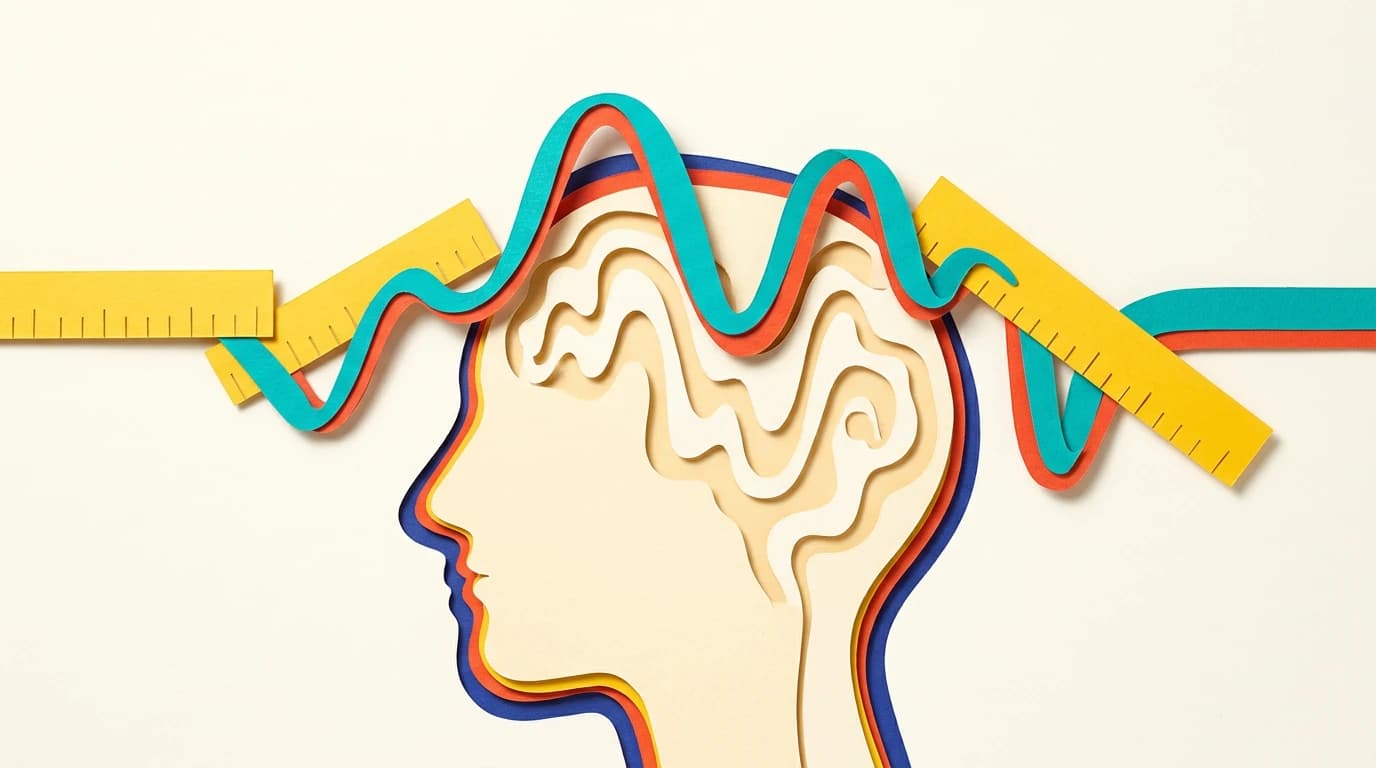
Traditional artificial neural networks process data using rigid, linear steps. They act like a series of straight rulers trying to trace a winding coastline: they miss subtle, bending patterns. To fix this, researchers tested Kolmogorov-Arnold Networks (KANs), a model architecture that places learnable curves directly onto the network connections.
The team analysed frequency-domain features, which convert raw brain waves into distinct electrical rhythms. They fed these rhythms from a benchmark record called the EDRA dataset into two new setups: ConvKAN and ConvKAN Efficient. Both systems replace standard linear layers with specialised KANLinear layers.
What the tests showed
ConvKAN Efficient used dynamic grid updating, careful weight initialisation, and mathematical rules called regularisation to keep calculations manageable. The approach outperformed conventional convolutional networks and older machine learning methods. In tests on the EDRA dataset, ConvKAN Efficient achieved an accuracy, precision, recall, and F1-score all exceeding 94%.
The study evaluates how well an algorithm sorts data on a test set, rather than demonstrating real-world clinical diagnostic implementation in a hospital. Even so, it shows that computer models can reliably track complex brain dynamics without slowing down.
What we still don't know
The network proved itself only on the EDRA dataset. We do not yet know how it copes with larger, more diverse groups of patients or distinct subtypes of depression. The team also evaluated signals broken down into frequencies, leaving open the question of how the architecture handles raw electrical readings over time.
Science words
- Electroencephalogram (EEG)
- A recording of electrical brain activity captured via sensors placed on the scalp.
- Kolmogorov-Arnold Networks (KANs)
- Neural networks that use flexible, learnable functions along their connections to capture complex nonlinear patterns.
- ConvKAN
- A convolutional network architecture built with Kolmogorov-Arnold Network layers.
- Frequency-domain features
- Brain wave data converted into frequency bands, such as rhythmic electrical cycles, rather than tracked over time.
- F1-score
- A score that balances how many identified cases were correct against how many total cases were spotted.
Check it yourself
This story is based on a real research paper in JMIR AI by Yang, Fan, Wei et al. We write with AI help and check it against the paper, but the original is the final word.