How Earth's Magnetic Shield Blocks Galactic Cosmic Rays Near the Moon
Source PublicationScience Advances
Primary AuthorsShang, Liu, Xu et al.
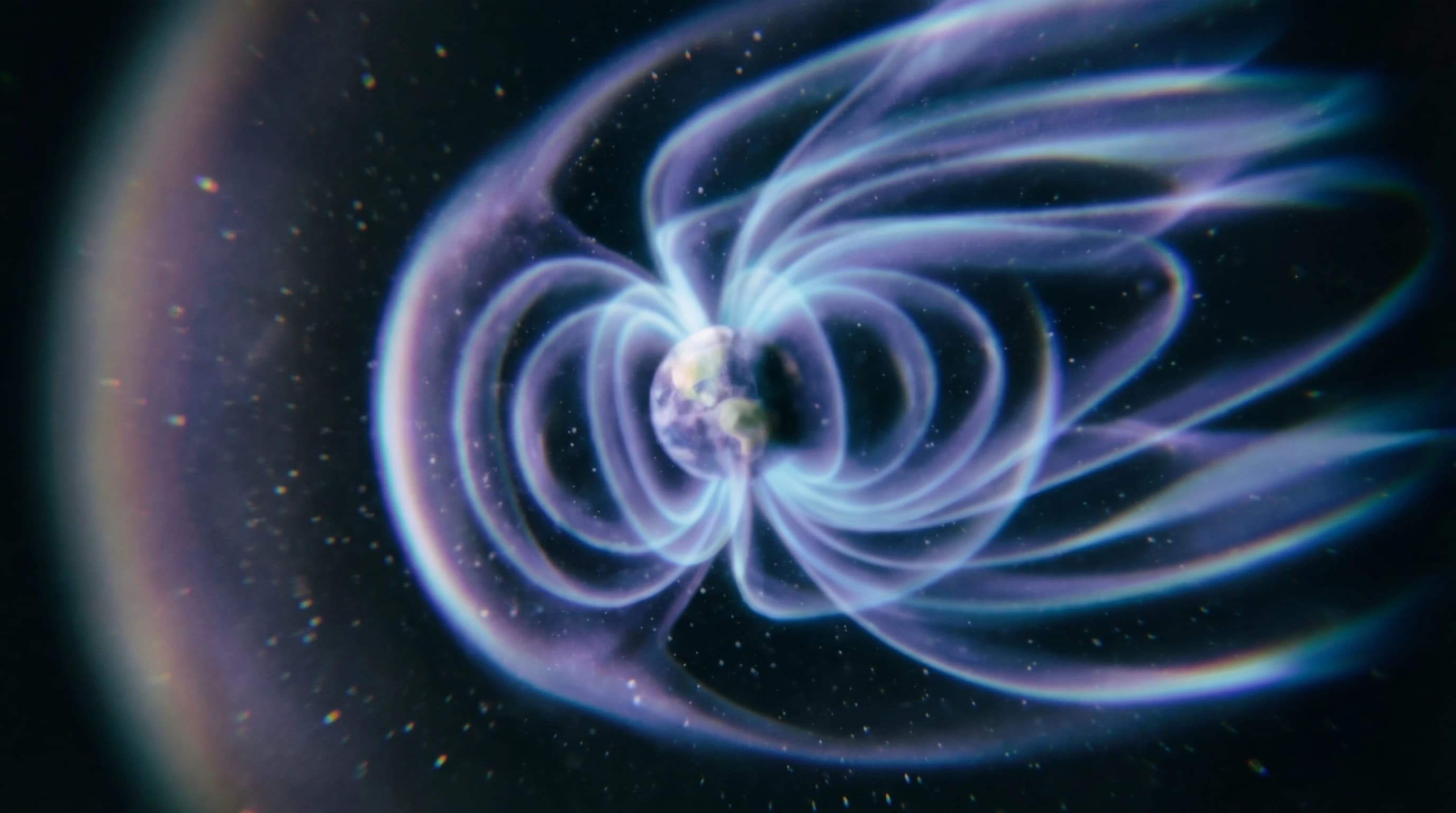
Imagine Earth is a massive boulder sitting in the middle of a rushing, violent river. The water crashing against the rock splits, leaving a calm, quiet eddy swirling just behind it.
In space, that river is a constant flood of hazardous radiation. The boulder is our planet's magnetic field.
Until recently, scientists assumed the space between Earth and the Moon was entirely flooded by this dangerous radiation, known as galactic cosmic rays. But new data suggests our planet casts a massive, invisible shadow that offers a surprising pocket of safety.
The Danger of Galactic Cosmic Rays
Space is an incredibly hostile environment. Astronauts leaving low Earth orbit face a constant barrage of high-energy particles raining down from deep space.
These galactic cosmic rays are an ever-present hazard in the vacuum of space, posing a persistent, high-level radiation risk to long-term lunar missions.
Navigating this invisible threat is a major challenge for space agencies. Finding a natural safe zone could make lunar exploration significantly safer, offering a built-in refuge from the worst of the cosmic weather.
Mapping the Magnetic Shadow
Researchers analysed data from the LND (Lunar Lander Neutron and Dosimetry) experiment onboard China's Chang'E-4 lander. They precisely measured radiation levels as the Moon completed its orbit around Earth.
They found a distinct drop in radiation in the 'prenoon sector' of the lunar orbit. For context, this is a specific region of space that the Moon passes through just before it aligns with the sunward side of Earth. This suggests Earth's magnetic field acts as a giant obstacle to the incoming radiation.
The field creates an energetic particle cavity where radiation levels are notably reduced. This cavity indicates that Earth's magnetic influence stretches much further into the solar system than anyone expected, reaching well beyond the Moon.
A Natural Safe Harbour for Astronauts
This observation suggests we could use Earth's magnetic tail to our advantage. Mission planners might time lunar landings or spacewalks to coincide with the Moon passing through this quiet eddy.
Future deep-space missions could also fly through this zone to minimise early radiation exposure. While these insights are currently based on specific measurements from the Chang'E-4 lander's instruments, planning around this natural shield means space agencies could:
- Avoid the highest radiation levels during critical phases of lunar exploration.
- Lower the overall radiation exposure for astronauts on extended lunar missions.
- Plot safer trajectories for vehicles heading out into deeper space.
It turns out our planet is still protecting us, even when we are hundreds of thousands of miles away. As we prepare to return to the Moon, this invisible shield might just be our greatest asset.