How deep churning inside Earth could explain a missing rock gap
Digital simulations reveal that rising heat currents deep in Earth's mantle pushed land up to erode and then pulled it down, preserving the Great Unconformity.
Reading level
The full story with proper science words explained.
A missing chapter in stone
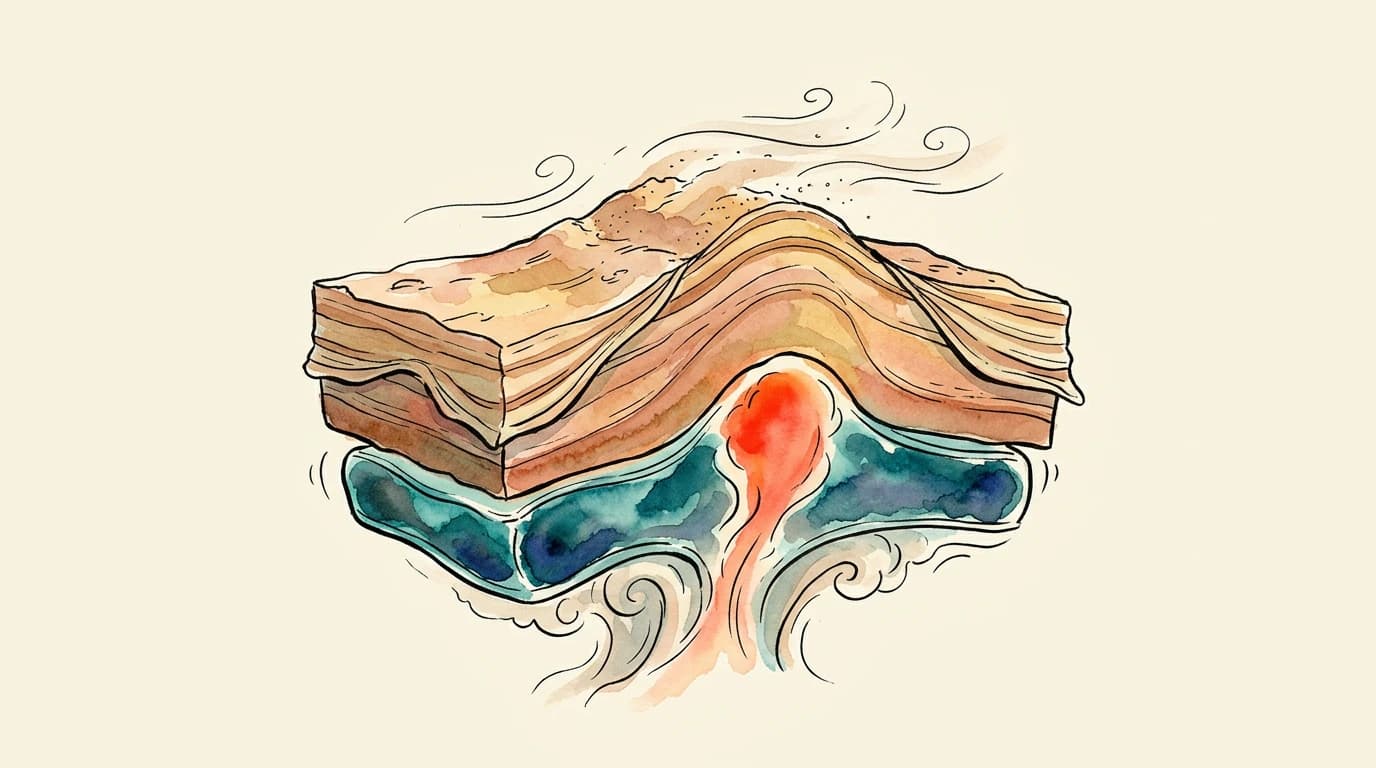
At the base of the Grand Canyon, hundreds of millions of years of rock are missing. Young stone beds sit flat on top of much older crust. Earth experts call this missing time gap an unconformity, a place where older rock wore away before new layers settled. This planetary break is the Great Unconformity. It marks an erosional pause of 200 million years or more. For a long time, experts wondered what scraped away so much crust worldwide.
The mantle's slow elevator
A study team tested this puzzle using 3D simulations of Earth's interior over the past billion years. Using a program called CitcomS, they tracked how churning heat below pushed the crust up and down. This vertical motion, steered by flow deeper than 350 kilometres, is called dynamic topography.
The digital run showed a clear global pattern. Between 800 and 600 million years ago, hot rock rising in the deep interior hoisted land masses upward. This long lift raised ancient crust in Laurentia, Baltica, and North China. It shoved these high tracts into the path of wind, rain, and ice. Then, from 600 to 420 million years ago, the deep flow flipped. Sinking mantle currents pulled these same land tracts downward. This drop let rising seas drown the land and drop thick sand and mud, burying the eroded surfaces.
Why location mattered
This single up-and-down cycle helped shape and protect the gap. Where land felt only one cycle, the old boundary stayed safe under new stone. But other tracts, like South America and Australia, went through two cycles of rising and sinking. That extra churning ground away earlier layers, which explains why the gap is missing or faint there today. Africa saw its own path, dropping down for a long span before rising and sinking once more.
As these land blocks sank, the volume of preserved sediments per year more than doubled across the globe. This rush of debris points to massive denudation, the total stripping away of surface rock. Yet the models reveal a key limit. The gentle tilts caused by deep mantle lift could not give rivers enough energy to strip away so much rock alone. Instead, uplift had to work alongside huge ice sheets to grind away the land.
What we still do not know
These simulations track broad trends, but large questions remain. Mapping ancient tectonic plates back toward a billion years ago involves wide margins of error. These uncertainties could alter how simulated currents flowed in the code. Because the model leaves out forces shallower than 350 kilometres, it also overpredicts lift height by about double. In addition, experts still do not know the exact quantitative way this pulse of washed-away rock altered ocean chemistry or helped trigger the sudden rise of early animal life.
Science words
- Unconformity
- A surface representing a missing time gap in the geological rock record where younger rock layers sit directly upon much older eroded rocks.
- Great Unconformity
- The largest known global geological gap, representing a hiatus of 200 million years or more between ancient crystalline rocks and Cambrian sediments.
- Dynamic topography
- Large-scale vertical rising (uplift) or sinking (subsidence) of Earth's crust caused by the upward or downward churning of the underlying mantle.
- Denudation
- The long-term wearing away and stripping of Earth's surface rocks by weathering and erosion.
Check it yourself
This story is based on a real research paper in Nature by Dhungana, Flament. We write with AI help and check it against the paper, but the original is the final word.