How coral symbiosis shifts between orderly adaptation and pure chaos
A long-term study shows that coral partnerships with internal algae adapt predictably under moderate ocean heat, but veer into random divergence under extreme conditions.
Reading level
The full story with proper science words explained.
Partners under pressure
Coral reefs support a quarter of marine life and nearly a billion people. Their secret is coral symbiosis, a mutually beneficial partnership between corals and microscopic algae living inside them. As oceans warm, these internal algal partners, called symbionts, face immense pressure. Do corals pick tougher partners to survive, or do their fragile groups simply drift apart by chance?
Simulating future seas
To find out, scientists ran a study lasting 2.5 years. They gathered clone pieces of single corals across eight species that cover major coral family trees. These pieces lived in a mesocosm, an outdoor test enclosure built to mimic future ocean water. The team used a factorial setup, testing multiple factor mixes at the same time.
By tracking clone fragments from the same parent, the team could watch how algae changed over time. This method matters because identical fragments share the same genes. Any contrast between them reveals whether their algae change predictably or purely by luck.
Adaptation versus chaos
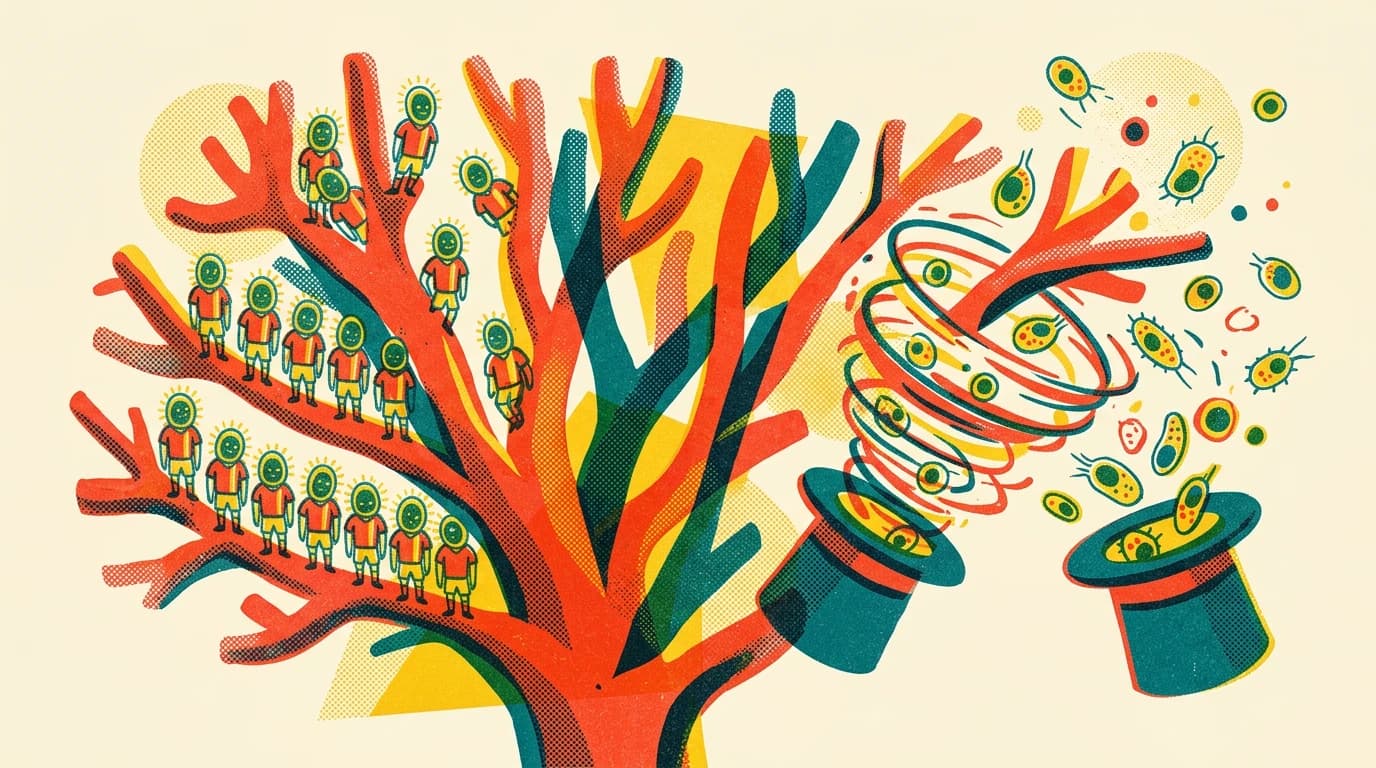
The outcomes fell along a spectrum rather than a single rule. Under moderate heat stress, corals displayed deterministic shifts. This means their changes were orderly, predictable, and driven by clear rules. Symbiont diversity shrank, reorganising into tougher groups suited for warmer water. It was like a football coach choosing a defensive lineup to face a tough rival.
Yet under extreme heat, this orderly response broke down. Corals experienced stochastic divergence, meaning their changes became random and unpredictable. Clone fragments from the same parent took on completely erratic mixes of algae. Instead of picking winners, it was like names were being drawn from a hat. The team does not claim all corals act the same. Instead, responses fall along a scale between order and breakdown.
What we still do not know
Because this test took place inside a simulated enclosure, open-ocean conditions might add unexpected complications. Scientists do not yet know the exact heat thresholds that divide orderly adaptation from random collapse across wild species.
Science words
- Symbiosis
- A close relationship between two different living organisms that benefits both sides.
- Symbiont
- An organism living in a mutual partnership inside another host, such as algae inside coral.
- Mesocosm
- A controlled outdoor or lab enclosure that mimics natural environmental conditions.
- Deterministic
- Predictable and driven by specific rules or pressures rather than chance.
- Stochastic
- Random or unpredictable in nature.
- Factorial setup
- A test design that studies two or more factors together across different combinations.
Check it yourself
This story is based on a real research paper in Science Advances by de Souza, Bruce, Cros et al. We write with AI help and check it against the paper, but the original is the final word.