How City Planning for Microbes Could Fix Solid-state Fermentation
Source Publicationnpj Science of Food
Primary AuthorsMüller, Zermatten, Germerdonk et al.
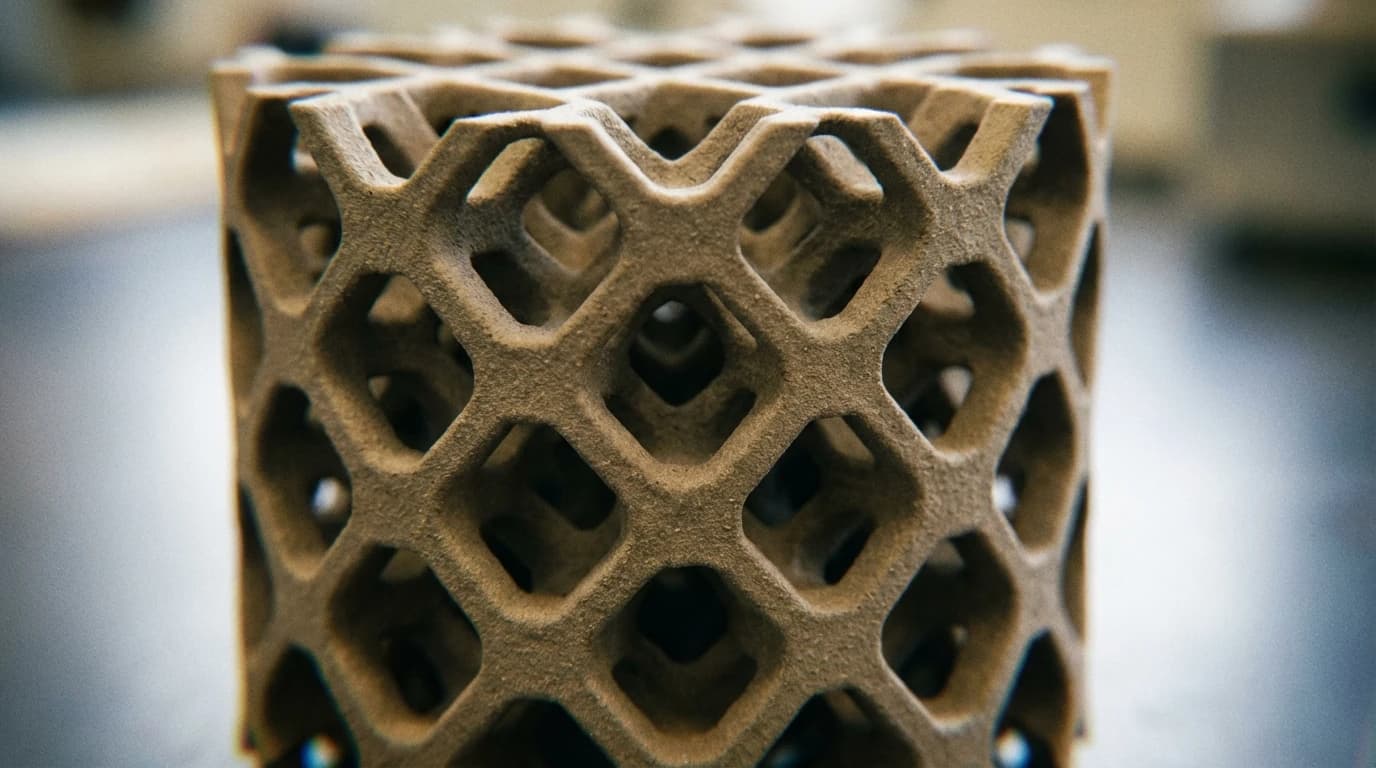
The Hook: Building a Metropolis for Microbes
Imagine you are an urban planner tasked with housing a billion hungry fungi. If you dump them onto a giant, chaotic pile of raw materials, it is like dropping a population into a dense jungle without roads.
Only the microbes on the outside thrive, while the centre starves. This uneven growth has been a major hurdle for solid-state fermentation.
The Context: The Flaws in Traditional Solid-state Fermentation
Food scientists use fungi to ferment solid materials to improve the nutritional quality of plant-based foods.
Historically, producers have simply accepted whatever shape and texture the raw plant material happens to possess. They rely entirely on the inherited, natural properties of the grains or beans.
Because of this passive approach, the fungi cannot always penetrate deeply. The process becomes highly inefficient, as the bioconversion is patchy rather than spatially uniform.
The Discovery: Rethinking the Food Architecture
A recent scientific perspective suggests a different method for feeding these microbes. Instead of treating the plant material as a passive pile of food, researchers propose reframing the substrate as an active, engineered component.
The authors outline how redesigning the physical structure of the food allows us to control how the fungi behave. They focus on integrating three main principles into the substrate design:
- Biochemical principles
- Mechanical principles
- Architectural principles
By integrating these specific design principles, the authors note that we can engineer substrates that promote volumetric and spatially uniform bioconversion. This means the fungi grow evenly throughout the entire three-dimensional space.
The Impact: A Blueprint for Plant-Based Foods
This shift in thinking could drastically improve how we manufacture sustainable, plant-based foods. While currently a conceptual perspective, when fungi can grow evenly through a structured material, the resulting food may offer superior nutritional quality.
This framework suggests that future plant-based foods could be grown uniformly. It removes the bottlenecks of relying on raw, unstructured materials.
By actively designing the environment, we do more than just feed the fungi. We build them the perfect city, ensuring every single microbe can do its job.