How Castor Oil Can Become Biodegradable Plastic in a Single Flask
Chemists have shown a way to convert plant-derived fatty acids into water-repellent, biodegradable plastics at just 40 °C using two catalysts in one vessel.
Reading level
The full story with proper science words explained.
Building chains without the blistering heat
Imagine trying to assemble a plastic model kit using boiling tar instead of normal glue. Traditional plastics called polyanhydrides usually require harsh activating agents and searing temperatures above 180 °C. At those blistering conditions, sensitive chemical components burn or break down, creating messy mixtures of uneven chains.
A team of chemists tried a gentler route. They set out to build a renewable polyanhydride synthesis starting directly from castor oil. Their goal was a smooth, mild reaction that works inside a single reaction vessel.
Two catalysts working in sequence
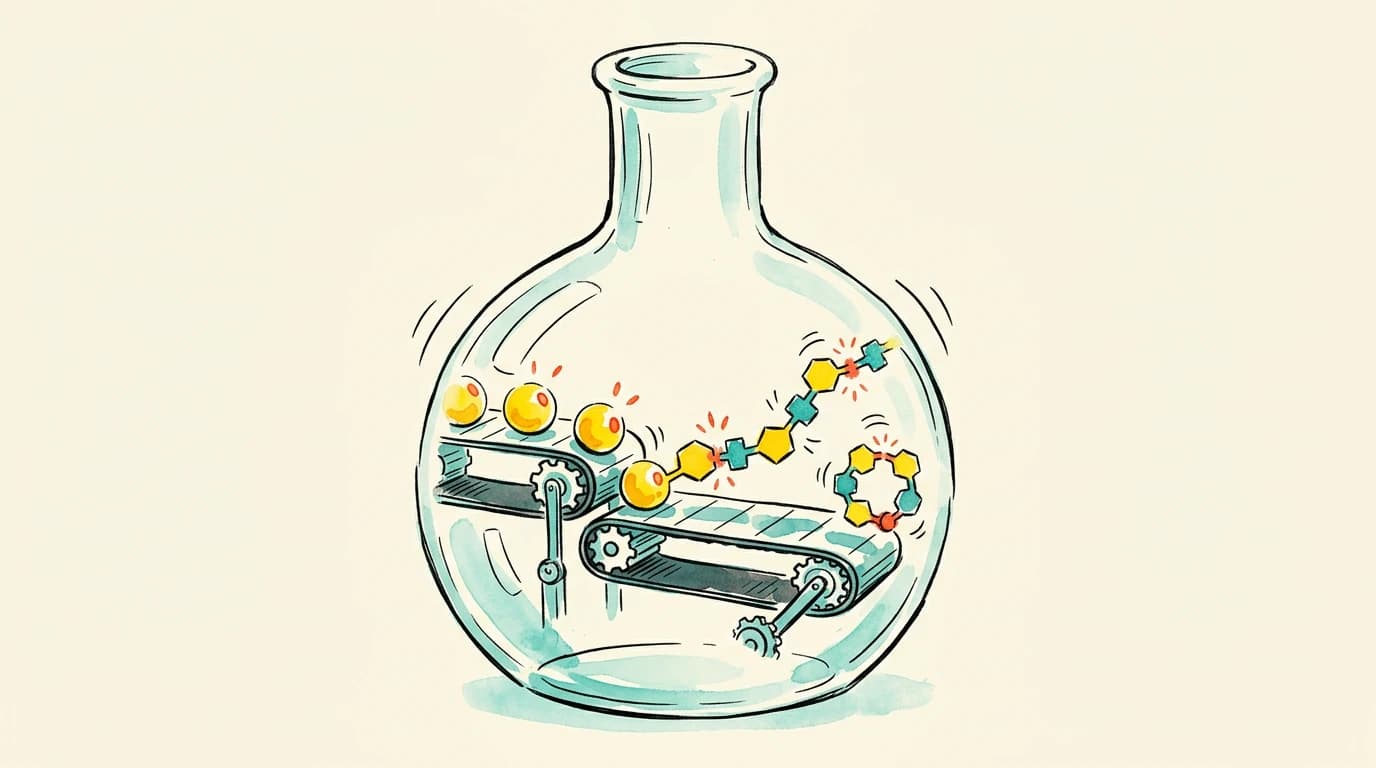
The starting ingredient is 10-undecenoic acid, a fatty acid derived from castor beans. To turn small molecules into a long-chain plastic, the researchers used tandem catalysis, where two different catalysts carry out sequential chemical steps in the same pot.
First, a ruthenium catalyst performs olefin metathesis. It snaps the carbon double bonds on two fatty acid pieces, stitches them together into a longer diacid, and releases harmless ethylene gas. An acetic acid additive stops the double bonds from shifting position. Without this control, unwanted monoacid impurities would ruin the chain growth.
Next, without stopping to purify the mixture, the researchers added a magnesium catalyst and a coupling agent called dimethyl dicarbonate. At a gentle 40 °C, the magnesium catalyst drives step-growth polymerisation. The diacid units snap together end-to-end like linkable plastic tracks, forming long polyanhydride chains while releasing carbon dioxide and methanol.
Water-repelling films from plants
The resulting polymer is semicrystalline and melts at roughly 57 °C. Most biodegradable plastics soak up water like a kitchen sponge, but this material behaves differently.
Instead, drops of water bead up tightly on its surface. When tested, its water contact angle reached up to 99.9°, demonstrating hydrophobicity comparable to petroleum-based polyolefins. Because water cannot easily soak inside, polyanhydrides break down through surface erosion, peeling away predictably layer by layer like a bar of soap. That behaviour makes them valuable for medicine, where capsules must release drugs at a steady rate.
What we still do not know
This laboratory trial is a mild, step-efficient proof of concept. Scaling it up will require reducing reagent consumption, recovering materials, or finding cheaper catalytic alternatives. The coupling agent had to be added in a 1.25-fold excess, which adds waste. In addition, when the team attempted to reuse the ruthenium catalyst on a solid support, it lost activity and allowed bonds to shift.
Chemists also do not yet know the exact crystal packing structure of the solid plastic. They have yet to confirm whether small ring-shaped loops form alongside the long chains during the reaction. Even so, running both steps smoothly below 40 °C shows that plant oils can yield high-grade polymers without extreme heat.
Science words
- Polyanhydride
- A biodegradable polymer containing anhydride chemical bonds that slowly break down from the outside inward.
- Tandem catalysis
- A process where two or more distinct catalytic reactions run one after another in the same reaction vessel.
- Olefin metathesis
- A chemical reaction that redistributes carbon-carbon double bonds to assemble new hydrocarbon structures.
- Step-growth polymerisation
- A reaction where monomers link step by step into pairs, triplets, and eventually long polymer chains.
- Contact angle
- The angle formed by a liquid droplet on a solid surface, where values above 90° reveal a water-repelling surface.
- Surface erosion
- A breakdown process where a material dissolves steadily from its outer boundary rather than all through its interior.
Check it yourself
This story is based on a real research paper in ChemSusChem by Fournier, Bekmirzaev, Simon et al. We write with AI help and check it against the paper, but the original is the final word.