How baking suspended micro-prints shrinks 3D photonic crystals into visible colours
By printing tiny diamond lattices on sacrificial pedestals and carefully baking them in two steps, researchers shrunk microscopic structures by 73 percent without warping, allowing them to reflect visible light.
Reading level
The full story with proper science words explained.
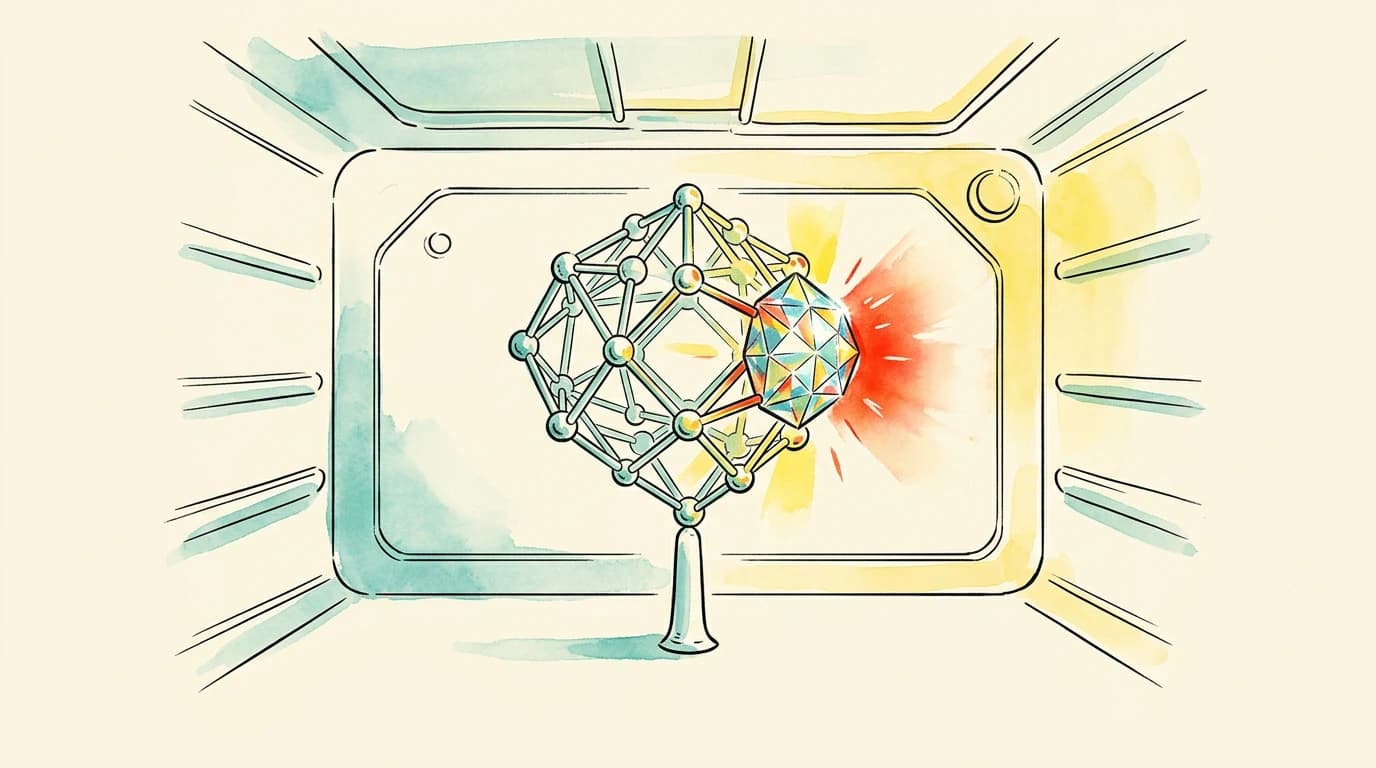
What if you could 3D print a tiny object, bake it in an oven, and watch it turn into a jewel glowing with colour? Guiding light in all dimensions needs tiny repeating patterns. To steer light waves, the grid inside a crystal must be smaller than the light waves themselves. Making working 3D photonic crystals has long hit a wall because light beams cannot print such tiny details directly.
The problem with simple ovens
Teams build tiny objects using two-photon polymerization, a laser printing method that hardens small dots of liquid resin into plastic. Yet, this method faces a physical limit along its vertical axis of around 300 nanometres. Because that is too wide for visible light, shapes must be printed larger and shrunk down later using pyrolysis, which is high-heat baking that drives out carbon parts.
Normally, shrinking causes disaster. When a printed shape sits flat on a glass base, friction drags along the bottom while the top pulls inward. The structure warps and ruins the optical pattern. Baking in plain air also creates huge pulling stress, tearing the fragile mesh apart.
Stilt pillars and two-step baking
Researchers found a clever way to let shapes shrink freely in mid-air. First, they coated a base with a removable plastic film, cut tiny holes with a laser, and printed diamond-grid networks from POSS resin, a silica-forming hybrid resin. Each grid attached to the glass base only by a single central pillar. When they dissolved the plastic film, the grid hung suspended in the air like a tiny house on a stilt.
Next came a two-step baking recipe: vacuum first, air second. Heating to roughly 600 degrees Celsius in a vacuum turned the resin into stable carbon without oxygen attack. Then, baking in air gently removed the remaining carbon. Without surface friction, the grids underwent isotropic shrinkage, contracting evenly in every direction by about 73 percent. A shape that began 58.3 micrometres wide shrank down to just 15.6 micrometres.
Vivid reflections without warping
The gap between rows dropped from 1900 nanometres down to 507 nanometres. Most importantly, the spread across the whole grid was only 5.75 nanometres, about 45 times more uniform than shrinking flat on a base. This accuracy shifted their photonic bandgap—a range of blocked light waves that bounce straight back—from the infrared range into visible colours.
By tuning the initial print size, the team created bold physical colours across the entire rainbow, including purple, green, orange, and red. They even printed the numbers “2026” across a tiny chip. The resulting crystals achieved an absolute reflection of 61.6 percent and worked identically regardless of the light's polarisation angle.
What we still don't know
Despite this fine control, test tools like light guides and splitters cannot yet show practical performance because of light losses in the silica glass. Reflectance also peaks at around 61.6 percent after 30 grid layers because front layers scatter and absorb light before it reaches the back. Scientists still need to test whether denser glass can reduce these losses, and whether the same stilt method works with other ingredients like titania.
Science words
- photonic crystal
- A material built with tiny repeating structures that control and reflect specific colours of light.
- two-photon polymerization
- A high-precision 3D printing method using focused laser pulses to cure tiny liquid resin voxels into solid plastic.
- pyrolysis
- High-temperature heating in a controlled atmosphere that burns off organic parts to shrink a structure.
- POSS resin
- A hybrid polymer resin that transforms into pure silica glass when heated.
- isotropic shrinkage
- Shrinking evenly by the exact same proportion in all directions without bending or warping.
- photonic bandgap
- A range of light colours blocked from travelling through a crystal, causing them to reflect.
Check it yourself
This story is based on a real research paper in Science Advances by Hu, Li, Gao et al. We write with AI help and check it against the paper, but the original is the final word.