How bacteria turn a virus's favourite tool into an alarm
Bacteria can sense invading phages when a viral cutting enzyme accidentally snips a built-in tripwire, switching on an ancient defence pathway.
Reading level
The full story with proper science words explained.
A sneaky molecular trap
What if a virus triggered an alarm simply by building its new offspring? Inside tiny single-celled hosts, the struggle for bacterial immunity is constant and harsh. Invading viruses called phages break inside to multiply.
To stop this threat, host cells use a protective pathway named CBASS. Scientists knew that CBASS worked, but not how it detected the phage. Now, lab tests on phage T4 show how this trap is sprung.
Snapping the tripwire
As a phage develops, it makes a cutting protein called a prohead protease. The virus needs this tool during the growth of its head parts. However, the host cell turns that tool into a fatal mistake.
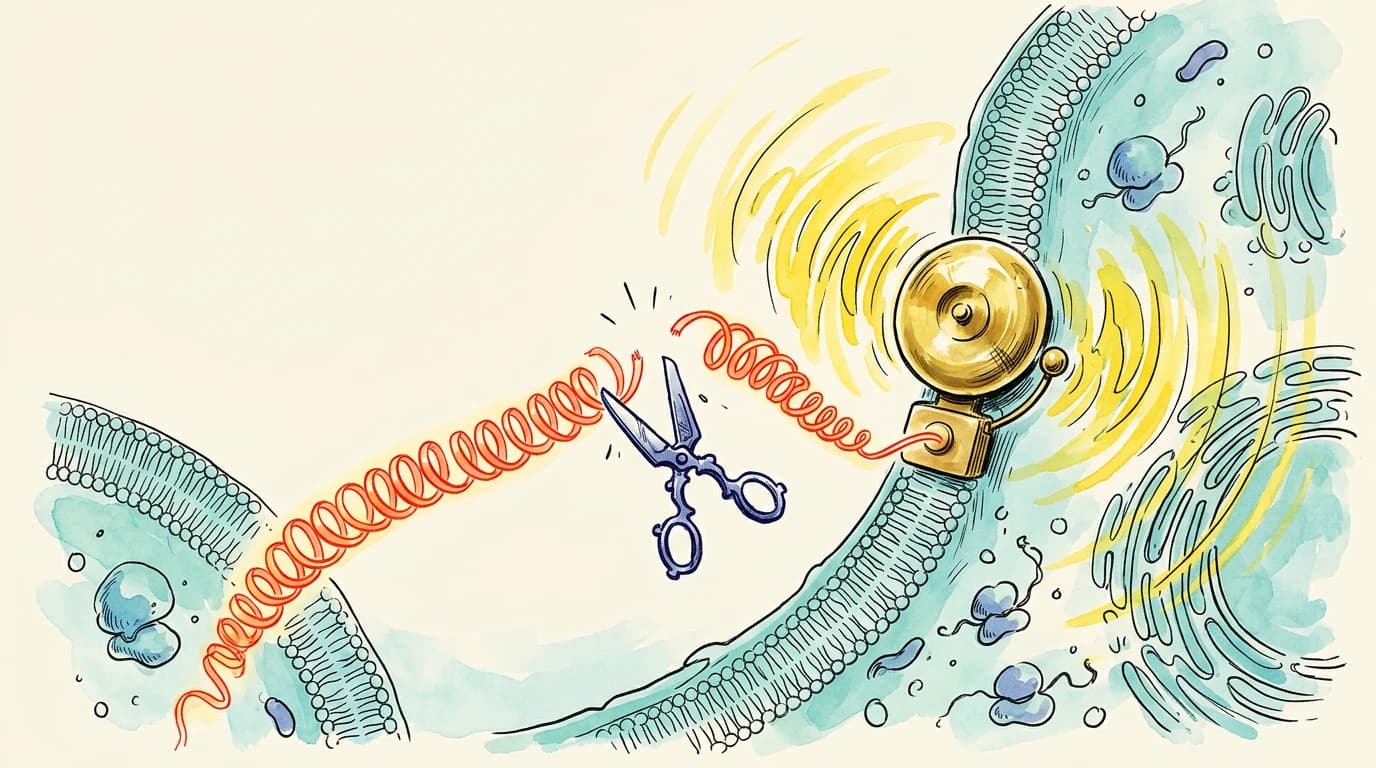
A host sensor enzyme called CD-NTase sits waiting inside the cell. It carries an activation loop, which acts just like a tight tripwire. When the viral protease cuts this loop, the sensor suddenly turns on. This cut forces the CD-NTase to make nucleotide signals, sounding the alarm to spark downstream defences.
Because the virus only builds its cutting tool late in its life cycle, host defence strikes late as well. This timing lets the cell hit back before new phages finish forming.
Roots of our own defence
This tripwire trick is not a rare quirk. Structural maps found similar loops across several CD-NTase clades, specifically clades A, D, and G. Specific parts of these loops respond to distinct phage families.
CBASS is an evolutionary ancestor of the cGAS-STING pathway in humans. Tracking how single cells time their protection sheds light on how our own innate immunity first took shape.
What we still do not know
Tests proved this mechanism in phage T4 and chosen enzyme clades, but unstudied clades still need testing. The exact identities and downstream effects of signals across all diverse clades also remain open questions. Scientists also wonder if wild phages carry extra factors that stop the cut.
Science words
- Phage
- A virus that infects and replicates inside bacteria.
- CBASS
- An ancient bacterial immune pathway related to human cGAS-STING.
- Prohead protease
- A viral enzyme used by phages to assemble and mature their viral heads.
- CD-NTase
- A bacterial sensor enzyme that makes nucleotide signals when triggered.
- Activation loop
- A structural part of an enzyme that switches the protein on when cut.
- cGAS-STING
- An immune signaling pathway in humans that is evolutionarily related to bacterial CBASS.
Check it yourself
This story is based on a real research paper in Science by Hobbs, Kranzusch. We write with AI help and check it against the paper, but the original is the final word.