How baby brain development rewires itself during natural play
By tracking awake, playing infants, scientists discovered that the brain rewires differently for specific actions like babbling and grabbing, rather than maturing all at once.
Reading level
The full story with proper science words explained.
Heads up: this study is a preprint, which means other scientists haven’t finished checking it yet.
Scanning the wiggle
How do you look inside an infant's head when keeping them still is almost impossible? Past studies often waited for babies to sleep or made them do rigid drills. Real life is messy, full of quick drops, grabs, and babbles.
Researchers chose to embrace that chaos to study baby brain development. They watched babies aged 6 to 13 months during free play. While filming every move, they tracked blood oxygen using functional near-infrared spectroscopy, or fNIRS. When brain cells fire, they pull in fresh blood. These hemodynamic responses show which parts of the brain work during each act.
Separating the noise
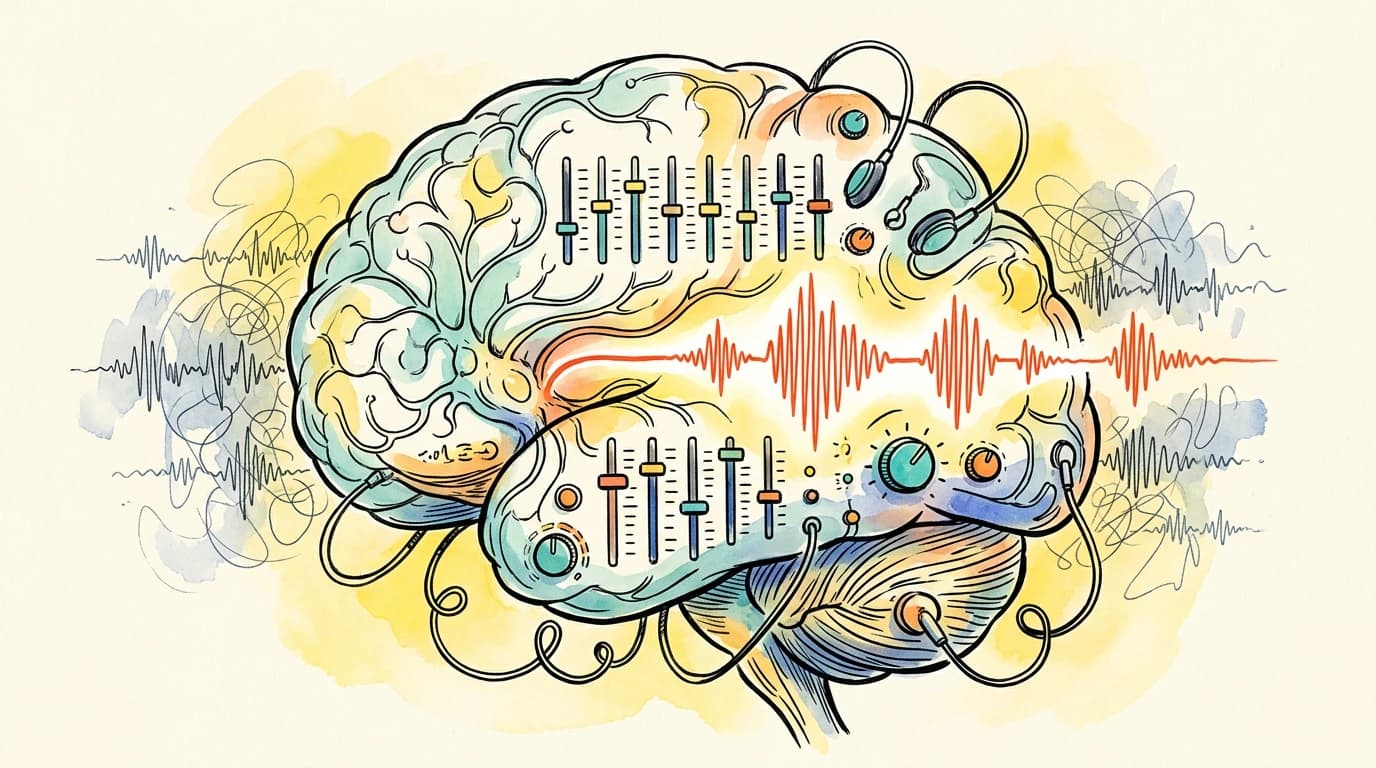
Studying a busy child is like picking out one voice in a loud lunchroom. When a baby grabs a cup while babbling, brain signals overlap. The team used finite impulse response modelling to map brain signals freely without guessing their shape ahead of time. They also added nuisance regressors, which act like audio filters to strip out extra body twitches from the data.
As babies grew, their habits shifted. Between 6 and 13 months, reaching to grasp toys and making vocal sounds happened more often. At the same time, all three tracked acts—reaching, vocalising, and putting hands to mouths—became faster and shorter.
Different skills, different paths
Importantly, the brain did not change the same way across all skills. During reaching, posterior parietal activity—signals in brain zones that combine sight with space—dropped as babies aged. In contrast, somatomotor activity in regions that control touch and body motion went up during babbling and hand-to-mouth acts.
These brain shifts matched personal habits, not just age on a calendar. A child who reached often showed brain signals matching their daily practice. This method matters because studying free play reveals real growth that sleeping scans miss.
What we still do not know
The study tracked only three specific acts, leaving other spontaneous body moves unmapped. The report did not include exact group numbers or background details. We also do not know how these patterns change after 13 months.
Science words
- fNIRS
- An optical imaging method that monitors brain activity by tracking blood oxygen levels through the skull.
- Hemodynamic responses
- Local changes in blood flow and oxygen delivery that occur when brain cells become active.
- Finite impulse response modelling
- A statistical technique that calculates the timing and shape of brain responses without guessing the pattern in advance.
- Nuisance regressors
- Mathematical filters used to remove unwanted background noise or unrelated movements from brain data.
- Posterior parietal activity
- Signalling in the upper back of the brain that combines vision with spatial awareness to guide movements.
- Somatomotor activity
- Signalling in brain areas responsible for feeling physical sensations and directing body movements.
Check it yourself
This story is based on a real research paper in Scientific Publication by Burke, de Zeeuw, Grimm et al.. We write with AI help and check it against the paper, but the original is the final word.