How Antarctic sea ice miles above links to life on the deep sea floor
A study in the Southern Ocean reveals that benthic isopod diversity is strongly correlated with sea-ice cover far above, putting rare deep-water specialists at risk as surface ice shrinks.
Reading level
The full story with proper science words explained.
A frozen roof over a dark world
Why would a tiny creature crawling along the pitch-black sea floor care about ice floating high above?
Thousands of metres down in the Southern Ocean, the mud crawls with isopods. These small crustaceans are related to woodlice. To study them, a team dragged an epibenthic sledge—a heavy net that scoops up sea-floor life—across 37 sites. They sorted 16,157 specimens into 214 species.
Next, they compared their catches to 14-year environmental records. They wanted to see what controls who lives where. The results showed that surface ice cover, not water heat or salt levels, best matched the number of species living below.
The food drop to the seabed
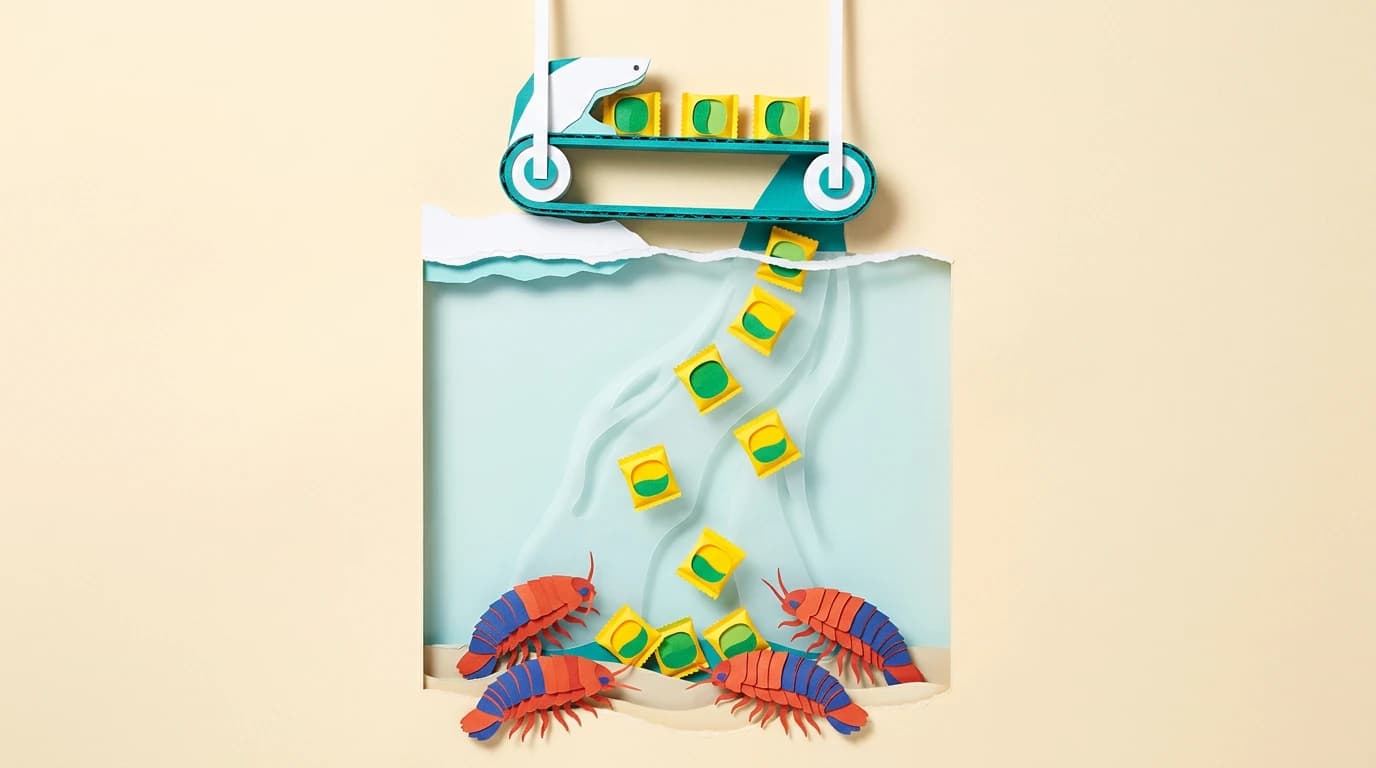
Surface ice acts like a moving track loaded with freight. The frozen layer traps iron and grows algae. When warm summer air breaks the ice up, dead plant bits sink fast. This falling meal is called phytodetritus. It plunges thousands of metres straight to the benthos, which means the community living on the sea floor.
Statistical tests of shelf sites showed ice cover explained 23.2% of the variation in species counts. It came out ahead of chlorophyll-a, which explained 15.0%. Other factors like water speed and oxygen levels showed no statistical link to species counts.
The team then checked a larger dataset with 763 species down to 4,976 metres. The link held firm. Ice cover remained the main driver, explaining 25.1% of the pattern. It beat out iron, surface plant growth, and water depth. Deep mud under dense ice hosts a rich mix of life.
Unique animals stuck in place
Life under dense ice is surprisingly distinct. Nearly a third of the shelf species—68 out of 214—showed up only in high-ice zones. Over half of those restricted types were new to science. Three out of four were rare and lived only in tiny spots.
These high-ice sites also held pickier eaters. The haul held four species that eat sinking algae and seven that sift food from mud. Both feeding groups were almost absent in low-ice zones. High-ice sites also held 137 sponge-dwelling commensal isopods, which are small beasts that share space on sea sponges without harming them. Low-ice sites held only seven.
These sea-floor creatures rely on brooding, which means parents carry their eggs and young. They do not send out swimming larvae to drift with currents. Because the young cannot swim away, these populations cannot easily flee if their food drop slows down.
What we still do not know
These models reveal strong statistical patterns, but sampling the deep sea is tough. Some species may look rare simply because nets have only swept a few tiny patches of the vast seabed.
We also do not know if these animals can switch diets if the algae mix changes. Nor do we know how shifts in ocean currents might send sinking food sideways into different deep troughs. But if surface ice retreats, the food chain feeding these unique sea-floor species could break.
Science words
- Epibenthic sledge
- A heavy towed sampling net designed to collect small animals living directly on top of the seafloor sediment.
- Benthos
- The community of organisms living on, in, or directly above the sea bed.
- Phytodetritus
- Decomposing microscopic algae and organic debris that sinks from surface waters down to the ocean floor.
- Commensal
- An organism that lives on or with another species to gain shelter or food without causing harm.
- Brooding
- A reproductive method where parents carry developing embryos instead of releasing free-swimming larvae.
Check it yourself
This story is based on a real research paper in Biology Letters by Di Franco, Linse, Griffiths et al. We write with AI help and check it against the paper, but the original is the final word.