How Analogue Gravity Lets Us Trap 'Black Hole' Light on a Tabletop
Source PublicationAdvanced Science
Primary AuthorsXu, Sundaresan, Kazkal et al.
The Hook: The Bathtub Whirlpool
Imagine trying to study a massive, violent whirlpool in the middle of the ocean. You cannot safely get near it, and the sheer scale makes it impossible to measure directly.
These results were observed under controlled laboratory conditions, so real-world performance may differ.
But what if you could build a perfectly scaled-down version in your bathtub using a specially shaped drain and some food colouring? You could study the ocean's physics safely at home.
This is the exact logic behind analogue gravity. Instead of travelling light-years to study a black hole, physicists are recreating their mechanics right here on Earth.
The Context: The Ringing of Spacetime
When massive black holes collide, they send ripples across the universe. These gravitational waves ring out like a struck bell before slowly fading away.
Scientists routinely detect these vibrations, known as quasinormal modes, using massive sensors. However, the exact physical nature of these vibrations remains difficult to pin down.
You cannot exactly put a black hole under a microscope. To understand how light and gravity interact in these extreme environments, researchers needed a local stand-in.
The Discovery: Analogue Gravity in a Microcavity
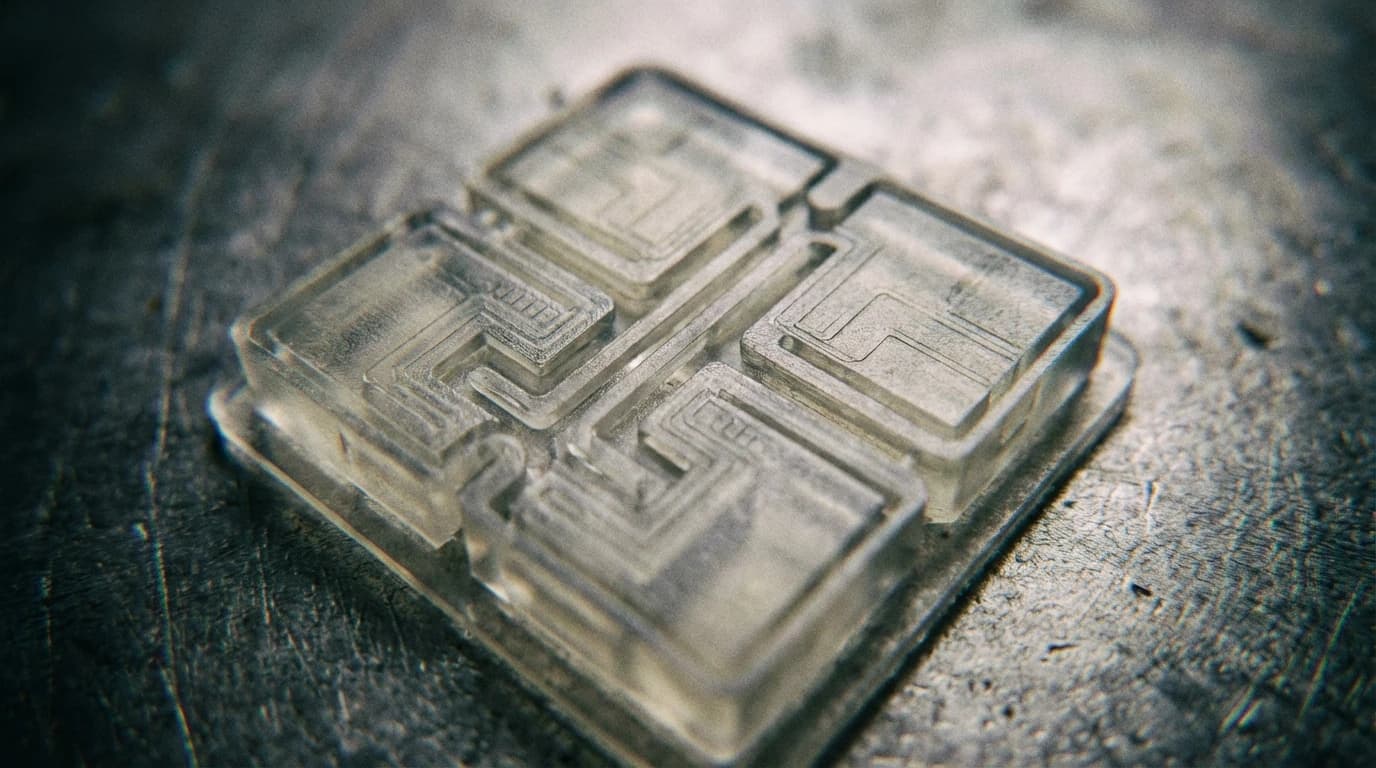
In a recent lab study, researchers built a miniature, functional model of a black hole's optical behaviour. They 3D-printed tiny, uniquely curved structures called microcavities and infused them with fluorescent dye.
They designed the shape of these cavities to mimic the way a four-dimensional black hole warps spacetime. When they pumped light into the system, they measured something fascinating.
Light did not just bounce around the outer edges. A specific set of light waves became trapped in circular orbits near the centre, recreating a phenomenon known as a photon sphere.
The Impact: Tabletop Cosmos
The team successfully measured lasing action within this artificial photon sphere. The spatial profiles of the trapped light matched the mathematical predictions for actual black holes.
This suggests that tabletop optics could serve as a highly accurate testing ground for theoretical physics. We may soon test complex astrophysical ideas without ever leaving the laboratory.
While these findings are currently confined to the lab bench, they offer more than just a window into the cosmos. By proving we can trap and control light in these non-Euclidean shapes, this research is already inspiring entirely new approaches to microcavity photonics—the science of manipulating light at microscopic scales.