How a Viral Repair Crew Solved the Agrobacterium CRISPR Editing Puzzle
Researchers combined CRISPR scissors with viral repair enzymes to cleanly alter Agrobacterium tumefaciens, a microbe central to plant biology. The method allows scientists to rewrite the bacterium's genetic code step by step without leaving behind messy marks.
Reading level
The full story with proper science words explained.
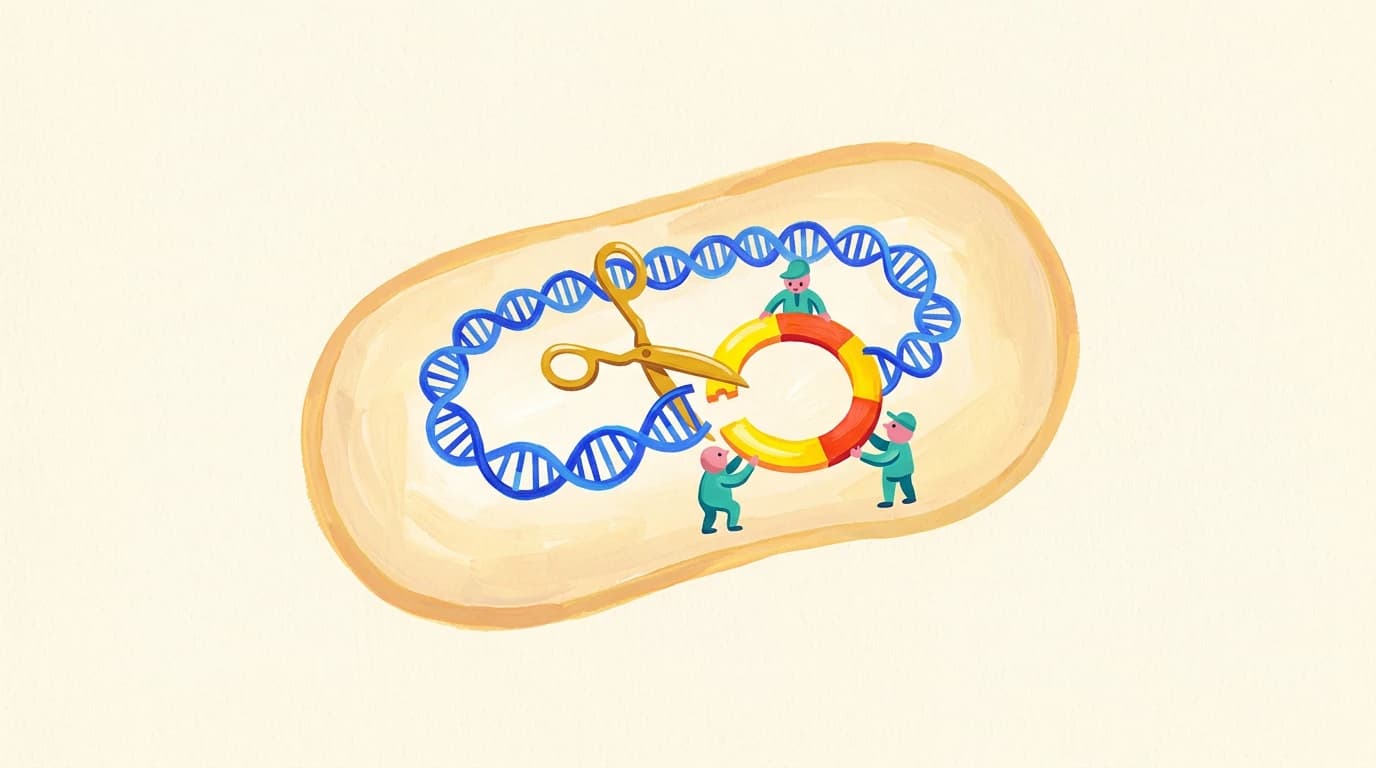
A single broken chromosome is usually fatal for a bacterium.
For decades, plant biologists have relied on a soil microbe called Agrobacterium tumefaciens. This bacterium carries a Ti plasmid, a circular loop of DNA that naturally inserts genetic material into plant cells. While it acts as biology's best plant-engineering courier, modifying the microbe itself has always been frustratingly difficult.
The Repair Problem
When researchers try Agrobacterium CRISPR editing, the Cas9 enzyme acts as molecular scissors. It makes a double-strand break, a deadly cut through both sides of the DNA ladder. Normally, scientists provide a patch to fix the cut. But Agrobacterium has weak native repair pathways. In tests targeting a gene called thyA, its natural repair machinery repaired exactly zero cut sites.
Without a reliable repair mechanism, cutting the chromosome simply kills the cell. To solve this, researchers borrowed a viral toolkit called lambda Red recombinase from a bacteriophage, a virus that preys on bacteria. Using lambda Red to swap DNA sequences is known as recombineering.
Bringing in the Specialist Builders
The system works like a demolition crew paired with an imported team of specialist builders. Cas9 swiftly tears down any target sequence matching its guide. Meanwhile, the lambda Red enzymes rebuild the broken DNA using a supplied blueprint called a donor template. Flanking sequences on this template, known as homology arms, show the enzymes exactly where the new patch belongs.
Cells that fail to fix the cut die off, leaving only the accurately repaired survivors. When researchers switched on the lambda Red system, gene deletion frequencies jumped from zero to between 26.7% and 86.7%. For single-letter point edits, the success rate reached an astonishing 100%. Edits on the Ti plasmid were equally effective, succeeding at rates between 93.3% and 100%.
Clean Editing in Repeated Rounds
Earlier methods left behind unwanted DNA markers, like footprints stuck in wet cement. The new approach uses plasmid curing, a clean-up step where bacteria wipe away the editing tools. Researchers triggered a molecular self-destruct mechanism using a gene called SacB, which causes cells to perish on ordinary sucrose if they keep the plasmid tools. This leaves the bacterium's genome clean and ready for another edit.
The team demonstrated this by stripping out four native antibiotic resistance genes in a single strain. They also altered a tiny 18-amino-acid segment of a bacterial protein called EF-Tu. Plants normally recognise this segment and sound the alarm. The altered strain slipped past plant defences, boosting gene delivery into Arabidopsis seedlings.
What We Still Do Not Know
The system does have boundaries. It only works efficiently when the repair blueprint sits on a circular plasmid; flat, linear DNA strips yielded just 6.7% efficiency. High amounts of Cas9 also poison the host cells, meaning its production must stay tightly capped.
Questions remain. We do not yet know if this method can insert massive chunks of foreign DNA without using antibiotic markers. Furthermore, bacteria carrying two swapped protein copies grew noticeably slower in liquid culture, and the exact physical reason for this slowdown remains unknown.
Science words
- Ti plasmid
- A circular piece of bacterial DNA that naturally transfers genes into plant cells.
- Double-strand break
- A severe cut across both strands of the DNA double helix that is lethal to bacteria if left unhealed.
- Recombineering
- A genetic technique that uses phage-derived enzymes to replace or modify DNA sequences.
- Homology arms
- Matching DNA segments on the ends of a repair template that guide it to the correct genomic location.
- Plasmid curing
- The process of clearing out temporary genetic tools from a bacterial cell after editing is finished.
- SacB
- A selection gene that causes bacteria to die when grown on sugar, ensuring only cells that discarded their editing plasmids survive.
Check it yourself
This story is based on a real research paper in Plant Biotechnology Journal by Zheng, Liu, Huang et al. We write with AI help and check it against the paper, but the original is the final word.