How a tiny molecular machine spins to conduct more electricity
Scientists have tested a single spiral molecule that spins with complete directional preference under an electric current, dramatically boosting electrical flow.
Reading level
The full story with proper science words explained.
A spiral motor on tiny tips
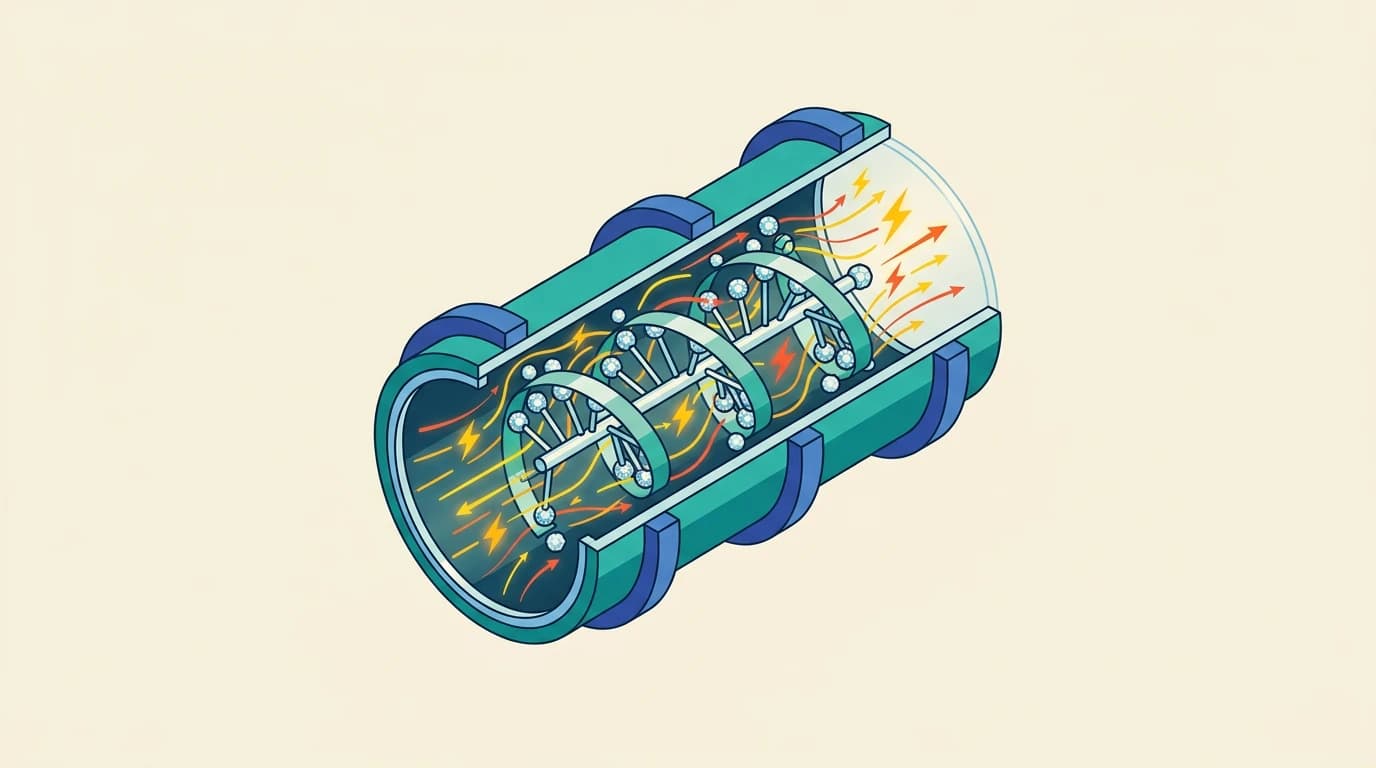
Could an ancient water-lifting screw inspire motors built from individual parts of matter? Scientists placed a single spiral helicene between two metal tips to make a nanoscale circuit. Helicene is chiral, meaning its shape has a clear handedness that cannot match its mirror reflection, like a left or right shoe.
When the team applied an electric push, tiny charges flowed across the tiny gap. This flow created torque, a twisting force that causes an object to spin. The force drove the spiral to turn around its axis just like an ancient Archimedean screw, a spiral machine historically used to lift water.
Spinning into higher gear
The resulting cyclic motion had one hundred per cent directional preference. It always turned in one set direction. Switching the voltage polarity, which swaps the plus and minus terminals, flipped the spin the other way. At low energy, the spiral turned in brief, stepwise stops.
Once the driving push passed a set threshold, calculations and tests showed a clear shift. The spiral changed from jerky steps into smooth, continuous spin. As it spun continuously, it twisted into shapes that let far more charge pass through at once. This jump in conductance, a measure of how easily charge moves through a material, was not seen in earlier helical setups because of different shapes and methods.
Tuning the tiny motor
The team also found they could tune the setup by moving the metal tips. Pulling the tips apart stretched the spiral, while pushing them closer squashed it. This physical adjustment changed the exact voltage needed to trigger the continuous spin and the high current flow.
What we still do not know
This lab experiment provides an early test build for a torque-driven molecular machine, but important questions remain open. The boost only works after passing that specific voltage threshold. We still do not know how other shape changes might affect the spin, or how many turns the tiny motor can endure before wearing out.
Science words
- Helicene
- A molecule with a helical, spiral-like shape.
- Chiral
- Asymmetrical in a way that cannot be matched onto its mirror image, like left and right hands.
- Torque
- A twisting or rotational force that causes an object to spin.
- Archimedean screw
- A machine with a helical spiral historically used to lift water or act as a turbine when fluids pass through it.
- Voltage polarity
- The orientation of the positive and negative terminals of an electrical source.
- Conductance
- A measure of how easily an electric current passes through a material or object.
Check it yourself
This story is based on a real research paper in Nature by Singh, Martin, Sršen et al. We write with AI help and check it against the paper, but the original is the final word.