How a tiny coiled chip creates powerful frequency combs
By routing light alongside microwaves over a folded 36-centimetre track on a small chip, researchers built an efficient, cavity-free optical frequency comb with over 550 sharp colour lines.
Reading level
The full story with proper science words explained.
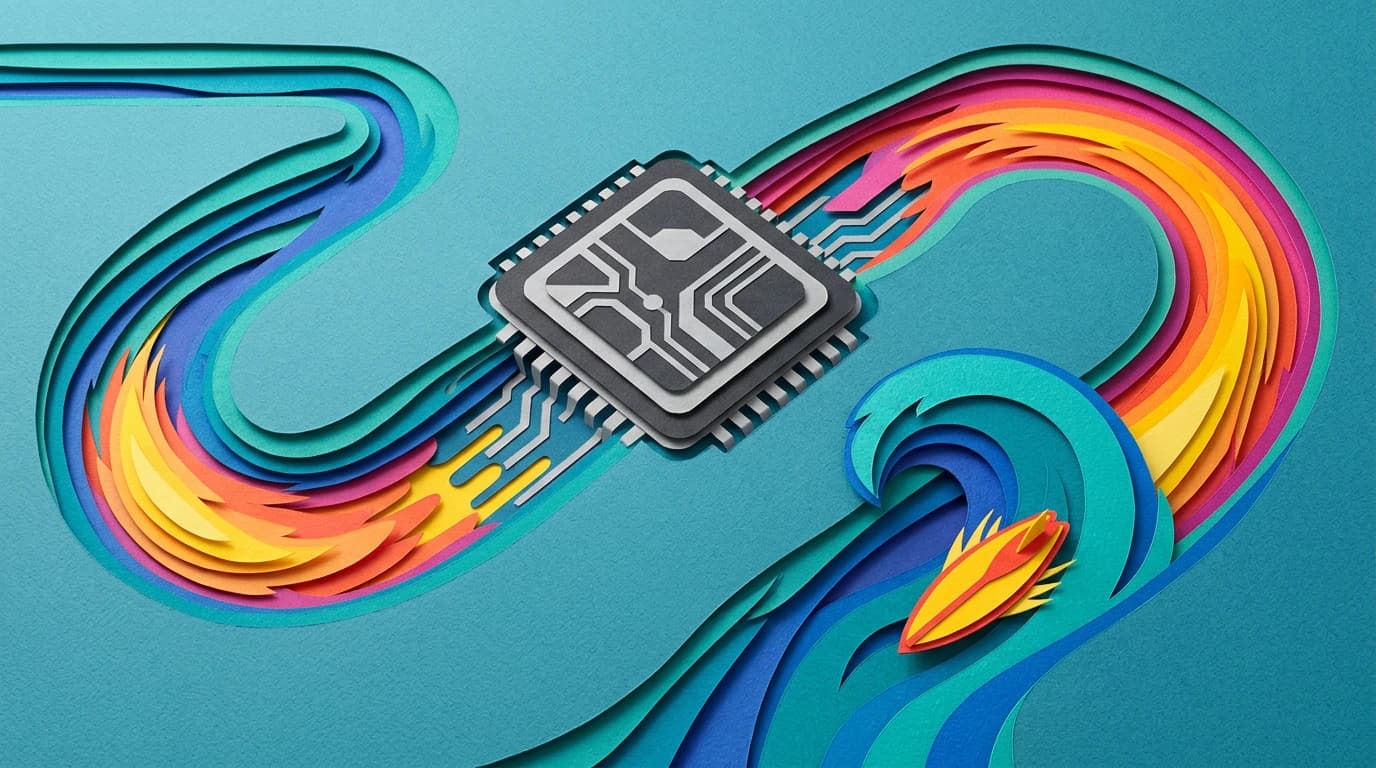
Surfing a microwave wave
Imagine a surfer matching a rolling wave's speed perfectly to stay on it for miles. That is what happened on a chip measuring just 2.4 square centimetres. Scientists wanted to build better frequency combs, which are specialised light sources composed of evenly spaced optical frequencies that look like teeth on a hair comb.
Winding paths on a chip
Normally, shifting laser light using electrical signals requires bouncing the beam between mirrors in an optical cavity. Instead, the team went cavity-free. They used thin-film lithium niobate, an optical crystal that guides light with remarkably low loss.
Because the electro-optic effect is naturally weak, light needs a long runway to pick up energy. To solve this, the researchers folded and cascaded their waveguides into a tight snake-like track. This extended the interaction distance to 36 centimetres on a tiny chip.
By ensuring strict phase matching, the microwave signal and the light beam travelled side-by-side at identical speeds. The electrical push added up continuously over the entire run. This low-power driving resulted in a very low half-wave voltage, meaning tiny voltages triggered huge changes in the light.
Bright colours without mirrors
The results were striking. The device split a single laser into more than 550 distinct frequency lines spanning 52 nanometres across the telecom bands. Using a complementary drive, the chip produced 187 milliwatts of output power with a 77 percent pump-to-comb conversion efficiency.
Connecting gigahertz microwaves directly to hundreds of terahertz light frequencies matters. It could aid optical computing, fast data links, and networks tying quantum processors together across standard glass fibres.
What we still do not know
This work is described in a preprint and has not yet completed peer review. Keeping microwave loss low over even longer, meter-scale tracks remains a difficult engineering challenge. We also do not know how smoothly these chips will perform when linked to actual superconducting quantum machines.
Science words
- Frequency comb
- A laser beam split into many distinct, perfectly evenly spaced colour frequencies.
- Thin-film lithium niobate
- A crystalline material that lets light pass through with very low loss while reacting strongly to electrical voltages.
- Cavity-free
- A system where light travels in one direction down a path without needing to bounce between mirrors.
- Phase matching
- Keeping a microwave wave and a light wave travelling at precisely the same speed so their interaction builds steadily.
- Half-wave voltage
- The voltage required to shift a light wave's cycle by half a period, where lower values show greater efficiency.
Check it yourself
This story is based on a real research paper in Preprint by Yu, Lee, Ren et al.. We write with AI help and check it against the paper, but the original is the final word.