How a tiny brainstem hub controls our social perception
A theoretical framework suggests that our ability to read social cues relies on balanced chemical signals from a small brainstem region called the locus coeruleus.
Reading level
The full story with proper science words explained.
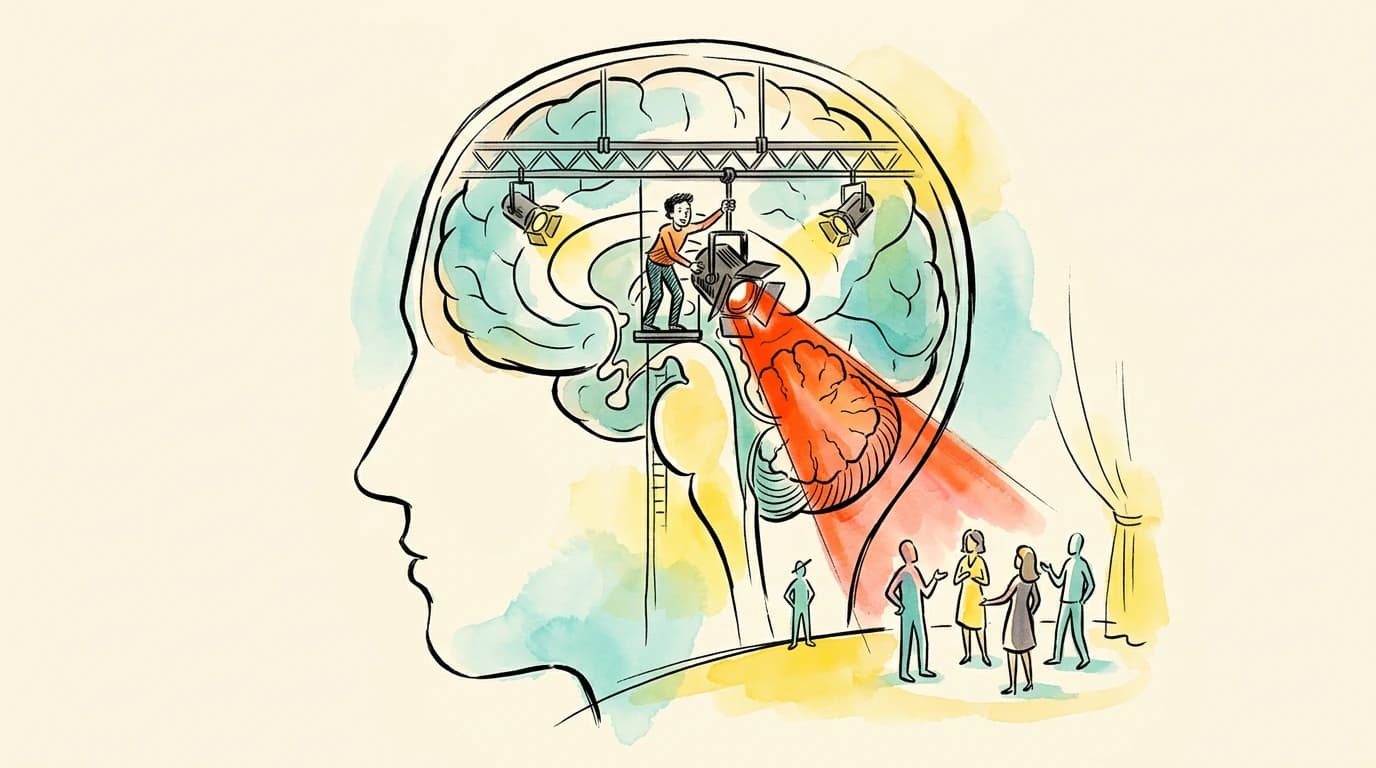
Reading the room
Why can a single nervous glance instantly change how you understand someone? Our ability to read other people's emotions and intentions is known as social perception. A new scientific framework suggests this skill depends on a tiny cluster of brainstem cells called the locus coeruleus.
The stage lighting of the mind
The locus coeruleus is the brain's main source of norepinephrine, a chemical messenger tied to alertness. Think of this system like a theatre spotlight. For the best performance, the operator needs a steady, moderate ambient glow across the stage, paired with sharp, rapid beams that track the main actors when they speak.
In the brain, this steady baseline is called tonic activity. The sudden bursts triggered by emotional cues are phasic responses. According to the framework, the locus coeruleus releases norepinephrine across the cortex to adjust local cortical gain, amplifying key signals over background static. It also reorganises large-scale brain networks, helping the mind gather sensory clues over time through evidence accumulation.
When the dial is turned too far
Balance is everything. If the system is sluggish, low baseline activity leaves you detached, limiting engagement with social cues. But if the system becomes hyperactive, the theatre fills with blinding, chaotic light. Diffuse arousal and hypervigilance make it almost impossible to tell important social signals from meaningless background noise.
Understanding this balance matters because it offers a single explanation for how brain chemicals guide daily interactions. It may also help explain social deficits observed in ageing, neurodegenerative conditions, and neuropsychiatric disorders.
What we still do not know
This paper is a theoretical proposal, meaning it provides a conceptual map rather than new lab measurements. Scientists still need to run experiments to test these specific predictions. We also do not yet know the exact causal role of this system in the social symptoms of specific brain disorders.
Science words
- Locus coeruleus
- A small region in the brainstem that produces most of the brain's norepinephrine.
- Norepinephrine
- A chemical messenger that regulates alertness, arousal, and attention.
- Tonic activity
- The steady, regular background firing rate of brain cells.
- Phasic responses
- Short, rapid spikes of brain cell activity triggered by important events.
- Cortical gain
- The boosting of important brain signals compared to background noise.
- Evidence accumulation
- The way the brain collects sensory information over time to reach a conclusion.
Check it yourself
This story is based on a real research paper in Scientific Publication by Ziaei, Jensen, Hussein et al. We write with AI help and check it against the paper, but the original is the final word.