How a tiny blood filter traps runaway circulating tumour cells in mice
A microfluidic blood-filtering device captured circulating tumour cells in mice, reducing post-surgery cancer recurrence and boosting survival over 28 days.
Reading level
The full story with proper science words explained.
The great escape into the blood
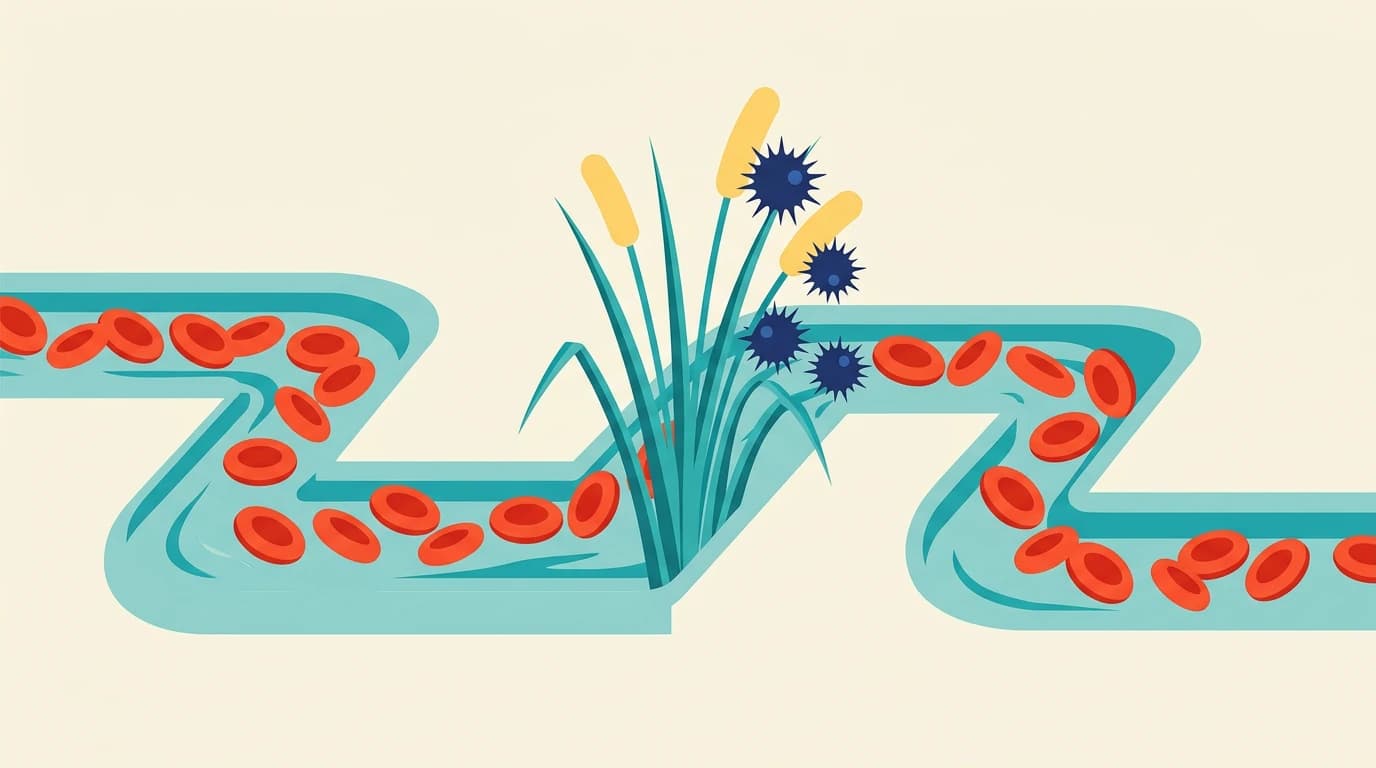
Over 90% of cancer deaths happen when rogue cells slip away from a main tumour. They travel through the bloodstream to seed new tumours in other organs. Scientists call these escapees circulating tumour cells, or CTCs for short. Catching them in moving blood is very hard. Once an operation takes away a main mass, loose cells left drifting in the vessels can cause cancer to return.
To stop these wanderers, scientists built an outside trap nicknamed the "Black-hole" system. The team wanted to know if they could safely weed out these dangerous strays in living mice without relying on toxic nanomaterials.
Filtering blood outside the body
The device uses microfluidics, the science of moving tiny volumes of fluid through miniature channels on a chip. Flexible tubes connect a mouse's neck artery to its neck vein. This creates extracorporeal circulation, which reroutes blood outside the body and back in with a pump. As blood trickles through the chip, it hits microscopic triangular pillars and curved posts.
These posts carry a coating of antibodies that recognise EpCAM, a surface protein found on many tumour cells. EpCAM acts like an identity tag. Healthy red and white blood cells glide past the posts without sticking. In contrast, target cancer cells bump into the obstacles and bind fast, letting clean blood return to the body.
In test tubes, the trap caught over 99% of targeted cancer cells at low flow speeds. When 1,000 human breast cancer cells were mixed into one millilitre of whole blood, the system captured 82% of them within an hour. Next, the team tested female mice with aggressive breast tumours whose main growths had been taken out by an operation.
Clearing out the strays
Clearing the blood for 30 minutes alongside a dose of the chemotherapy drug paclitaxel produced striking results. This adjuvant therapy, an extra treatment given after an operation, dropped circulating tumour cell counts from 1,934 down to just 53 by day 28.
Treated mice had a 16.7% lower recurrence rate and much smaller areas of cancer spread in their lungs. Half of the mice given the combined treatment survived through the 28-day study, whereas all untreated mice died by day 21. Reassuringly, the mice showed no burst red blood cells, had normal white cell counts by day 28, and kept healthy organs.
However, the trap has a major blind spot: it only catches cells displaying the EpCAM protein tag. Cancer cells that lack this specific marker slip past untouched.
What we still do not know
The system has only been tested in mice over a 28-day test window after their operations. The tube connections required blood thinners and led to brief early weight loss in the mice. We do not yet know whether this chip can be scaled up to process the vastly larger blood volumes found in humans.
Future studies will also need to test how well the chip catches sneaky tumour cells that lose their surface tags during their journey, and whether the extra protection holds over longer periods.
Science words
- Circulating tumour cells
- Cancer cells that detach from a main tumour and travel through the bloodstream.
- Microfluidics
- The science of directing and controlling tiny volumes of fluid inside microscopic channels.
- Extracorporeal circulation
- Rerouting blood outside the body through an external device before pumping it back into the blood vessels.
- EpCAM
- A surface protein common on tumour cells that acts as a target tag for capture antibodies.
- Adjuvant therapy
- An additional medical treatment given after an initial operation to destroy leftover cancer cells.
Check it yourself
This story is based on a real research paper in Microsystems & Nanoengineering by Abdulla, Chen, Yan et al. We write with AI help and check it against the paper, but the original is the final word.